
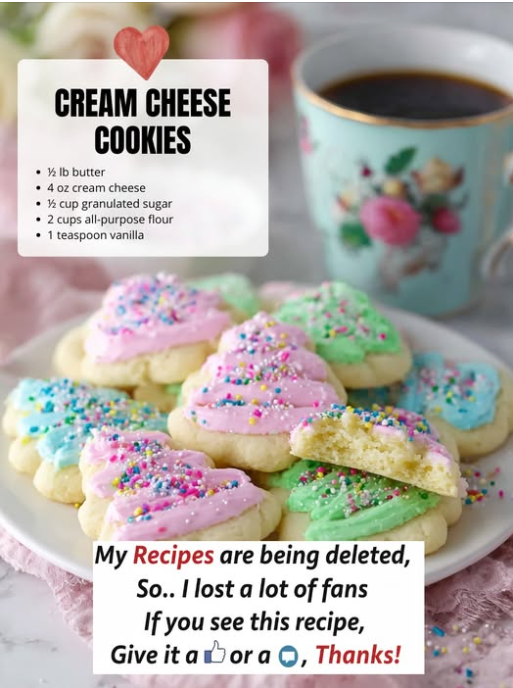
The Science of Softness: Mastering Chewy & Soft Cream Cheese Cookies
Introduction: The Role of Fat and Protein
The secret to the **Chewy & Soft Cream Cheese Cookie** lies in the unique properties of its fats. Cream cheese is high in fat but also contains protein and moisture. When combined with **butter**, this mixture creates a dough rich in stable, emulsified fats that resist spreading during baking, resulting in a soft, tender crumb instead of a thin, crispy cookie.
The core of the cookie’s structure is the accurate creation of the initial fat mixture. The method used to combine the **butter, cream cheese, and granulated sugar** is the primary technical determinant of the cookie’s final texture and height.
Success requires adherence to three core regulations: **The Creaming and Emulsification Mandate, The Chill and Scoop Protocol, and The Leavening Strategy.**
The first regulation, **The Creaming and Emulsification Mandate** (Instruction 2), is paramount. The **softened butter and cream cheese** must be thoroughly creamed with the **sugar** until light and fluffy. This process incorporates air into the fat, creating microscopic pockets that expand during baking, contributing to the cookie’s rise and tender texture. It also ensures the fat and water from the cream cheese are properly bound before the flour is added.
The second regulation, **The Chill and Scoop Protocol** (Instruction 4 & 5), manages spread. Chilling the dough solidifies the **butter and cream cheese**. When the cold dough hits the heat of the oven, the fat takes longer to melt, providing time for the cookie’s structure to set before excessive spreading can occur. Baking the cookies from a uniform, cold scoop ensures consistent size and shape.
The third regulation, **The Leavening Strategy** (Ingredient II), controls the rise. This cookie relies on a small amount of **baking powder** for a gentle lift. Since the dough is heavy with fat and protein, a leavener is needed to work alongside the trapped air from the creaming process. Too much leavener, however, can lead to a cake-like, rather than chewy, texture.
Ingredients: Defining Fat, Structure, and Leavening
The full components for about 3 dozen tender cookies:
I. The Fats & Flavor (Tenderizing Agents):
- **$\frac{1}{2}\text{ lb (2 sticks)}$** unsalted butter (Fat, softened)
- **$4\text{ oz}$** cream cheese (Full-fat, softened)
- **$\frac{1}{2}\text{ cup}$** granulated sugar (Sweetener, aeration)
- **$1\text{ teaspoon}$** vanilla extract (Aromatic)
II. The Structure & Rise:
- **$2\text{ cups}$** all-purpose flour (Structure)
- **$1\text{ large}$** egg yolk (Added fat for chewiness, optional)
- **$1\frac{1}{2}\text{ teaspoons}$** baking powder (Chemical leavener)
- **$\frac{1}{4}\text{ teaspoon}$** salt (Flavor balance)
III. Finishing:
- **$\frac{1}{4}\text{ cup}$** extra granulated sugar (For rolling/coating, optional)
