
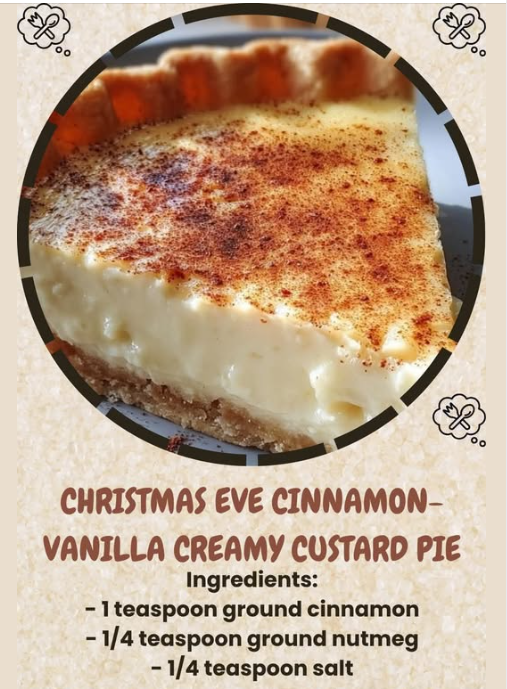
Holiday Velvet: Mastering Cinnamon-Vanilla Custard Pie
Introduction: The Delicate Chemistry of Custard
A true **Creamy Custard Pie** is fundamentally a thickened blend of dairy, sugar, and eggs. The setting process is entirely based on **protein coagulation**—specifically, the proteins in the egg yolk and white must unravel and form a delicate, interlocking network that suspends the liquid. This network forms optimally at temperatures between $160^\circ\text{F}$ and $180^\circ\text{F}$ ($71^\circ\text{C}$ and $82^\circ\text{C}$). If the temperature rises too quickly, the proteins clump, resulting in a rubbery, grainy, or scrambled texture.
The success of the custard pie hinges on the two most critical steps in custard making: **tempering** the eggs and using **low, slow oven heat**.
Success requires adherence to three core regulations: **The Gentle Protein Coagulation Mandate, The Tempering and Emulsion Protocol, and The Structural Set Principle.**
The first regulation, **The Gentle Protein Coagulation Mandate** (Instruction 3 & 4), controls the final texture. The **eggs** must be heated slowly and evenly. The dairy is scalded (Instruction 3) to dissolve the sugar and extract flavor from the **cinnamon stick**, but the final mixture is baked at a **low oven temperature** ($325^\circ\text{F}$ or $160^\circ\text{C}$) to ensure the center sets softly and uniformly without curdling or weeping.
The second regulation, **The Tempering and Emulsion Protocol** (Instruction 3), prevents immediate failure. Tempering involves slowly raising the temperature of the **egg yolks** by gradually whisking in hot dairy. This ensures the eggs do not scramble when added to the hot liquid, achieving a stable, smooth **emulsion** before baking.
The third regulation, **The Structural Set Principle** (Instruction 6), dictates when the pie is done. Custard is done not when it feels firm, but when it achieves a “wobble.” The edges should be set, but the center (about a $2\text{-inch}$ radius) should still have a **jiggly wobble**, indicating the proteins are cooked just enough. Residual heat will finish the cooking process outside the oven.
Ingredients: Defining Structure, Fat, and Spice
The full components for $1\text{ nine-inch pie}$:
I. Crust & Dairy Base:
- **$1\text{ unbaked}$** 9-inch pie crust (Structure and container)
- **$2\text{ cups}$** whole milk (Liquid base)
- **$1\text{ cup}$** heavy cream (Fat source, richness)
II. Sweetness & Thickener:
- **$\frac{3}{4}\text{ cup}$** granulated sugar (Sweetness, moisture retention)
- **$\frac{1}{4}\text{ cup}$** all-purpose flour or cornstarch (Minor thickening agent, suspension)
- **$4\text{ large}$** egg yolks, and $2\text{ whole eggs}$ (Primary coagulant and binder)
III. Aromatics:
- **$1\text{ teaspoon}$** pure vanilla extract (Aromatic lift)
- **$1\text{ cinnamon stick}$** (Whole, for infusion)
- **$\frac{1}{4}\text{ teaspoon}$** ground nutmeg (Garnish and warming spice)
- **$\frac{1}{4}\text{ teaspoon}$** salt (Flavor contrast)
