ADVERTISEMENT
Phase 1: Flavor Foundation (Maillard Reaction)
- **Sear the Beef (MAILLARD):** In a large skillet, sear the **beef stew meat** over medium-high heat for about **$5\text{ minutes}$** to brown the outside. This step is critical for developing deep flavor. Transfer the seared beef to the crockpot. (Optional: Sauté the onion and garlic in the skillet until softened, then add to the crockpot.)
Phase 2: Slow Cooking (Tenderization Mandate)
- **Combine Ingredients:** Add the **chopped onion, minced garlic, cream of mushroom soup, onion soup mix, beef broth, Worcestershire sauce, salt, and pepper** to the crockpot. Stir well to combine all the umami and seasoning agents.
- **Cook:** Cover and cook on **low for $6\text{ to }7\text{ hours}$** or on high for $3\text{ to }4\text{ hours}$, until the beef is fork-tender and pulls apart easily.
Phase 3: Slurry and Service
- **Thicken the Sauce (SLURRY PROTOCOL):** About $30\text{ minutes}$ before serving, whisk the **$1\text{ tablespoon}$ of flour** with a small amount of **cold water** (about $2\text{ tbsp}$) to make a smooth, lump-free slurry. Stir this slurry into the crockpot liquid to thicken the sauce rapidly. [Image demonstrating how to create a smooth flour slurry by mixing flour with cold water before stirring it into a hot liquid.]
- **Prepare the Noodles:** Cook the **egg noodles** according to the package instructions (Instruction 5). Drain well.
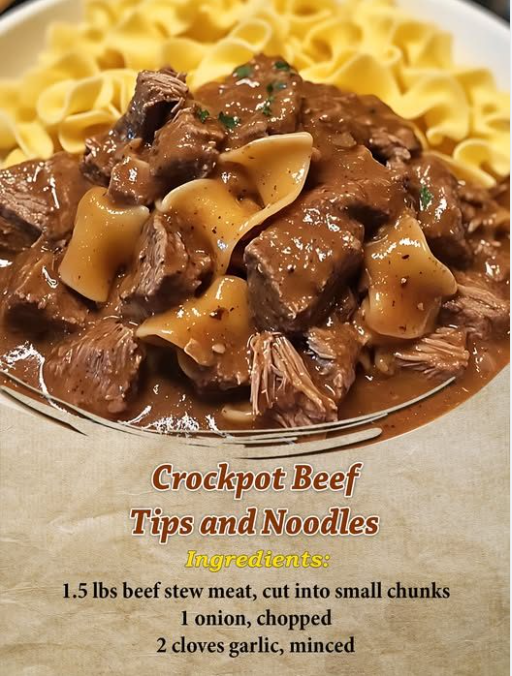
- **Serve:** Once the beef is tender and the sauce has thickened, serve the beef tips and rich sauce generously over the cooked egg noodles.
Tips & Technical Insights:
The Temperature is Key: Always stick to the **low-and-slow cooking time** (Instruction 3). If cooked too fast or not long enough, the tough collagen will not convert to gelatin, leaving you with dry, chewy meat.
Why Sear? While optional, **searing the beef** (Instruction 1) is vital for flavor depth. The Maillard reaction adds notes that cannot be achieved through the moist, relatively low heat of the crockpot.
Slurry vs. Roux: This recipe uses a simple **slurry** (flour + cold liquid) to thicken at the end (Instruction 4). A roux (fat + flour) is used at the start. Using the slurry avoids adding flour at the beginning of the slow cook, which can sometimes interfere with tenderization or cause the sauce to settle too heavily.
Salt Control: Be mindful of the salt content (Ingredient III). The **onion soup mix** and **cream of mushroom soup** are high in sodium. Start with the recommended amount and adjust only after the long cooking time is complete, as the sauce reduces and concentrates flavor.
Liquid Level: The total liquid ($\frac{1}{2}\text{ cup}$ beef broth + mushroom soup) is deliberately low. Slow cooking requires minimal external liquid because the meat and vegetables release their own moisture throughout the long cooking process.
Variations: Customizing Flavor and Serving
Easily adapt the components and richness of your beef tips:
- **Creamy Stroganoff Style:** Add $\frac{1}{2}\text{ cup}$ of **sour cream or cream cheese** (removed from the crockpot) into the thickened sauce at the very end of the cooking process for a classic stroganoff creaminess.
- **Mushroom Boost:** Add $8\text{ oz}$ of **sliced fresh mushrooms** (button or cremini) to the crockpot along with the other ingredients (Instruction 2) for added earthiness.
- **Wine Depth:** Replace $\frac{1}{4}\text{ cup}$ of the beef broth with $\frac{1}{4}\text{ cup}$ of **dry red wine** (like Merlot or Cabernet) for a deeper, more robust flavor profile.
- **Serving Swap:** Serve the beef tips over **mashed potatoes or rice** instead of egg noodles for a change of texture.
Conclusion: A Rich and Tender Reward
The **Crockpot Beef Tips and Noodles** recipe is a satisfying technical exercise in leveraging time and low heat. By executing **The Maillard Reaction and Slurry Protocol** to build flavor and then adhering to **The Low-and-Slow Tenderization Mandate**, you achieve a meat and sauce combination that is intensely rich, perfectly seasoned, and irresistibly tender. This is comfort food engineered for maximum flavor.
Frequently Asked Questions (FAQ)
Q: Why did my beef turn out tough?
A: The beef was likely **not cooked long enough** (Instruction 3). Tough cuts of meat go through a stage where they get tougher (around $140^\circ\text{F}$ to $170^\circ\text{F}$) before the collagen breaks down. They need to cook past this stage to reach the tender $195^\circ\text{F}$ range.
Q: My sauce is too thin. What should I do?
A: Ensure you created a smooth **flour slurry** and stirred it in. If it’s still too thin after $30\text{ minutes}$ of simmering, create another small slurry using $\frac{1}{2}\text{ tablespoon}$ of flour and stir it in. Alternatively, use cornstarch (a more powerful thickener) slurry instead of flour.
Q: Can I use fresh mushrooms instead of canned soup?
A: **Yes**, but you will need to replace the liquid and seasoning the soup provides. Sauté $1\text{ cup}$ of fresh mushrooms and add them to the pot, then increase the **beef broth** by $1\text{ cup}$ and add $1\text{ tsp}$ of **salt** and $1\text{ tsp}$ of **dried thyme** for flavor.
Q: Should I use water for the slurry?
A: **Yes, cold water** (or broth) is crucial. Using hot liquid will cause the flour or cornstarch to clump instantly, creating lumps in your sauce (Instruction 4).
ADVERTISEMENT