
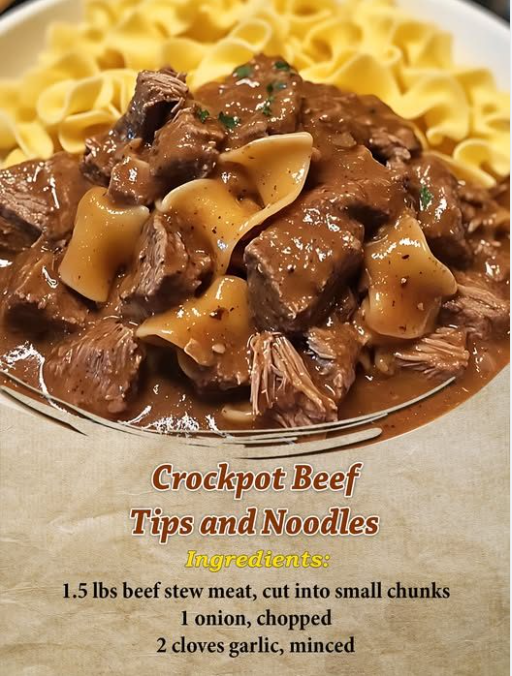
Tender Perfection: Mastering Crockpot Beef Tips and Noodles
Introduction: The Magic of Low and Slow Cooking
This **Crockpot Beef Tips and Noodles** recipe is a classic demonstration of thermodynamics in action. The **beef stew meat**, which is a tough cut (like chuck or round) rich in connective tissue (collagen), requires prolonged, low heat to become tender. The crockpot provides the perfect environment for **braising**, where meat is cooked submerged in liquid over many hours. This allows the tough collagen to dissolve and convert into gelatin, which coats the meat fibers, ensuring a moist, fall-apart tender result.
The success of this dish hinges on two key technical steps: **searing** for flavor depth, and utilizing the **slurry** for the final sauce viscosity.
Success requires adherence to three core regulations: **The Low-and-Slow Tenderization Mandate, The Maillard Reaction and Slurry Protocol, and The Umami Amplification Principle.**
The first regulation, **The Low-and-Slow Tenderization Mandate** (Instruction 3), is vital. Cooking on low heat for **$6\text{–}7\text{ hours}$** keeps the meat below the temperature where muscle fibers contract and squeeze out moisture (around $160^\circ\text{F}$ or $71^\circ\text{C}$). Instead, the internal temperature hovers around $195^\circ\text{F}$ to $205^\circ\text{F}$ ($90^\circ\text{C}$ to $96^\circ\text{C}$), ensuring that the collagen converts fully to gelatin while the muscle fibers remain succulent. [Image illustrating the conversion of collagen to gelatin during slow cooking, showing how the connective tissue structure breaks down into liquid gelatin.]
The second regulation, **The Maillard Reaction and Slurry Protocol** (Instruction 1 & 4), builds both flavor and texture. **Searing the beef** (Instruction 1) triggers the **Maillard Reaction** on the surface, creating hundreds of complex, savory flavor compounds that cannot be achieved through slow cooking alone. The final **flour slurry** (Instruction 4) is then used to quickly thicken the sauce at the end without adding unnecessary starch at the start, which could hinder the beef’s tenderization process.
The third regulation, **The Umami Amplification Principle** (Instruction 2), stacks savory flavors. The recipe uses multiple ingredients rich in **umami** (the savory taste) to create depth: the **beef broth**, **cream of mushroom soup**, **onion soup mix**, and **Worcestershire sauce**. These layers of glutamates create a final sauce that is intensely rich and satisfying.
Ingredients: Defining Bulk, Depth, and Thickening Agents
The complete components for $6\text{ servings}$:
I. Protein & Aromatics:
- **$1.5\text{ lbs}$** beef stew meat, cut into small chunks (Tough cut for slow cooking)
- **$1\text{ onion}$**, chopped (Aromatic base)
- **$2\text{ cloves}$** garlic, minced (Aromatic base)
II. Liquid & Umami Agents:
- **$1\text{ can}$** ($10.5\text{ oz}$) cream of mushroom soup (Richness, creaminess, umami)
- **$1\text{ packet}$** onion soup mix (Umami, seasoning, salt)
- **$\frac{1}{2}\text{ cup}$** beef broth (Braising liquid, salinity)
- **$2\text{ tablespoons}$** Worcestershire sauce (Umami enhancer, acid)
III. Seasoning and Starch:
- **$1\text{ teaspoon}$** salt
- **$\frac{1}{2}\text{ teaspoon}$** pepper
- **$1\text{ tablespoon}$** flour (for thickening slurry)
- **$8\text{ oz}$** egg noodles, cooked (Serving foundation)
