
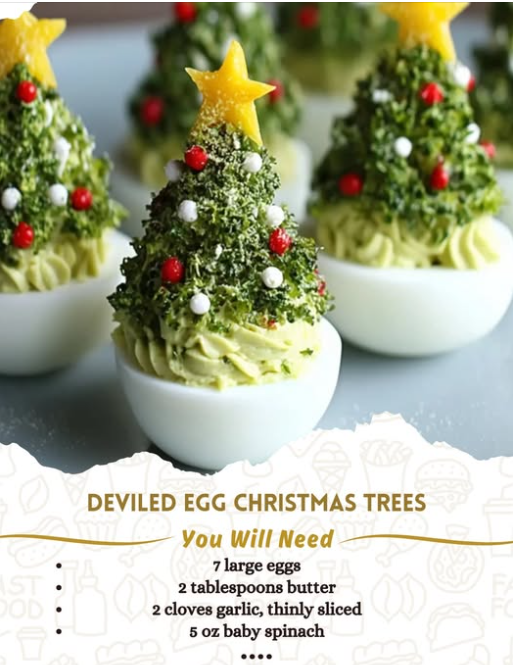
Festive & Fluffy: Mastering Deviled Egg Christmas Trees
Introduction: The Intersection of Cuisine and Craft
The **Deviled Egg Christmas Tree** is a novelty appetizer where execution of shape and color is as important as flavor. The core challenge is two-fold: creating a **perfectly creamy and smooth deviled egg filling** and ensuring this filling is strong enough to be piped into a tall, stable cone reminiscent of a Christmas tree. This requires careful management of the fat and moisture content in the filling.
The **hard-boiled eggs** (Ingredient I) provide the structure (whites) and the bulk (yolks). The **mayonnaise and butter** provide the fat and lubrication necessary for a smooth texture. The addition of **sautéed spinach** is the clever, natural source for the necessary green color and an earthy, savory flavor.
Success requires adherence to three core regulations: **The Perfect Hard Boil Mandate, The Fat-to-Yolk Creaminess Ratio, and The Dye and Pipe Protocol.**
The first regulation, **The Perfect Hard Boil Mandate** (Instruction 1), ensures easy peeling and high-quality yolks. Eggs should be cooked just until set. Overcooked eggs yield dry yolks and that unsightly greenish-gray ring of iron sulfide ($FeS$), which muddies the final green color. Using **older eggs** (at least one week old) and shocking them in **ice water** are key techniques for easy peeling.
The second regulation, **The Fat-to-Yolk Creaminess Ratio** (Instruction 4), dictates the filling’s texture. The $\frac{1}{3}\text{ cup}$ of **mayonnaise** and $2\text{ tbsp}$ of **butter** provide sufficient fat to emulsify the dry egg yolks into a silky, lump-free paste. The butter, specifically, adds a depth of richness and also helps the piped shape hold firm when chilled.
The third regulation, **The Dye and Pipe Protocol** (Instruction 5 & 6), is the creative execution. The filling is blended until perfectly smooth (often with a food processor) to ensure it passes through a small piping tip without clogging. The use of a **star-shaped nozzle** is essential to create the festive, branched look of a Christmas tree. The final chilling ensures the butter in the filling firms up, stabilizing the piped shape.
Ingredients: Defining Bulk, Structure, and Color
The full components for about 14 Christmas tree halves (from 7 eggs):
I. The Egg & Aromatics Base:
- **7 large** eggs (The protein and bulk)
- **2 tablespoons** butter (Fat for sauté and creaminess)
- **2 cloves** garlic, thinly sliced (Aromatic)
- **5 oz** baby spinach (Natural green dye and flavor)
II. The Creamy Filling & Seasoning:
- **$\frac{1}{3}\text{ cup}$** mayonnaise (Moisture and binder)
- **1 tablespoon** mustard (Sharpness and tang)
- **$\frac{1}{2}\text{ teaspoon}$** salt (Seasoning)
- **$\frac{1}{4}\text{ teaspoon}$** black pepper (Spice)
- **2 tbsp** white vinegar or pickle juice (Acidity and flavor)
III. Garnish (The Ornaments):
- **Pretzel sticks or carrot squares** (The trunk/base)
- **Pimento strips, chopped red pepper, or small star-shaped cheese slices** (The ornaments)
