
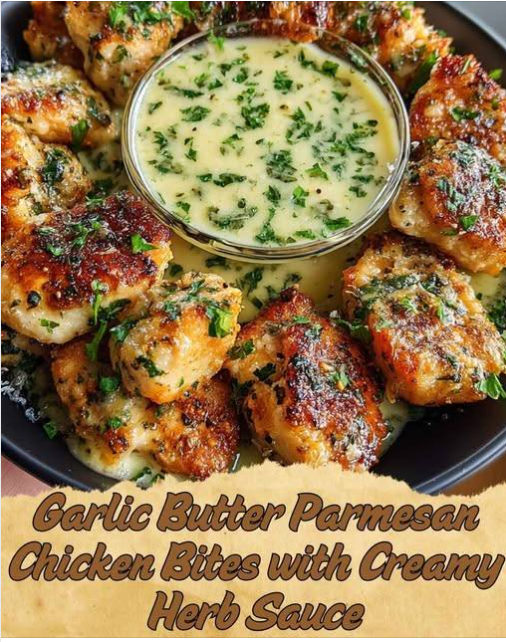
Searing Science: Mastering Garlic Butter Parmesan Chicken Bites
Introduction: The Dual Techniques of High Heat and Emulsion
This recipe is a two-part technical success: the high-heat searing of the **Chicken Bites** to achieve the **Maillard Reaction**, followed by the delicate temperature control required to stabilize the **Creamy Herb Sauce** via a roux and emulsion.
The successful outcome hinges on three core regulations:
The first regulation, **The Sear and Crust Mandate** (Chicken, Instruction 3), demands high heat. The **chicken pieces** must be seared quickly in a combination of **olive oil** (high smoke point) and **butter** (flavor) to create a golden-brown crust. This process, known as the Maillard Reaction, develops deep, savory flavor compounds. Crucially, the chicken must be cooked in **batches**; overcrowding the pan lowers the temperature, preventing the Maillard Reaction and resulting in steamed, gray chicken instead of seared, golden-brown chicken.
The second regulation, **The Roux and Emulsion Protocol** (Sauce, Instruction 5 & 6), dictates the sauce’s texture and stability. The base of the sauce is a **roux** (equal parts butter and flour) cooked briefly to eliminate the raw flour taste. The **heavy cream** and **chicken broth** are then added gradually. The starch in the roux traps the liquid and fat, preventing the high-fat dairy (heavy cream) from separating when heated, creating a velvety, stable emulsion. The key is to incorporate the liquids **warm** and stir constantly to prevent lumps.
The third regulation, **The Garlic-Parmesan Infusion Principle** (Chicken, Instruction 4), governs the final flavor of the chicken. The **minced garlic** and **Parmesan cheese** must be added *after* the chicken is nearly cooked. If added too early, the garlic burns (becoming bitter) and the Parmesan cheese melts away and scorches onto the pan before the chicken is done. Adding them last allows the residual heat of the cooked chicken and butter to toast the garlic and melt the Parmesan into a delicious crust.
Ingredients: Defining Sear, Sauce Base, and Seasoning
The formal components for approximately $4\text{ servings}$:
I. The Chicken Bites:
- **$1\frac{1}{2}\text{ lbs}$** boneless, skinless chicken breasts, cut into bite-sized pieces (Protein)
- **$1\text{ tsp}$** salt, $\frac{1}{2}\text{ tsp}$ black pepper, $1\text{ tsp}$ garlic powder, $\frac{1}{2}\text{ tsp}$ smoked paprika (Seasoning rub)
- **$2\text{ tbsp}$** olive oil (High heat searing)
- **$2\text{ tbsp}$** unsalted butter (Flavor, finish)
- **$4\text{ cloves}$** garlic, minced (Aromatic)
- **$\frac{1}{2}\text{ cup}$** grated Parmesan cheese (Crust, umami)
II. The Creamy Herb Sauce:
- **$2\text{ tbsp}$** unsalted butter (Roux fat)
- **$2\text{ tbsp}$** all-purpose flour (Roux starch, thickening agent)
- **$1\text{ cup}$** chicken broth (Liquid, base)
- **$1\text{ cup}$** heavy cream (Emulsion, richness)
- **$1\text{ tsp}$** Italian seasoning (Herb mix)
- **$1\text{ tbsp}$** chopped fresh parsley (Fresh finish)
- **$1\text{ tbsp}$** chopped fresh basil (optional) (Aromatic)
- Salt and pepper to taste (Seasoning)
