ADVERTISEMENT
Phase 1: Preparation and Coating
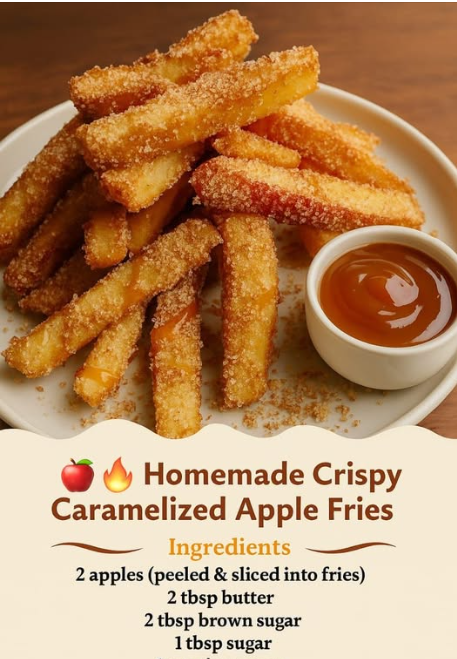
- **Prep Apples:** Peel and slice the **2 apples** into uniform $\frac{1}{2}\text{-inch}$ thick fries. Pat them dry with paper towels to remove excess moisture.
- **Starch Coat (STARCH AND MOISTURE RULE):** In a bowl, toss the apple fries with the **1 tbsp of cornstarch** and **1 tsp of cinnamon** until every piece is coated in a thin, visible white layer.
Phase 2: Cooking and Caramelization
- **Initial Cook (DOUBLE-COOK METHOD, Part 1):** Melt **1 tbsp of the butter** (or heat the oil) in a large skillet over medium-high heat. Add the coated apple fries in a single layer (work in batches if necessary). Cook for **$3\text{–}4\text{ minutes}$ per side** until the apples are lightly golden and slightly tender inside. Remove apples and set aside.
- **Caramel Base (CARAMELIZATION INTEGRITY):** Reduce the heat to medium. Add the **remaining 1 tbsp of butter** to the skillet. Once melted, stir in the **2 tbsp brown sugar** and **1 tbsp white sugar**. Stir constantly until the sugars are completely dissolved and the mixture is bubbling and glossy.
- **Caramelize (DOUBLE-COOK METHOD, Part 2):** Return the cooked apple fries to the skillet. Toss quickly and continuously in the bubbling caramel for **$1\text{–}2\text{ minutes}$**, until the fries are completely coated, shiny, and the sauce has thickened to a glossy glaze.
- **Serve:** Remove immediately from the pan and serve hot with a dusting of extra cinnamon or a scoop of vanilla ice cream.
Serving and Storage: Maximizing Crispness
Optimal handling for this dessert:
- **Serving:** Must be served **immediately** after Step 5 to enjoy the crisp texture. The caramel coating will soften the apples over time.
- **Storage:** Leftovers should be stored in an airtight container in the refrigerator for up to **3 days**.
- **Reheating:** Reheat in a **$350^\circ\text{F}$ ($175^\circ\text{C}$) air fryer** or oven for $3\text{–}5\text{ minutes}$ to help restore some crispness, although they will not be as crisp as fresh.
Choosing the Right Apple: Use a **firm, baking-friendly apple** (e.g., Honeycrisp, Fuji, or Granny Smith). Soft apples (like Gala) will turn to mush during **The Double-Cook Method**.
The Pat-Dry Step: Patting the peeled apple fries dry (Instruction 1) is key to **The Starch and Moisture Rule**. Less surface water means the cornstarch coating will be stronger and crispier.
Preventing Clumping: Ensure the apple fries are evenly spaced during the initial cook (Instruction 3). Overcrowding the pan will drop the temperature, causing the apples to steam instead of fry, resulting in a soggy coating.
Caramel Safety: Be vigilant when making the caramel (Instruction 4). Sugar burns quickly. Once the caramel is glossy, the fries must be added and removed quickly to maintain **The Caramelization Integrity**.
Enhancing the Cinnamon: For a deeper flavor, use **Vietnamese cinnamon**, which has a higher oil content and a stronger, sweeter aroma.
Variations: Customizing Coatings and Cooking Methods
Easily adapt the flavor and technique:
- **Deep-Fried Crisp:** For the crispiest result, deep-fry the cornstarch-coated apples (Instruction 3) in neutral oil at $350^\circ\text{F}$ ($175^\circ\text{C}$) for $2\text{–}3\text{ minutes}$ until golden, before adding to the caramel.
- **Spiced Caramel:** Add a pinch of **nutmeg and ground ginger** to the caramelizing sugar mix (Instruction 4) for a gingerbread twist.
- **Maple Glaze:** Substitute the **brown sugar** with **maple sugar** or use $\frac{1}{4}\text{ cup}$ of **thick maple syrup** instead of the sugar mix for a distinct maple caramel flavor.
- **Chocolate Drizzle:** After the caramelized fries have cooled slightly, drizzle them with **melted dark chocolate** for an extra layer of richness.
**Caramel Color:** Allow the initial butter/sugar mix (Instruction 4) to cook slightly longer—until it just starts turning **amber**—for a deeper, richer caramel flavor before tossing the apples back in.
**Pan Choice:** Use a **heavy-bottomed, non-stick skillet** (Instruction 3). Heavy bottoms distribute heat evenly, preventing the butter/sugar from burning in hot spots.
**Salted Caramel:** For a sophisticated finish, sprinkle a few **flaky sea salt crystals** (like Maldon) over the fries immediately after they are removed from the caramelizing pan.
**Starch Substitute:** While cornstarch is ideal, **tapioca starch** can be substituted (Ingredient I) for a similar crisping effect.
Conclusion: The Sweet Satisfaction of Crispness
The **Homemade Crispy Caramelized Apple Fries** are a testament to how simple ingredients can be transformed through precise application of heat and starches. By adhering to **The Starch and Moisture Rule** to set the crisp exterior and mastering **The Double-Cook Method** to balance the interior tenderness with exterior crunch, you create a unique dessert that is both familiar and delightfully new.
Frequently Asked Questions (FAQ)
Q: Why did my apple fries turn out mushy?
A: You likely used a **soft variety of apple** (Tip 6) or you **overcrowded the pan** during the initial cook (Tip 6), causing the apples to steam instead of fry, failing **The Double-Cook Method**.
Q: My caramel sauce hardened immediately. What happened?
A: The caramel mixture was either **cooked too long** at too high a temperature (Instruction 4) or the **apple fries were too cold** when added back to the pan, shocking the sugar and causing it to seize.
Q: Can I use less sugar?
A: You can slightly reduce the sugar, but both the **brown and white sugar** (Ingredient II) are necessary for proper caramelization and the glossy, hard finish (**The Caramelization Integrity**).
Q: Is peeling the apples necessary?
A: **Yes**, peeling is highly recommended (Instruction 1). Apple skins prevent the cornstarch from adhering properly and can make the fries taste tough and chewy.
ADVERTISEMENT