
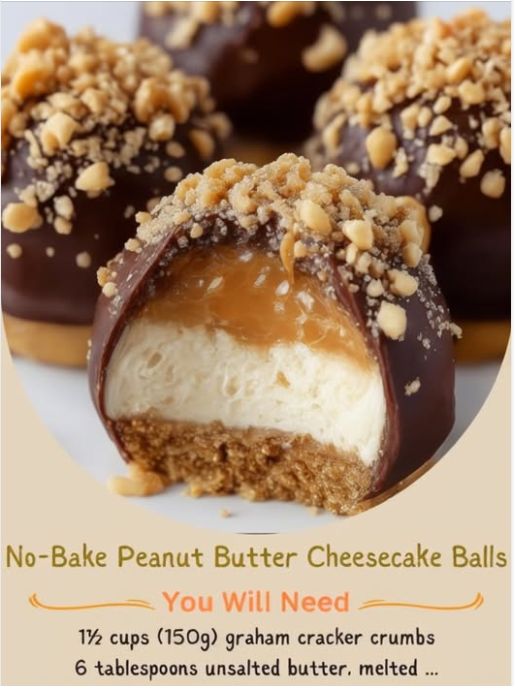
The Art of the Truffle: Mastering No-Bake Peanut Butter Cheesecake Balls
Introduction: The Engineering of a No-Bake Structure
These **No-Bake Peanut Butter Cheesecake Balls** are a form of confectionary known as truffles, relying entirely on temperature manipulation—specifically **chilling and freezing**—to achieve their final structure. The core challenge is combining the high-fat ingredients (**cream cheese** and **peanut butter**) with the sugar and stabilizing that mixture into a firm, rollable dough.
The success hinges on the transition of the mixture from a soft paste to a solid core, a process governed by **The Fat Fusion and Chill Mandate**. The chilling is not just for convenience; it solidifies the fats in the peanut butter and cream cheese, which is essential for rolling and dipping. If the core is too soft, the warm chocolate coating will melt the surface, causing the ball to collapse.
Success requires adherence to three core regulations: **The Fat Fusion and Chill Mandate, The Temperament and Coating Protocol, and The Moisture Control Principle.**
The first regulation, **The Fat Fusion and Chill Mandate** (Instruction 1 & 3), dictates the core’s quality. Softening the **cream cheese** (Instruction 1) ensures it creams smoothly, avoiding lumps. The chilling phase (Instruction 3 & 5) then forces the mixture’s abundant fats to resolidify, creating a firm, cohesive structure perfect for handling.
The second regulation, **The Temperament and Coating Protocol** (Instruction 6 & 7), addresses the shell. Adding **coconut oil or shortening** (Instruction 6) to the melted chocolate chips is a crucial shortcut. While technically not tempering, this fat addition lowers the viscosity of the melted chocolate, making it thinner and easier to dip, yielding a smoother, thinner, and snappier shell upon cooling. This is essential for a professional finish.
The third regulation, **The Moisture Control Principle**, is subtle but important. The powdered sugar (Ingredient I) acts as an absorbent agent, binding any free moisture in the mixture. Furthermore, the **freezing step** (Instruction 5) is key because the extremely cold surface of the ball quickly sets the melted chocolate, preventing it from completely melting the outer layer of the cheesecake core.
Ingredients: Defining Structure, Binder, and Flavor
The components for approximately $20\text{–}24\text{ bites}$:
I. The Core Base (Binder & Stabilizer):
- **$8\text{ ounces}$** ($1\text{ block}$) cream cheese, softened (Structural fat)
- **$1\text{ cup}$** creamy peanut butter (Flavor, fat, binding)
- **$\frac{1}{2}\text{ cup}$** powdered sugar (Confectioners’ sugar) (Sweetener, moisture absorption)
- **$1\text{ teaspoon}$** vanilla extract (Aromatic flavor)
- **$1\text{ cup}$** graham cracker crumbs (Optional: Texture, added stability)
II. The Coating & Finish:
- **$1\text{ cup}$** semi-sweet real chocolate chips (Shell structure)
- **$1\text{ tablespoon}$** coconut oil (or shortening) (Optional: Lowers viscosity for dipping)
- Extra crushed graham crackers or chopped peanuts (Optional: Garnish)
