ADVERTISEMENT
Phase 1: Preparing the Breading Station
- **Prepare Seasoning and Wash:** In a shallow dish, whisk together the **flour, salt, pepper, and paprika**. In a separate shallow dish, whisk the **eggs** with the **milk**.
- **Dredge (Initial Coat):** Lightly dredge each **cube steak** in the flour mixture, patting off any excess. This initial coat helps the egg wash adhere evenly.
- **Double Dredge (ADHESION PRINCIPLE):** Dip the flour-coated steak completely into the egg mixture, allowing excess to drip off. Immediately place the steak back into the seasoned flour. **Press the flour firmly onto the steak with your hands**, then lift and lightly shake the steak to create the desired **craggy texture**. Place the breaded steaks on a clean plate (do not stack them).
Phase 2: Frying and Finishing
- **Heat Oil (HEAT MANAGEMENT RULE):** Heat $\frac{1}{2}\text{ inch}$ of **vegetable oil** in a heavy-bottomed skillet (cast iron is ideal) over medium-high heat until it reaches $175^\circ\text{C}$ ($350^\circ\text{F}$). If you don’t have a thermometer, drop a pinch of flour into the oil; it should sizzle immediately.
- **Fry:** Carefully place the steaks in the hot oil (do not overcrowd the skillet). Fry for approximately **4 minutes per side**, or until the crust is deeply golden brown and crispy.
- **Drain and Rest:** Remove the fried steaks and immediately drain them on a wire rack placed over paper towels. This crucial step prevents the bottom crust from steaming and becoming soggy.
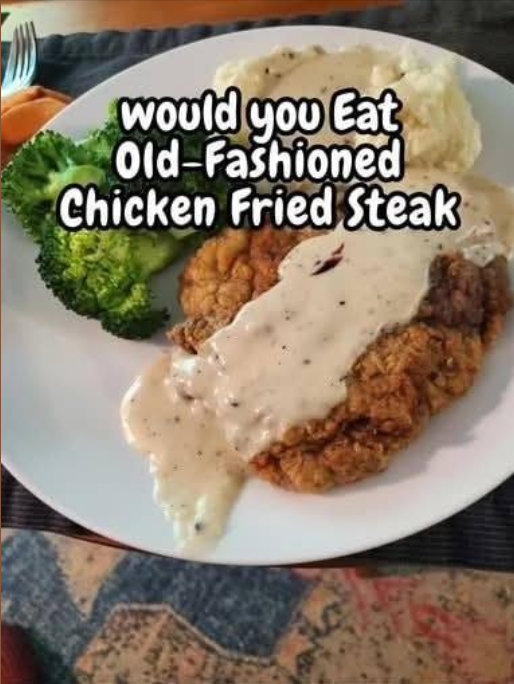
- **Serve:** Serve the Chicken Fried Steak hot with traditional creamy white gravy (made from the pan drippings) and classic sides like mashed potatoes.
Serving and Storage: Preserving the Crisp
Optimal handling for this fried dish:
- **Serving:** CFS is best served immediately after the 1-2 minute resting period. The longer it sits, the more the crust softens.
- **Storage (Leftovers):** Store fully cooled, wrapped leftovers in an airtight container for up to **3 days**.
- **Reheating:** To regain crispness, reheat in a **$175^\circ\text{C}$ ($350^\circ\text{F}$) oven or toaster oven** for 10 minutes, or until hot. Avoid the microwave.
Tips: Essential Techniques for Crunch and Flavor
Breading Relaxation: After the double dredge (Instruction 3), let the breaded steaks **rest for 5–10 minutes** before frying. This allows the moisture in the meat to penetrate the crust slightly, creating a “glue” that helps the coating adhere more securely to the steak during the shock of hot oil.
Pat the Steak: Always **pat the cube steaks completely dry** (Instruction 2) before the initial flour dredge. Excess surface moisture will cause the coating to slide off during frying.
Cast Iron Advantage: Use a **cast iron skillet** (Instruction 4). Cast iron holds heat extremely well, which is vital for maintaining the oil temperature when cold steaks are added, adhering to the **Medium-High Heat Management Rule**.
Craggy Formation: To achieve a truly craggy crust (Instruction 3), after the final flour coat, lift the steak and **wiggle it slightly** while holding the edges. This action separates some of the coating, creating large, crisp flakes.
White Gravy Base: The traditional accompaniment is white gravy. This is created by stirring $\frac{1}{4}\text{ cup}$ of the leftover cooking oil/drippings with $\frac{1}{4}\text{ cup}$ of flour, cooking for 1 minute, and then whisking in $2\text{ cups}$ of milk and seasoning until thickened.
Variations: Customizing Spices and Binders
Easily adapt the flavor profile of the crust:
- **Spicy Southwest:** Add **$\frac{1}{2}\text{ teaspoon}$ of cayenne pepper and 1 teaspoon of chili powder** to the flour mixture (Instruction 1).
- **Buttermilk Tenderizer:** For a tangier flavor and even more tender steak, marinate the cube steaks in a mixture of **buttermilk and hot sauce** for 30 minutes before dredging. Omit the $\frac{1}{2}\text{ cup}$ of milk from the egg wash, using only the eggs and the buttermilk marinade residue.
- **Herb Infusion:** Add **1 tablespoon of dried parsley flakes and 1 teaspoon of dried thyme** to the final flour coat (Instruction 3) for an herbaceous crust.
- **Extra Crispy:** Substitute $\frac{1}{4}\text{ cup}$ of the all-purpose flour with **cornstarch or rice flour** in the final dredge (Instruction 3) for a lighter, crispier, and longer-lasting crunch.
**Oil Temperature Monitoring:** Keep a **thermometer** (Instruction 4) clipped to the side of your skillet. If the temperature drops below $165^\circ\text{C}$ ($330^\circ\text{F}$) when the steaks are added, remove the steaks and wait for the oil to reheat.
**Avoid Overcrowding:** Only fry 1-2 steaks at a time (Instruction 5). Overcrowding drastically lowers the oil temperature, leading directly to the dreaded soggy crust.
**The Meat Tenderizer:** If using non-tenderized round steak, pound it gently but firmly with the **flat side of a meat mallet** to break down muscle fibers and ensure rapid cooking.
**Serving Surface:** **Never place the fried steaks directly on paper towels** (Instruction 6). Paper towels wick moisture away from the crust, but they also trap moisture, leading to a soggy bottom. A wire rack is necessary to allow air circulation and drain excess oil.
Conclusion: A Southern Masterpiece
**Old-Fashioned Chicken Fried Steak** is a dish defined by its crust. By meticulously applying **The Double Dredge Adhesion Principle** for texture, strictly observing **The Medium-High Heat Management Rule** for crispness, and ensuring adherence through the **Tenderizing Prep Method**, you achieve the holy grail of CFS: a tender, well-seasoned steak encased in a perfect, craggy, golden-brown coating, ready to be smothered in creamy gravy.
Frequently Asked Questions (FAQ)
Q: Why did my crust fall off the steak?
A: The steak was likely **too wet** before the first dredge, or you didn’t firmly **press the final flour coat** onto the meat (Instruction 3).
Q: Why is my crust soggy and oily?
A: The oil was **not hot enough** ($175^\circ\text{C}$ to $190^\circ\text{C}$ or $350^\circ\text{F}$ to $375^\circ\text{F}$), or you **overcrowded the pan** (Instruction 4/5).
Q: Can I use pork chops instead of cube steak?
A: **Yes**, you can use thin-cut pork chops, prepared using the exact same dredging and frying method. This is often called “Country Fried Pork.”
Q: Should I use self-rising flour?
A: **No**. Self-rising flour contains leavening agents that can give the crust a cake-like texture rather than the desired crispy, craggy texture.
ADVERTISEMENT