
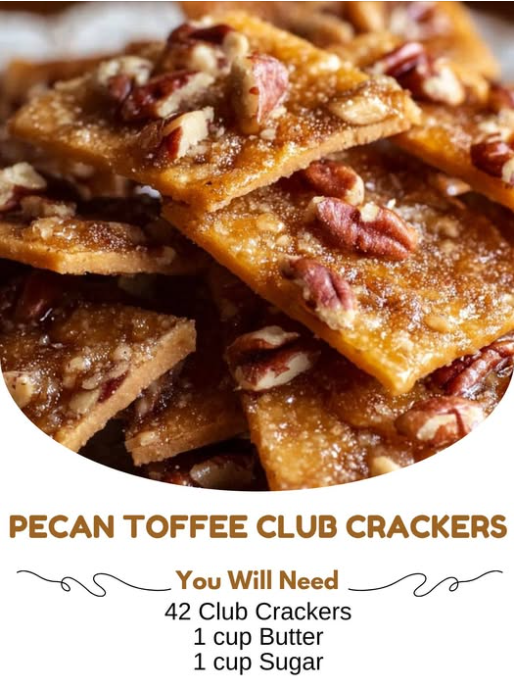
Salty-Sweet Obsession: Mastering Pecan Toffee Club Crackers
Introduction: The Simple Science of Instant Toffee
The **Pecan Toffee Club Cracker** is an exercise in controlled caramelization and structural contrast. By melting butter and sugar together, we create a quick toffee that adheres perfectly to the salty, buttery base of the Club cracker. This recipe’s success is governed by three critical regulations: **The High-Heat Caramelization Window, The Acid-Based Flavor Stabilization, and The Post-Bake Setting Protocol.**
The first regulation, **The High-Heat Caramelization Window**, dictates the cooking of the toffee. Combining **1 cup Butter** and **1 cup Sugar** (Steps 3-4) over heat creates a sugar syrup emulsified with fat. This mixture must boil for exactly **2 minutes** (Step 5) to ensure the sugar reaches the appropriate temperature (approximately $250^\circ\text{F}$ or $121^\circ\text{C}$), known as the **firm-ball stage**. This stage provides the perfect viscosity for coating the crackers before the oven completes the caramelization, pushing the mixture toward the hard-crack stage necessary for true crunch.
The second regulation, **The Acid-Based Flavor Stabilization**, relates to the finish. After removing the toffee from the heat, **2 tsp Vanilla extract** is stirred in (Step 6). The small amount of alcohol and acid in the vanilla not only adds flavor but also helps *stabilize* the hot sugar mixture, reducing the likelihood of crystallization (where the sugar turns back into a hard, grainy mass). The optional pinch of salt enhances this complexity, cutting the sweetness of the sugar.
The third regulation, **The Post-Bake Setting Protocol**, involves the mandatory chilling. The crackers, covered in the hot toffee and **1 1/2 cups Chopped Pecans**, are baked for **10-12 minutes** (Step 9) until golden. The oven heat allows the toffee to fuse with the crackers and slightly toast the nuts. Crucially, the final setting (Step 10) must occur at room temperature. If the toffee is cooled too quickly (e.g., in a fridge), the rapid temperature change can cause the sugar to revert to a softer, more chewy stage, or even crack the entire slab, making clean breaking impossible.
