
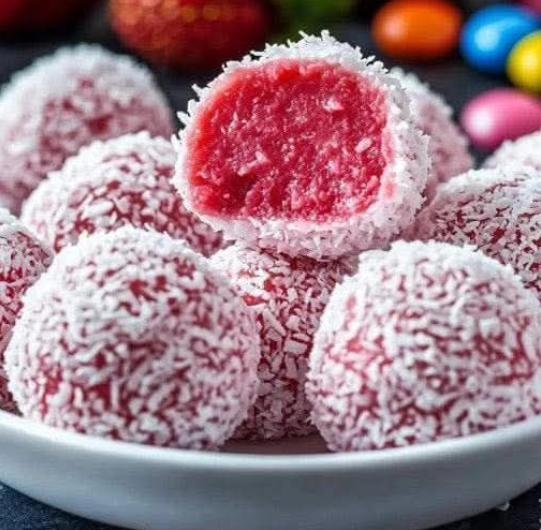
No-Bake Brilliance: Mastering Raspberry Coconut Balls
Introduction: The Confectionary Power of Condensed Milk
These **Raspberry Coconut Balls** belong to a category of confectionery that requires no baking. They rely entirely on the high sugar and low water activity of **sweetened condensed milk** to bind the dry ingredients. The milk acts as a syrup, coating the **desiccated coconut** and the **raspberry powder** to form a dense, pliable matrix. The **chilling step** (Instruction 4) is essential, as the cold temperature solidifies the fat within the coconut and condensed milk, turning the sticky dough into a firm, sliceable ball.
The innovation here is the use of **freeze-dried raspberries**. Unlike fresh or frozen raspberries, which would introduce too much water and quickly turn the dough into a soggy mess, freeze-dried fruit is purely flavor and color, delivering an intense, concentrated taste that is then easily bound by the condensed milk.
Success requires adherence to three core regulations: **The Powdering and Chilling Protocol, The Binding and Hydration Mandate, and The Textural Balance Principle.**
The first regulation, **The Powdering and Chilling Protocol** (Instruction 1 & 4), ensures a smooth finish and a stable structure. The **freeze-dried raspberries** must be crushed into a fine powder (Instruction 1). Any large chunks will introduce pockets of unhydrated material, leading to a gritty texture. Chilling is the final setting step; the dough will be too sticky to handle and roll properly until the fats are solidified.
The second regulation, **The Binding and Hydration Mandate** (Instruction 2), governs the rollable consistency. The **sweetened condensed milk** (Ingredient II) must be added slowly until a sticky dough forms. The key is to stop mixing immediately once the dough holds together. Excessive mixing will prematurely hydrate the coconut and make the dough oilier and harder to manage.
The third regulation, **The Textural Balance Principle** (Ingredient I), focuses on the coconut. **Desiccated coconut** is preferred over shredded or flaked coconut because its fine texture absorbs the liquid more evenly and creates a smoother final dough, reminiscent of traditional *bounty* or *rafaello* confections.
Ingredients: Defining Texture, Binder, and Flavor
The full components for about 20–24 balls:
I. The Core & Texture:
- **$1\text{ cup (100g)}$** desiccated coconut (plus extra for rolling) (Texture, structure)
- **$1\text{ cup (120g)}$** freeze-dried raspberries (or $\frac{1}{2}\text{ cup}$ raspberry powder) (Intense flavor, color)
II. The Binder & Flavor:
- **$\frac{1}{2}\text{ cup (125g)}$** sweetened condensed milk (or coconut condensed milk) (Binder, sweetness)
- **$1\text{ tsp}$** vanilla extract (optional) (Aromatic)
- **Pinch of salt** (Flavor balance)
III. Optional Add-Ins:
- **$1\text{–}2\text{ tbsp}$** maple syrup (Extra sweetness)
- **$2\text{ tbsp}$** coconut oil (Richer mouthfeel, aids freezing)
- **Crushed nuts or white chocolate chips** (Texture contrast)
