
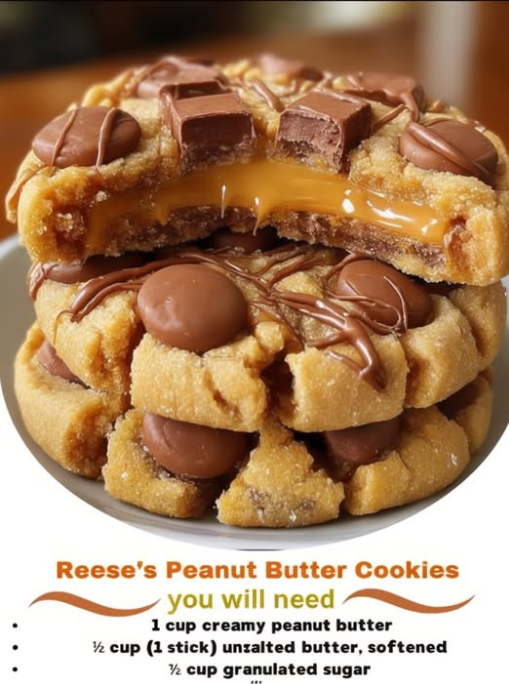
The Perfect Fusion: Mastering Reese’s Peanut Butter Cookies
Introduction: The Science of the Perfect Peanut Butter Cookie
This **Reese’s Peanut Butter Cookie** recipe is a hybrid confection, seeking the dense chewiness of a classic peanut butter cookie while ensuring the dough is robust enough to cradle the **Reese’s Peanut Butter Cup** without collapsing. Achieving the perfect texture relies on precise management of fat, sugar, and protein.
The **peanut butter** (Ingredient I) provides protein and fat, contributing to the cookie’s dense, rich structure. The combination of $\frac{1}{2}\text{ cup}$ **granulated sugar** (a spreading agent) and $\frac{1}{2}\text{ cup}$ **light brown sugar** (which contains molasses, a humectant that retains moisture) ensures the cookie spreads slightly but stays soft and chewy . The scientific challenge is the integration of these fats and sugars into a stable dough.
Success requires adherence to three core regulations: **The Sugar-Fat Ratio Mandate, The Creaming and Quick-Set Protocol, and The Short-Bake Strategy.**
The first regulation, **The Sugar-Fat Ratio Mandate** (Instruction 2), governs the texture. By creaming the $\frac{1}{2}\text{ cup}$ **butter** and the **sugars** with the **peanut butter**, we incorporate tiny air bubbles. This process, known as creaming, is critical for initial leavening and establishing the cookie’s internal structure. Failure to cream long enough results in a dense, flat cookie.
The second regulation, **The Creaming and Quick-Set Protocol** (Instruction 2 & 8), ensures the perfect finish. The dough is not chilled (Instruction 6), which is unusual for a chewy cookie, because the high-fat content from the peanut butter and butter already provides stability. However, the use of **baking soda** (Instruction 4) ensures a quick spread and set. The **Reese’s Cup** must be pressed into the cookie immediately after baking (Instruction 8) while the cookie is still above the melting point of the chocolate, ensuring the center melts and binds perfectly to the soft core.
The third regulation, **The Short-Bake Strategy** (Instruction 7), dictates tenderness. Baking for only **$8\text{–}10\text{ minutes}$** ensures the center remains soft and slightly underdone. The residual heat (carryover cooking) on the pan (Instruction 9) finishes the cooking process, resulting in a perfectly chewy center rather than a dry, hard one.
Ingredients: Defining Structure, Flavor, and Finish
The full components for about 3 dozen cookies (based on tablespoon scoops):
I. For the Cookie Dough (Fat, Sugar, Leavening):
- **$1\text{ cup}$** creamy peanut butter (Fat and flavor)
- **$\frac{1}{2}\text{ cup (1 stick)}$** unsalted butter, softened (Primary fat)
- **$\frac{1}{2}\text{ cup}$** granulated sugar (Spreading agent)
- **$\frac{1}{2}\text{ cup}$** packed light brown sugar (Moisture retention/chewiness)
- **$1\text{ large}$** egg (Binding protein)
- **$1\text{ teaspoon}$** vanilla extract (Aromatic)
- **$1\frac{1}{2}\text{ cups}$** all-purpose flour (Bulk and structure)
- **$1\text{ teaspoon}$** baking soda (Chemical leavening)
- **$\frac{1}{2}\text{ teaspoon}$** salt (Flavor balance)
II. For the Filling & Topping (Fusion):
- **$36$** mini Reese’s Peanut Butter Cups, unwrapped (Core filling)
- **$1\text{ cup}$** semi-sweet chocolate chips (optional, for melting/drizzle) (Garnish)
