
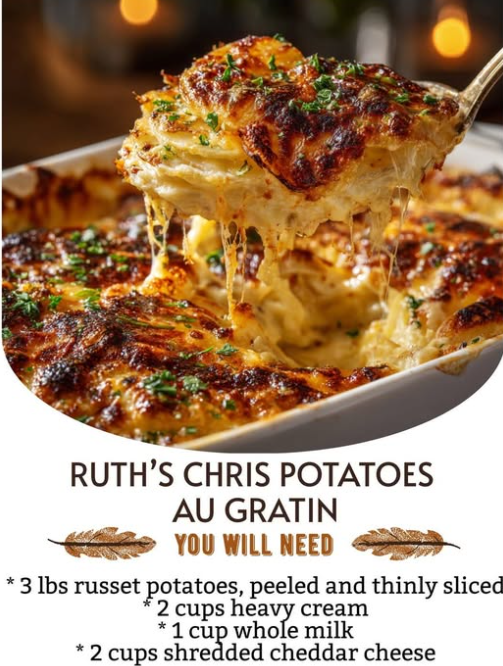
Steakhouse Excellence: Mastering Ruth’s Chris Potatoes au Gratin
Introduction: The Geometry and Chemistry of Gratin
The **Ruth’s Chris Potatoes au Gratin** is famous for being incredibly rich, cheesy, and tender—the antithesis of dry, stiff scalloped potatoes. This outcome is achieved through careful management of three critical principles: **The Uniform Slice Geometry, The Roux-Stabilized Cream Base, and The Two-Stage Thermal Process.**
The first principle, **The Uniform Slice Geometry**, is non-negotiable for tender, evenly cooked potatoes. The **3 lbs Russet potatoes** must be sliced incredibly thin (ideally $\frac{1}{8}$-inch or less). If slices are uneven, thinner pieces will turn to mush while thicker pieces remain hard. Uniformity ensures the starch released by each slice is consistent and the entire dish cooks to the same fork-tender finish.
The second principle, **The Roux-Stabilized Cream Base**, prevents the dish from separating. Combining **2 cups heavy cream** and **1 cup whole milk** alone will often result in a thin, curdled liquid during a long bake. The best gratins use a small amount of roux (a butter/flour mixture, assumed) to gently thicken the dairy, creating a basic, stable béchamel. When the **2 cups shredded cheddar cheese** (Assumed: sharp cheddar) is melted into this thickened base, it creates a robust, stable cheese sauce that coats the potatoes beautifully and remains smooth throughout the baking process.
The third principle, **The Two-Stage Thermal Process**, ensures both tenderness and color. The gratin is first baked slowly, **covered with foil**, at a moderate temperature (Assumed: $375^\circ\text{F}$ for 45–60 minutes). This slow steaming allows the thick slices to cook completely in the liquid without the top drying out. The foil is then removed for the final 15–20 minutes to achieve the beautiful **golden crust** that defines an *au gratin* finish.
