ADVERTISEMENT
Phase 1: Pre-Cooking and Assembly
- **Prep Oven and Ingredients:** Preheat the oven to $350^\circ\text{F}$ ($175^\circ\text{C}$). Gather all ingredients, chop the cabbage, and dice the onion.
- **Brown Beef (PRE-COOKED MEAT INTEGRITY):** In a large skillet over medium-high heat, cook and stir the **2 pounds of ground beef** until browned and crumbly ($5\text{ to }7\text{ minutes}$). Drain off any excess grease before setting aside.
- **Combine Filling:** In a large mixing bowl, combine the **chopped cabbage, tomato sauce, onion, uncooked rice, salt, and the cooked ground beef**. Mix thoroughly to ensure the raw rice is distributed evenly.
- **Pour and Hydrate (LIQUID ABSORPTION PRINCIPLE):** Pour the mixture into a $9\times 13\text{-inch}$ baking dish. Then, pour the **2 cans of beef broth** evenly over the top, making sure the liquid covers the rice/cabbage mixture.
Phase 2: Baking and Final Finish
- **First Bake (SLOW-SIMMER METHOD, Part 1):** Cover the baking dish tightly with aluminum foil and bake in the preheated oven for **1 hour**. The foil traps the steam required to cook the rice and tenderize the cabbage.
- **Second Bake and Stir:** Remove the cover and **stir the casserole** thoroughly to redistribute the rice (which may have settled) and move the partially cooked cabbage from the bottom to the top. Cover again and bake for an additional **$20\text{ to }30\text{ minutes}$**, or until the cabbage is fork-tender and the rice is cooked through.
- **Final Touch and Serve:** If using, sprinkle shredded cheese on top before the final $10\text{ minutes}$ of baking. Serve hot and enjoy!
Serving and Storage: The Cohesive Dish
Optimal handling for this hearty baked casserole:
- **Serving:** Best served hot. It pairs perfectly with a dollop of sour cream or a crusty bread.
- **Storage:** Store leftovers in an airtight container in the refrigerator for up to **5 days**.
- **Freezing:** Casseroles freeze exceptionally well. Cool completely, then cover tightly and freeze for up to **3 months**. Thaw overnight in the refrigerator and reheat in the oven ($350^\circ\text{F}$ or $175^\circ\text{C}$) until bubbling hot.
Tips: Essential Techniques for Tenderness and Texture
Cabbage Prep: Ensure the **cabbage** (Ingredient I) is chopped into uniform, manageable pieces. Large chunks will take longer to tenderize, compromising **The Slow-Simmer Method**.
Rice Rinsing: **Do not rinse the rice** (Ingredient I) for this recipe. Rinsing removes starches; here, the starch helps slightly thicken the final sauce, contributing to the casserole’s cohesive texture.
The Stirring Point: The **stirring step** after the first hour (Instruction 6) is crucial. It redistributes the rice and cabbage, ensuring all components have access to the hot liquid for even cooking, thereby fulfilling **The Liquid Absorption Principle**.
Browning for Flavor: If time allows, after browning the beef (Instruction 2), remove the meat and sauté the **chopped onion** (Ingredient II) in the beef fat until softened ($3\text{ minutes}$) before combining the ingredients. This deepens the aromatic base.
The Tomato Flavor: If you prefer a richer, less sweet tomato base, substitute $\frac{1}{2}\text{ can}$ of the **tomato sauce** with $\frac{1}{2}\text{ can}$ of **crushed tomatoes** for chunkier texture and more intense tomato flavor.
Variations: Customizing Meat and Liquid
Easily adapt the flavor and richness of the casserole:
- **Sweet and Sour Profile:** For a classic sweet-and-sour cabbage roll flavor, mix in **$\frac{1}{4}\text{ cup}$ of brown sugar** and **2 tablespoons of white vinegar** into the tomato sauce mixture (Instruction 3).
- **Lighter Meat:** Substitute the **ground beef** (Ingredient I) with a mix of **ground turkey** or **ground pork** for a different flavor profile. The Pre-Cooked Meat Integrity rule still applies—always brown and drain.
- **Liquid Swap:** Substitute the **beef broth** (Ingredient II) with **chicken broth** for a milder flavor, or use **vegetable broth** for a vegetarian base (substituting lentils or mushrooms for the meat).
- **Grain Change:** For a healthier option, substitute the **white rice** (Ingredient I) with an equal volume of **cooked quinoa** or **brown rice**, but note that the amount of liquid needed would change, and brown rice would require *pre-cooking* before assembly.
**Cabbage Variety:** Use **green cabbage** for this recipe. Red cabbage will bleed color into the sauce, making the casserole appear purple and muddy.
**Seasoning Depth:** To enhance the savory depth, add **$\frac{1}{2}\text{ teaspoon}$ of dried oregano and $\frac{1}{4}\text{ teaspoon}$ of dried thyme** to the filling mixture (Instruction 3).
**Preventing Dryness:** Ensure your aluminum foil lid (Instruction 5) is tightly sealed during the first hour of baking. A loose seal allows steam to escape, which results in dry rice and crisp cabbage.
**Batch Prep:** This recipe doubles well, making it ideal for large gatherings or freezer meals. Use a larger pan (e.g., $11\times 15\text{ inches}$) and ensure the liquid volume is increased proportionally.
Conclusion: The Ultimate Comfort Food Engineering
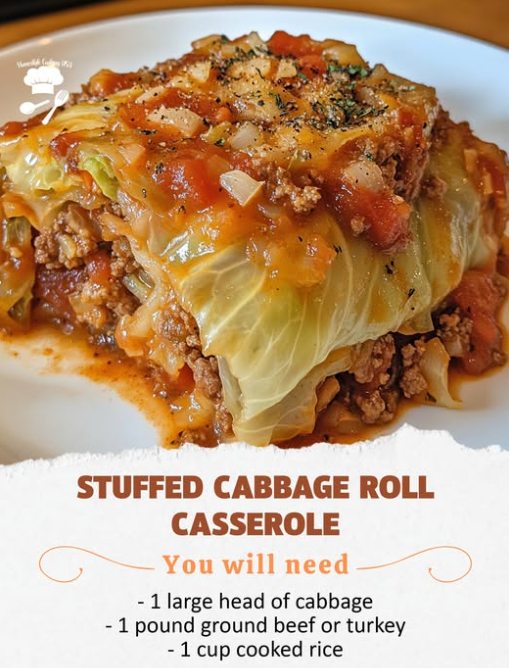
The **Stuffed Cabbage Roll Casserole** is a celebration of slow, moist cooking. By strictly adhering to **The Liquid Absorption Principle** for perfect rice and utilizing **The Slow-Simmer Method** to create tender, flavorful cabbage , you achieve a cohesive, rich, and deeply satisfying dish that offers all the flavor of the rolled classic without any of the fuss.
Frequently Asked Questions (FAQ)
Q: Why is my rice still crunchy after the full baking time?
A: The rice likely **did not have enough liquid access** (Instruction 4). This can be due to a loose foil cover, rice settling at the bottom, or not enough broth. Ensure you **stir well** during the mid-bake check.
Q: My casserole is too watery. How can I thicken the sauce?
A: Remove the cover for the final $15\text{ minutes}$ of baking to allow moisture to evaporate. If still too thin, mix **1 tablespoon of cornstarch** with **2 tablespoons of cold water** and stir into the casserole during the final uncovered bake.
Q: Can I use cooked rice?
A: **Yes**, but the amount of liquid would need to be reduced significantly. If using cooked rice, reduce the beef broth to just **1 (14 ounce) can** and decrease the initial covered bake time to $45\text{ minutes}$ (as the rice doesn’t need to cook, only to heat and absorb flavor).
Q: Is it necessary to drain the grease from the beef?
A: **Yes**, draining the grease (Instruction 2) is essential. Undrained grease will create an oily layer on top of the casserole during baking and make the final dish feel heavy.
ADVERTISEMENT