
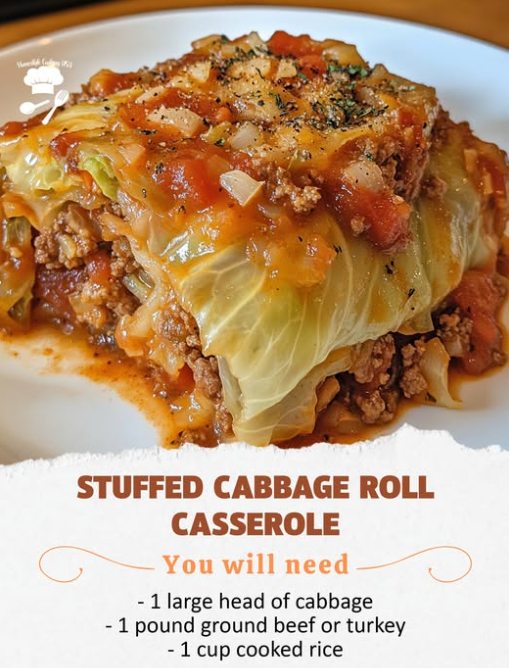
Comfort Classic: Mastering Stuffed Cabbage Roll Casserole
Introduction: The Magic of Deconstructed Rolls
The **Stuffed Cabbage Roll Casserole** takes the core flavor profile of traditional *holishkes* or *golubtsi*—a rich meat and rice filling, encased in sweet-and-sour cooked cabbage, bathed in tomato sauce—and simplifies the process. The key technical challenge is ensuring the **uncooked white rice** absorbs the correct amount of liquid while the **cabbage** simultaneously tenderizes in the oven’s moist environment.
The **cabbage** is the main vegetable component, providing bulk and a slight sweetness when cooked down. The **ground beef** provides richness and protein, and the **rice** acts as a sponge and starch binder. The final structure is a moist, cohesive, and scoopable casserole.
Success requires adherence to three core regulations: **The Liquid Absorption Principle, The Slow-Simmer Method, and The Pre-Cooked Meat Integrity.**
The first regulation, **The Liquid Absorption Principle** (Instruction 4), is crucial for the rice texture. The uncooked rice requires liquid to cook, and here, it uses the $2\text{ cans}$ of **beef broth** and the $1\text{ can}$ of **tomato sauce**. The specific ratio of $1\text{ cup}$ of uncooked rice to about $3\text{ cups}$ of total liquid ensures the rice cooks to tender perfection without becoming dry or mushy. The rice must be evenly distributed to maximize contact with the liquid before baking.
The second regulation, **The Slow-Simmer Method** (Instruction 5 & 6), tenderizes the ingredients. Baking **covered** (Instruction 5) for the first hour traps steam, creating a moist, low-intensity environment that breaks down the tough cellulose in the **chopped cabbage**. This moist, slow cooking is necessary to achieve the melt-in-your-mouth tenderness characteristic of a long-simmered cabbage roll. The final **stir and uncovered bake** (Instruction 6) thickens the sauce slightly and finishes the cabbage.
The third regulation, **The Pre-Cooked Meat Integrity** (Instruction 2), saves time and flavor. **Browning the ground beef** before mixing serves two purposes: it removes excess fat (grease), which would otherwise make the final casserole oily, and it deepens the flavor through the Maillard reaction.
Ingredients: Defining Structure, Moisture, and Flavor
The full components for this hearty casserole (serves 8-10):
I. The Core Structure:
- **2 pounds** ground beef (The protein base)
- **$3\frac{1}{2}\text{ pounds}$** chopped cabbage (The main volume and structure)
- **1 cup** uncooked white rice (The starch binder and absorber)
II. The Liquid and Flavor Base:
- **1 (29 ounce) can** tomato sauce (Acidity, color, and liquid)
- **2 (14 ounce) cans** beef broth (Primary cooking liquid and flavor)
- **1 cup** chopped onion (Aromatic base)
- **1 teaspoon** salt (Essential seasoning)
III. Optional Embellishments:
- **Shredded cheese** (e.g., mozzarella or Gruyère) (Optional topping for richness)
