ADVERTISEMENT
Phase 1: Preparing the Peanut Butter Core
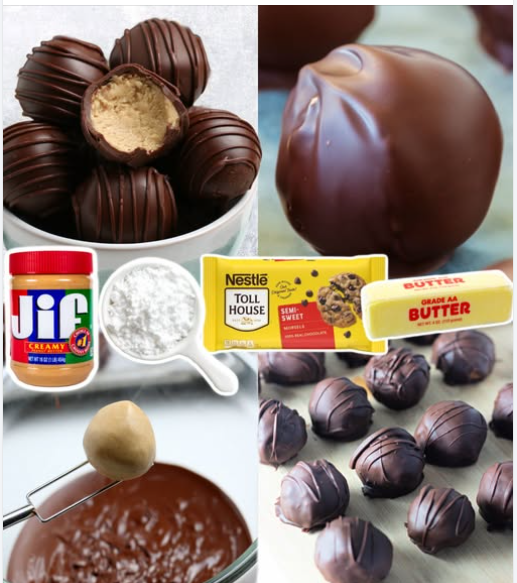
- **Mix:** In a large bowl, use a hand mixer or wooden spoon to combine the **creamy peanut butter and softened butter** until smooth.
- **Bind (MANDATE):** Gradually add the **powdered sugar** and **vanilla extract**. Mix until a stiff, cohesive dough forms. If the dough is too sticky, add $1\text{–}2\text{ tbsp}$ more powdered sugar.
- **Roll and Pre-Chill (PROTOCOL):** Roll the mixture into small balls (about $1\text{-inch}$ diameter) and place them on a parchment-lined baking sheet. **Chill for at least $30\text{ minutes}$** to firm up.
Phase 2: Coating and Final Setting
- **Melt (PRINCIPLE):** In a microwave-safe bowl, combine the **chocolate chips and shortening/coconut oil**. Microwave in $30\text{-second}$ intervals, stirring between each, until the chocolate is smooth and fully melted.
- **Dip (PRINCIPLE):** Using a dipping fork or toothpicks, quickly dip each chilled peanut butter ball into the melted chocolate, ensuring it is fully coated. Allow excess chocolate to drip off.
- **Set:** Return the coated balls to the parchment-lined sheet. If desired, drizzle with contrasting white chocolate or sprinkle with sea salt before the chocolate sets. **Chill for at least $1\text{ hour}$** until the coating is completely firm.
Phase 3: Storage and Serving
- **Store:** Store the finished balls in an airtight container in the refrigerator.
- **Serve:** Serve chilled or at cool room temperature.
Tips & Technical Insights:
Natural vs. Processed Peanut Butter: Use creamy, **processed peanut butter** (like Jif or Skippy) (Ingredient I). Natural peanut butter, which separates oil, has an unstable fat content that leads to a softer, greasier ball that is difficult to roll and coat (MANDATE).
Softening the Butter: The **butter** (Ingredient I) must be softened to room temperature, but **not melted**. Melted butter adds excess liquid fat, which throws off the crucial sugar-to-fat binding ratio (MANDATE).
The Role of Shortening/Coconut Oil: Adding a small amount of **shortening or coconut oil** (Ingredient II) to the melting chocolate is a classic trick. This fat lowers the viscosity of the chocolate, making it thinner and easier to dip, and improves the glossiness of the set coating, acting as a simple, effective ‘faux-tempering’ agent (PRINCIPLE).
Chill Temperature: The **$30\text{-minute}$ pre-chill** (Instruction 3) is vital. It firms the fat in the peanut butter balls, making them easier to handle and ensuring they are cold enough to rapidly set the warm chocolate coating, preventing streakiness.
Dipping Technique: Ensure the chocolate is **thin** enough to coat quickly. If the chocolate is too thick or cools down too much, reheat it briefly. Work quickly when dipping, as the cold balls will start the setting process almost immediately.
Variations: Customizing Flavor and Richness
Easily adapt the components and richness of your dessert balls:
- **Crunchy Interior:** Substitute $1\text{ cup}$ of the **powdered sugar** (Ingredient I) with $\frac{1}{2}\text{ cup}$ of **finely crushed graham crackers or crispy rice cereal** for a textural contrast.
- **Oatmeal Binder:** Replace $\frac{1}{2}\text{ cup}$ of the **powdered sugar** with $\frac{1}{2}\text{ cup}$ of **finely ground old-fashioned rolled oats** for an earthier flavor and better structure.
- **Extra Salt:** Add a sprinkle of **flaky sea salt** (Ingredient II) immediately after dipping for a sophisticated salty-sweet finish.
- **Espresso Boost:** Mix $\frac{1}{2}\text{ tsp}$ of **instant espresso powder** into the melted chocolate coating (Instruction 4) for a depth of flavor that complements the cocoa.
Conclusion: The Power of Fat and Sugar
The **No-Bake Peanut Butter Ball** is the ultimate testament to simple structural chemistry. By rigorously adhering to **The Fat and Binder Ratio Mandate**, you ensure the dough is perfect for rolling. By following **The Creaming and Chill Protocol** and applying the principles of chocolate coating, you guarantee a perfect, non-messy, 5-star result every time.
Frequently Asked Questions (FAQ)
Q: Why is my peanut butter mixture too soft and sticky?
A: The ratio is off (MANDATE). You likely need to add more **powdered sugar**—do this $1\text{ tbsp}$ at a time until the dough is firm enough to roll easily without sticking to your hands.
Q: Why is my chocolate coating streaky or dull?
A: This is due to **improper melting or tempering** (PRINCIPLE). Ensure you melt the chocolate gently and add shortening/coconut oil for gloss. Also, ensure the balls are very cold before dipping to set the coating quickly.
Q: Can I use crunchy peanut butter?
A: **Yes**, but the texture will be noticeably grainier due to the peanut pieces. Ensure you still use the **creamy-style processed** variety for the base fat and stabilization.
Q: How long can I store these?
A: They can be stored in an airtight container in the refrigerator for up to $2\text{ weeks}$, or frozen for up to $3\text{ months}$. Thaw overnight in the refrigerator.
ADVERTISEMENT