ADVERTISEMENT
Phase 1: Baking the Cheesecake Layer
- **Prep:** Preheat oven to $325^\circ\text{F}$ ($160^\circ\text{C}$). Grease an $8\text{-inch}$ springform pan.
- **Mix (MANDATE):** Beat the **softened cream cheese** until smooth, then beat in the **sugar and salt**. Mix in the **lemon zest, juice, and vanilla**. Add the **eggs** one at a time, mixing only until combined. Do not overmix.
- **Bake Gently:** Pour the mixture into the prepared pan. Bake for **$40\text{–}50\text{ minutes}$**, or until the edges are set and the center still has a slight wobble. Turn the oven off, prop the door open, and let the cheesecake cool inside for $1\text{ hour}$.
- **Chill:** Remove the cheesecake and chill in the refrigerator until completely firm (at least $4\text{ hours}$).
Phase 2: Baking the Cake Layers
- **Prep:** Increase oven temperature to $350^\circ\text{F}$ ($175^\circ\text{C}$). Grease and flour two $8\text{-inch}$ round cake pans.
- **Mix Cake (PROTOCOL):** Cream the **softened butter and granulated sugar** until light and fluffy. Beat in the **eggs** one at a time, then the **vanilla**. In a separate bowl, whisk the **flour, baking powder, baking soda, and salt**. Alternate adding the dry ingredients and the **buttermilk** to the wet ingredients, beginning and ending with the dry.
- **Bake:** Divide the batter evenly between the two pans. Bake for **$25\text{–}30\text{ minutes}$**, or until a toothpick inserted in the center comes out clean. Cool completely on a wire rack.
Phase 3: Frosting and Assembly
- **Frosting:** Beat the **softened cream cheese and butter** until smooth. Gradually beat in the **sifted powdered sugar, vanilla extract, and lemon juice** until the frosting is thick and spreadable.
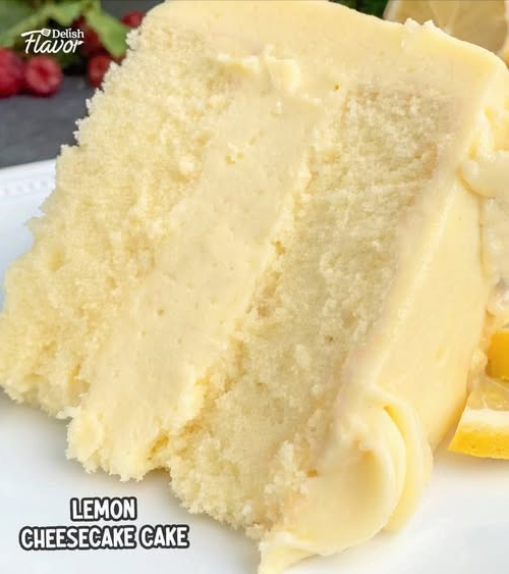
- **Crumb Coat (PROTOCOL):** Place one cake layer on a serving platter. Spread a layer of frosting, then place the **chilled cheesecake layer** on top. Spread another layer of frosting over the cheesecake, then top with the final cake layer. Apply a thin, light layer of frosting to the entire cake exterior (**the crumb coat**) and chill for $15\text{ minutes}$.
- **Final Frost (PROTOCOL):** Apply the remaining frosting in a final, thick, even layer. Garnish with lemon zest or slices. Keep chilled until $30\text{ minutes}$ before serving.
Tips & Technical Insights:
Preventing Cheesecake Cracks: Cracking is caused by temperature shock and over-mixing. Adhering to the **Gentle Bake Mandate** (Instruction 3)—especially the cooling inside the oven—ensures the center and edges cool uniformly, preventing the structure from tearing.
Cream Cheese Temperature: For both the cheesecake and the frosting, the **cream cheese and butter must be room temperature** (softened). Cold cream cheese will result in lumps in the batter and grainy frosting. Overheated/melted butter and cream cheese will result in a greasy, runny frosting that will not hold its shape.
Sifting the Powdered Sugar: The **powdered sugar** (Ingredient III) in the frosting must be sifted. Powdered sugar easily clumps, and those lumps will remain in the frosting, creating a grainy texture that compromises the smooth stability needed for the final structure.
The Role of Lemon: The **lemon juice and zest** (Ingredient I & II) provides essential contrast. The acid in the lemon juice tenderizes the cake crumb (Instruction 6) and cuts the richness of the high-fat cheesecake and frosting, preventing the dessert from tasting too heavy.
Buttermilk Substitute: If you don’t have buttermilk, the instructed substitute ($\frac{3}{4}\text{ cup}$ milk mixed with $1\text{ tsp}$ lemon juice) works because the **lemon juice activates the baking soda** (Ingredient II), ensuring the cake rises correctly and remains tender.
Variations: Customizing Richness and Shape
Easily adapt the components and richness of your decadent cake:
- **Crust Inclusion:** For the cheesecake layer, add a **graham cracker or vanilla wafer crust** to the bottom of the springform pan (Phase 1) for added texture.
- **Marmalade Swirl:** Swirl $2\text{ tbsp}$ of **lemon or orange marmalade** into the cheesecake batter just before baking (Instruction 3) for a beautiful ribbon of citrus flavor.
- **Ricotta Substitution:** For a lighter, slightly drier cheesecake texture, substitute one block of the **cream cheese** (Ingredient I) with $8\text{ oz}$ of **whole milk ricotta cheese**, ensuring the ricotta is drained of excess liquid first.
- **Triple Lemon:** Soak the cake layers (Instruction 7) with a quick **lemon syrup** (equal parts sugar and lemon juice, boiled until clear) brushed onto the layers before frosting to intensify the lemon flavor.
Conclusion: Structural Cohesion and Chill Time
The **Dreamy Lemon Cheesecake Cake** is a feat of baking architecture where success is earned through patience and temperature control. By adhering to **The Gentle Bake and Creaming Mandate**, you secure a perfect cheesecake, and by executing **The Layering and Crumb Protocol**, you guarantee a beautiful, stable, and deliciously complex final dessert ready for any occasion.
Frequently Asked Questions (FAQ)
Q: My cheesecake cracked. What happened?
A: Cracking is typically caused by one of two issues: **over-beating** (incorporating too much air) or **sudden temperature change** (MANDATE, Instruction 2 & 3). Ensure you cool the cheesecake slowly inside the oven.
Q: My cream cheese frosting is runny. How do I fix it?
A: The **butter/cream cheese ratio is off** (too much liquid/fat) or the ingredients were **too warm**. Add an extra $\frac{1}{4}\text{ cup}$ of sifted **powdered sugar** (Ingredient III) to help stabilize the frosting, and chill the frosting for $10\text{ minutes}$ before trying to whip it again (PROTOCOL).
Q: Can I bake the cheesecake and the cake layers at the same temperature?
A: **No.** The cheesecake requires a lower, slower bake ($325^\circ\text{F}$) to set the proteins without cracking, while the cake layers need a higher temperature ($350^\circ\text{F}$) for proper leavening and lift. They must be baked separately.
Q: What is the purpose of the crumb coat?
A: The **crumb coat** (Instruction 9) is a thin layer of frosting applied to seal in loose cake crumbs before the final, thick frosting is applied. It ensures the finished cake has a clean, smooth exterior, free of crumbs (PROTOCOL).
ADVERTISEMENT