
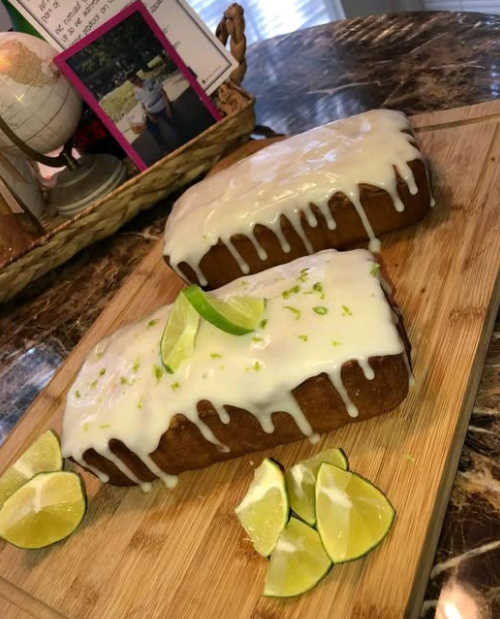
Velvety Zest: Mastering the Key Lime Pound Cake
Introduction: The Creaming Method and Structural Density
A true **Pound Cake** is defined by its tender, close-knit crumb—it is denser and richer than a typical layer cake. This is achieved by relying heavily on the **creaming method** to incorporate air, rather than relying solely on chemical leaveners. The high fat content (typically equal to the flour content by weight, or close to it) prevents gluten development, yielding a velvety, moist texture. In this recipe, the **Key Lime juice** and **zest** provide the essential bright, tart contrast to the rich, sweet butter.
The success of the pound cake hinges on the initial mixing stage, dictated by **The Fat Temperature and Creaming Mandate**. If the butter is too cold, it won’t incorporate enough air; if it’s too warm, the air pockets will collapse. Perfect creaming builds a stable foundation that holds the entire structure, including the heavy liquids (eggs, buttermilk, lime juice).
Success requires adherence to three core regulations: **The Fat Temperature and Creaming Mandate, The Emulsion and Acid Protocol, and The Gentle Mixing Principle.**
The first regulation, **The Fat Temperature and Creaming Mandate** (Instruction 2), is vital for structural stability. The butter must be **room temperature** ($68^\circ\text{F}$ to $70^\circ\text{F}$). Creaming the **butter and sugar** mechanically incorporates millions of tiny air bubbles. These bubbles expand during baking, providing lift and preventing the cake from becoming overly dense.
The second regulation, **The Emulsion and Acid Protocol** (Instruction 3 & 4), manages moisture and flavor. The **eggs** and **buttermilk/sour cream** must be added slowly to maintain the emulsion (fat suspended in liquid). The **Key Lime juice** (an acid) tenderizes the crumb by weakening the gluten strands, enhancing the delicate, velvety texture.
The third regulation, **The Gentle Mixing Principle** (Instruction 5), prevents toughness. The **flour** must be added on low speed and mixed only until the last streaks of flour disappear. Overmixing develops tough gluten, which immediately ruins the pound cake’s signature tender density.
Ingredients: Defining Structure, Fat, and Acidity
The full components for $1\text{ large}$ Bundt or Loaf Cake:
I. Dry & Leavening Agents:
- **$3\text{ cups}$** all-purpose flour (Structure)
- **$\frac{1}{2}\text{ tsp}$** baking powder (Minor lift support)
- **$\frac{1}{2}\text{ tsp}$** salt (Flavor contrast)
II. Fat & Sugar:
- **$1\text{ cup}$** unsalted butter, softened to room temperature (Structural fat)
- **$2\text{ cups}$** granulated sugar (Sweetness, moisture retention)
III. Liquid & Flavor:
- **$4\text{ large}$** eggs, room temperature (Binder, emulsion)
- **$1\text{ teaspoon}$** pure vanilla extract (Aromatic base)
- **$\frac{1}{2}\text{ cup}$** buttermilk or sour cream (Moisture, acid)
- **$\frac{1}{4}\text{ cup}$** fresh Key Lime juice (Acidity, flavor)
- **$1\text{ tablespoon}$** Key Lime zest (Aromatic oil)
IV. Lime Glaze:
- **$1\text{ cup}$** sifted powdered sugar (Glaze structure)
- **$3\text{ tablespoons}$** fresh Key Lime juice (Glaze liquid, intense flavor)
