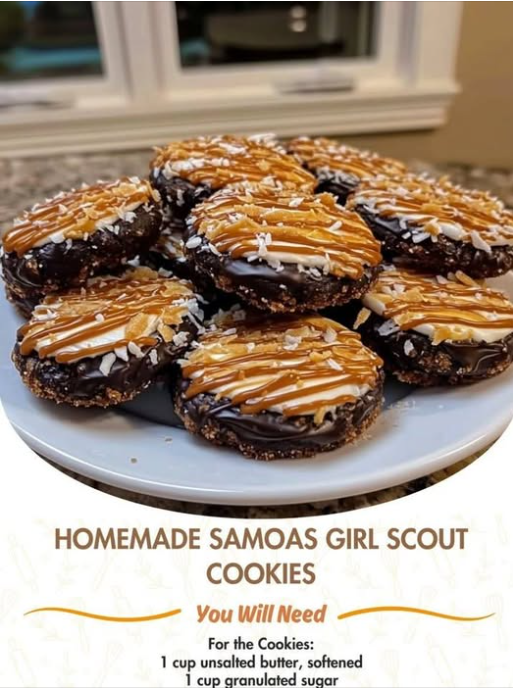
The full ingredient list, emphasizing roles and proportions:
I. The Shortbread Base:
- **1 cup** unsalted butter, softened
- **1 cup** granulated sugar
- **2 cups** all-purpose flour
- **¼ teaspoon** salt
- **1 teaspoon** vanilla extract
II. The Caramel-Coconut Layer:
- **$1\frac{1}{2}$ cups** shredded coconut, toasted (Texture)
- **1 cup** caramel sauce (Binder and flavor)
- **1 tablespoon** powdered sugar (Assumed, optional for thickening caramel)
III. The Chocolate Finish (Assumed):
- **6 ounces** semi-sweet or dark melting chocolate/wafers (For dipping and drizzling)
- **1 teaspoon** coconut oil or shortening (For smooth melt)
Instructions: Dough Prep, Baking, Layering, and Coating
Phase 1: Preparing the Shortbread Base
- **Cream Butter and Sugar:** In a stand mixer or large bowl, cream the **1 cup softened butter** and **1 cup granulated sugar** until light and fluffy. Beat in the **1 teaspoon vanilla extract**.
- **Add Dry Ingredients:** In a separate bowl, whisk together the **2 cups all-purpose flour** and **$\frac{1}{4}$ teaspoon salt**. Gradually add the flour mixture to the butter mixture, mixing on low speed until **just combined**. Stop mixing as soon as no streaks of flour remain to avoid gluten development.
- **Chill and Cut Dough (COLD TEMPERAMENT):** Form the dough into a disc, wrap it in plastic wrap, and chill for at least **30 minutes**. Preheat oven to $350^\circ\text{F}$ ($175^\circ\text{C}$).
- **Shape Cookies:** Roll the chilled dough to about $\frac{1}{4}$-inch thickness. Use a **2-inch round cookie cutter** for the perimeter and a **$\frac{1}{2}$-inch round cutter or piping tip** to create the center hole. Place cookies on a parchment-lined baking sheet.
- **Bake:** Bake for **10–12 minutes**, or until the edges are lightly golden. Let cool completely on a wire rack.
Phase 2: The Caramel-Coconut Topping
- **Toast Coconut:** Spread the **$1\frac{1}{2}$ cups shredded coconut** on a baking sheet. Toast in the oven for 5–8 minutes, stirring once, until golden brown. Let cool.
- **Prepare Caramel (STICKY INTEGRITY):** In a bowl, combine the **1 cup caramel sauce** with the toasted coconut. If the caramel seems too thin, heat the caramel gently on the stovetop for a few minutes to reduce and thicken it slightly, or stir in **1 tablespoon powdered sugar** (assumed).
- **Top Cookies:** Use a small offset spatula or a spoon to spread a layer of the caramel-coconut mixture over the top surface of each cooled cookie ring, leaving the center hole exposed.
- **Chill Topping:** Place the cookies back on the parchment-lined sheet and **refrigerate for 15 minutes** to firm up the topping.
Phase 3: The Double Chocolate Finish
- **Melt Chocolate:** Melt the **6 ounces of chocolate** (assumed) with the **1 teaspoon coconut oil/shortening** (assumed) using a double boiler or microwave (stirring frequently) until smooth and glossy.
- **Dip Base:** Take the chilled cookies. Dip the **flat bottom** of each cookie into the melted chocolate, coating it completely. Return to the parchment-lined sheet, chocolate-side down. Allow the chocolate to set completely (this can be done in the refrigerator for 5 minutes).
- **Drizzle Top:** Transfer the remaining melted chocolate into a small piping bag or a Ziploc bag with a tiny corner snipped off. Drizzle the chocolate in thin stripes back and forth across the caramel-coconut topping.
- **Final Set:** Allow the chocolate stripes to set completely at room temperature or in the refrigerator. Store in an airtight container.
Expert Tips for Success: Achieving Bakery-Quality Layers
Measuring Flour Correctly: For the tender shortbread (Step 2), **spoon the flour lightly** into the measuring cup, then level it off. Scooping directly can pack in too much flour, leading to a dry, tough cookie.
Toasting the Coconut: Do not skip toasting (Step 6). Toasted coconut has a deeper, nuttier flavor that is essential for the authentic Samoa taste. Watch closely as it burns quickly!
The Dough Scraps: When re-rolling the shortbread dough scraps (Step 4), try to handle the dough as little as possible. The more you work it, the tougher the final cookies will be.
Caramel Consistency Check: The caramel should be sticky enough to coat the coconut, but not so runny that it pools when applied (Step 7). If it’s too thick, add a drop of cream; if too thin, reduce it on the stove.
Chilling Protocol: Chill both the **dough and the topped cookies** (Steps 3 and 9). Chilling is what prevents spreading during baking and keeps the toppings stable during the dipping phase.
Variations: Customizing Texture and Sweetness
While classic Samoas are the goal, here are a few ways to customize:
- **Chocolate Quality:** Use high-quality **melting wafers or compound chocolate** (Step 10) for dipping, as they melt smoother and set harder than standard chocolate chips.
- **Salted Caramel:** Use a **salted caramel sauce** (Step 7) or sprinkle a few flakes of sea salt over the caramel layer before the final chocolate drizzle for a gourmet salted caramel finish.
- **Nut-Free Swap:** Substitute the shortbread base with a store-bought **vanilla wafer cookie** (crushed and mixed with butter) pressed into the ring shape for an extremely fast no-bake base.
- **Darker Flavor:** Use **dark cocoa powder** in the shortbread dough (reducing flour by 1/4 cup) for a dark, chocolatey base cookie.
Conclusion: Layered Perfection Achieved
Mastering **Homemade Samoas** is a rewarding task that hinges on careful execution of layers. By ensuring a **tender, chilled shortbread base**, creating a **perfectly sticky, toasted coconut-caramel topping**, and completing the cookie with a **precise chocolate dip and drizzle**, you achieve the complex texture and flavor of the iconic Girl Scout treat. Follow these steps meticulously, and you will have a batch of bakery-quality, layered perfection.
Frequently Asked Questions (FAQ)
Q: Why did my cookies spread too much and lose the center hole?
A: The **dough was not chilled long enough** (Step 3), or the butter was too soft. Cold butter prevents spreading. Ensure your dough is firm before cutting and baking.
Q: My caramel-coconut mixture keeps sliding off the cookie. Why?
A: The **caramel is too thin** (Step 7). This often happens if a runny ice cream topping is used. Thicken the mixture by heating the caramel separately to reduce its liquid content, or stir in a small amount of powdered sugar.
Q: My chocolate coating is dull and not shiny.
A: You likely **overheated the chocolate** (Step 10) or did not use the added shortening/coconut oil. The fat helps lower the viscosity and improves the shine.
Q: Can I use old-fashioned oats instead of coconut?
A: No. The texture will be completely different. The **shredded coconut** (Step 6) is key to the chewy texture. Do not substitute oats for the coconut.