
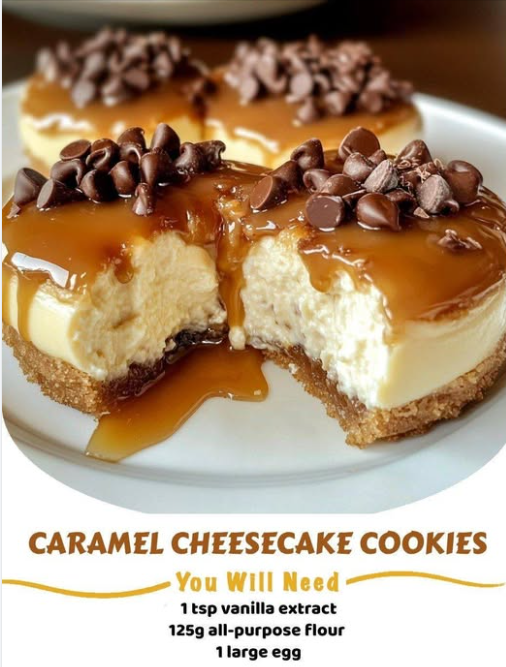
Caramel Cheesecake Cookies: A Fusion of Tang and Toffee 🧀🍯
The **Caramel Cheesecake Cookie** represents a sophisticated fusion dessert, combining the tender, slightly tangy crumb of a cheesecake batter with the rich chewiness of a perfect cookie, all centered around a molten caramel core. The “cheesecake” element is achieved by substituting a portion of the traditional cookie butter (fat) with **softened cream cheese**. The cream cheese introduces moisture, acidity, and protein, fundamentally altering the dough’s rheology—the way it flows and sets—resulting in a final product that is remarkably tender, resists excessive spread, and retains a pleasant, slight tang.
The **caramel core** is the second critical component. Unlike mixing caramel pieces throughout the dough, this method involves encasing a piece of soft caramel within the cookie dough before baking. During baking, the caramel melts, creating a pocket of gooey toffee that re-solidifies into a soft, chewy center upon cooling. The high moisture content from the **brown sugar** and **cream cheese** ensures the cookie itself stays moist, contrasting beautifully with the buttery richness of the caramel. This cookie is a study in controlled complexity, delivering the indulgence of cheesecake in a convenient, handheld form.
Introduction: The Role of Cream Cheese in Cookie Rheology
The addition of cream cheese to a standard cookie dough formula is not merely a flavor choice; it’s a deliberate manipulation of the dough’s structure. Traditional cookies rely solely on butter for fat and tenderness. In this recipe, the $\mathbf{115\text{g of softened cream cheese}}$ ($\approx 40\%$ of the total fat/dairy content) impacts the final texture significantly.
Acidity and Spread Control
Cream cheese contains buttermilk, which is slightly acidic. This acidity interacts with the $\frac{1}{2} \text{ teaspoon of baking powder}$, slowing its activation rate. Slower leavening translates to slower, more controlled spread in the oven. The result is a **thicker, puffier cookie** that is less likely to flatten out, which is ideal when carrying a dense central filling like caramel.
Moisture and Tenderness
Cream cheese has a higher water content than butter. This added moisture keeps the protein strands (gluten) from forming strong networks, contributing to the **extreme tenderness** of the cookie crumb. The final texture is softer and more “cake-like” than a standard cookie, perfectly mimicking the lightness of a baked cheesecake base.
The combination of $\mathbf{75\text{g of granulated sugar}}$ and $\mathbf{75\text{g of packed brown sugar}}$ is also key. The brown sugar’s molasses adds hygroscopicity (ability to attract and retain water), further enhancing the cookie’s chewiness and preventing it from drying out during the baking process.
