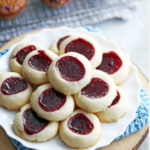
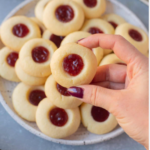
The full components for $24\text{ light, airy cookies}$:
I. Dry Ingredients & Structure:
- **$1\frac{1}{2}\text{ cups}$** all-purpose flour (Primary structure)
- **$\frac{1}{4}\text{ cup}$** cornstarch (Tenderness enhancer, gluten inhibitor)
- **$\frac{1}{4}\text{ tsp}$** salt (Flavor balance)
II. Fat & Aeration:
- **$1\text{ cup}$** unsalted butter, softened ($\approx 70^\circ\text{F}$ or $21^\circ\text{C}$) (Fat carrier, aeration base)
- **$\frac{1}{2}\text{ cup}$** powdered sugar (Fine sweetness, stabilization)
- **$1\text{ tsp}$** vanilla extract (Aromatic flavor)
III. Decoration:
- Sprinkles (for decorating)
Methods: Whip, Mix Gently, and Bake Low
Phase 1: Preparing the Base (Aeration Mandate)
- **Prep:** Preheat your oven to **$300^\circ\text{F}$ ($150^\circ\text{C}$)**. Line baking sheets with parchment paper or baking mats.
- **Whip Butter and Sugar (AERATION):** In a large mixing bowl (stand mixer recommended), beat the **softened butter and powdered sugar** together for a minimum of **$5\text{ minutes}$**, until the mixture is very pale, light, and fluffy. This must be thorough to incorporate maximum air.
- **Add Flavor:** Beat in the **vanilla extract** until just combined.
Phase 2: Combining and Shaping
- **Mix in Dry Ingredients (GENTLE HANDLING):** In a separate bowl, whisk together the **flour, cornstarch, and salt**. Gradually add the dry ingredients to the wet mixture, mixing on low speed until **just combined**. Stop immediately when no streaks of flour remain to prevent gluten formation.
- **Form the Cookies:** Dust your hands with **cornstarch**. Shape the dough into small balls, using about $2\text{ teaspoons}$ to $1\text{ tablespoon}$ of dough for each cookie.
- **Press and Decorate:** Place the dough balls on the prepared baking sheets. Press down the top of each cookie gently with a **fork dipped in cornstarch** to create a decorative pattern and prevent sticking. Add a few **sprinkles** on top of each cookie.
Phase 3: Baking and Finishing
- **Bake (LOW-HEAT):** Bake for **$10\text{–}15\text{ minutes}$** at $300^\circ\text{F}$, or until the tops look set and the edges are just barely starting to turn golden. The tops should remain very pale.
- **Cool:** Let the cookies cool on the baking sheet for a few minutes before transferring to a wire rack to cool completely.
Tips & Technical Insights:
The Role of Powdered Sugar: Using **powdered sugar** (Ingredient II) instead of granulated sugar is key. Its fine texture dissolves completely and seamlessly, contributing to the smooth texture and tenderness of the final cookie.
The Temperature of Butter: Ensure your butter is perfectly **softened** but still cool to the touch ($70^\circ\text{F}$). If the butter is too warm (melty), it cannot hold the air incorporated during the $5\text{-minute}$ whipping stage, resulting in a flat, greasy cookie.
Why Cornstarch? The $\frac{1}{4}\text{ cup}$ of **cornstarch** (Ingredient I) is the secret weapon for the “melt-in-your-mouth” texture. It weakens the protein network of the flour, resulting in a tender, crumbling crumb rather than a chewy one.
Do Not Overbake: The low oven temperature and short baking time (Instruction 7) are essential. Overbaking this cookie will make it dry and tough. They should look pale when removed from the oven.
Piping Variation: If you wish to pipe these cookies into rosettes or other shapes, follow the same method but use $1\text{–}2\text{ tbsp}$ less flour and do not use cornstarch on your hands. The dough should still be soft and smooth enough to pipe.
Variations: Customizing Flavor and Shape
Easily adapt the components and richness of the shortbread cookies:
- **Chocolate Swirl:** Melt $2\text{ ounces}$ of **semi-sweet chocolate** and swirl it gently into the dough after the dry ingredients are mixed (Instruction 4).
- **Nutty Shortbread:** Add $\frac{1}{2}\text{ tsp}$ of **almond extract** in place of half the vanilla and mix in $\frac{1}{4}\text{ cup}$ of **finely ground pecans** along with the flour.
- **Dip and Drizzle:** After cooling, dip one half of the cookies in **melted chocolate** or drizzle with a thin glaze made from powdered sugar and lemon juice.
- **Piped Shapes:** Instead of rolling into balls, use a **piping bag** fitted with a star tip (like a $1\text{M}$) to pipe the dough into rosettes or ‘S’ shapes directly onto the baking sheet.
Conclusion: A Delicate Balance of Air and Starch
The **Whipped Shortbread Cookie** is a technical triumph of simple ingredients guided by precise mixing. By meticulously adhering to **The Aeration and Low-Heat Mandate**—whipping the butter for a full 5 minutes and baking low and slow—and utilizing **The Cornstarch and Gentle Handling Protocol**, you achieve a cookie that delivers exceptional tenderness and the signature buttery flavor that defines the best holiday treats.
Frequently Asked Questions (FAQ)
Q: Why did my cookies spread too much and turn flat?
A: The most common reason is using **butter that was too warm or melted** (Instruction 2), which prevented it from holding the whipped air. Or, the oven temperature was **too high**, causing the butter to liquefy too quickly (Instruction 7).
Q: Why are my cookies tough instead of melt-in-your-mouth?
A: This is caused by **overmixing the dough** (Instruction 4). Overmixing develops gluten in the all-purpose flour. Mix only until the flour streaks disappear.
Q: Can I chill the dough?
A: **Not recommended.** This dough needs to be soft to form easily. Chilling will make it dense and difficult to handle or pipe. The proper low baking temperature prevents excessive spread.
Q: Can I use granulated sugar instead of powdered sugar?
A: **No**. Granulated sugar is too coarse. It will result in a grainy texture and will not dissolve as smoothly, compromising the tenderness and fine crumb.