The summons arrived that evening: Report to Admiral Rowan. Do not discuss this summons.
I knew why. Five years ago, I piloted Falcon 9 during Operation Dusk Ridge in Syria. Command ordered us to abort due to a crippling sandstorm. I cut the line, flew blind, and pulled six SEALs from a crater. Every manual told me to stop, but training manuals don’t bury men. Storms do.
When we landed, the helicopter was destroyed, but everyone lived. Everyone except the one who didn’t: Lieutenant Evan Rowan. Three days later, Evan—the Admiral’s son—died from internal injuries.
The official report arrived a month later, rewritten. The line “Pilot requested abort denied by command” was gone. The name on the denial—Commander James Rowan—was also missing. The file said the storm took him, not pride. I had the pilot’s log recording where Evan, just before passing out, whispered: Tell my father the pilot did everything right.
I knew my sister, Laya, was the key. Her department handled the press narrative, and her note later that night—Stop bringing up Dusk Ridge. Let it stay buried. —LK—confirmed her involvement in the cover-up. She had helped the Admiral bury the truth to protect his career.
When I was suspended from flight duty the next day, I didn’t fight the order. I needed to act before the system erased me completely. My young ally, Lieutenant Vance, confirmed Laya’s office had performed metadata edits on the Dusk Ridge file.
I found my opportunity when Laya confronted me in the comms building, foolishly leaving the DR204 file exposed. She grabbed the folder, tearing the page that read: REQUEST ABORT—Denied by Command.
“You really think that erases it?” I asked, catching her wrist.
She glared. “You’re chasing ghosts. The Navy doesn’t care who was right. It only cares who’s useful.”
I left her, retrieving the half-torn page that confirmed Rowan had issued the denial. It was all the proof I needed.
The Final Briefing and the Reckoning
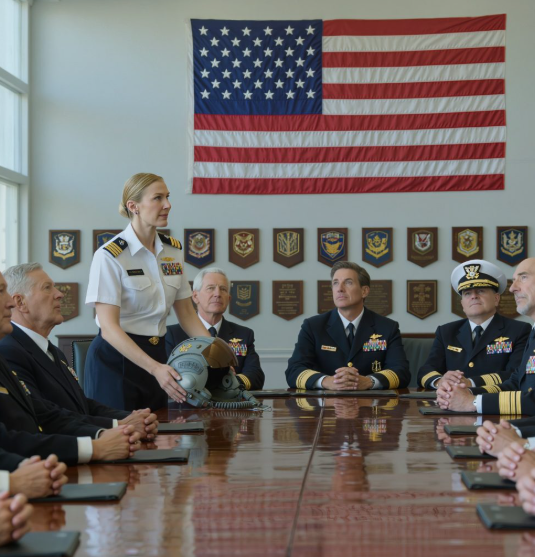
The next evening, the entire command staff, including Laya, assembled for a review session. The tension was palpable. Rowan stood at the front, his eyes meeting mine. I was suspended, but I was still present.
“Captain Katon,” Rowan said, his voice flat. “Since your flight services are paused, perhaps you can offer some insight on communication efficiency.”
Laya smirked, knowing this was designed to humiliate me.
I stood up. “Sir, I recommend streamlining communication between Command and Air Support, particularly concerning emergency directives and mission abort requests.” I paused, letting my gaze drift to Laya, then back to the Admiral.
“Specifically,” I continued, my voice cutting through the silence, “I recommend reviewing the chain of command that led to the death of Lieutenant Evan Rowan five years ago during Operation Dusk Ridge.”
The room sucked in a collective breath. Laya’s face was a mask of furious, terrified control. Rowan’s lips were pressed into a thin, white line.
“That matter is closed, Captain,” Rowan said, his authority cracking slightly. “It was a weather-related casualty.”
“No, sir. It was a weather-related extraction,” I corrected, walking slowly toward the front table. “The casualty was command-related.”
I reached the center table and pulled out the piece of paper I’d taped together—the REQUEST ABORT—Denied by Command page—and placed it gently beside the Admiral’s logbook.
“This confirms your signature on the abort denial, sir,” I stated. “The one my sister, Commander Katon, removed from the official file to protect your career.”
Laya shot out of her chair. “That’s classified material! A forgery!”
Rowan silenced her with a look. He stared at the torn paper, then at me.
“You should have kept your mouth shut, Mara,” Laya spat, her control finally shattering. “You’ve destroyed everything! You just wanted revenge for a stupid call sign!”
I ignored Laya. I looked only at the Admiral. “You didn’t need to bury the truth, sir. You needed to accept it. You lost your son to the storm, not to my disobedience. And he knew that.”
I reached into my pocket and pulled out a small, worn flash drive—the one Lieutenant Vance had secured for me—and plugged it into the podium’s connection port.
“Before Lieutenant Rowan succumbed to his injuries, he was recording a final voice message on the helicopter,” I announced to the stunned room. “This recording was saved from the flight recorder after the crash. It was suppressed by the Command Data Operations team—the third track in your cover-up, sir.”
The speakers crackled. I pressed play.
A young, static-laced voice filled the room—Evan Rowan’s voice: “…if anyone finds this. Tell my father. Tell Admiral Rowan. The pilot… she did everything right. The storm was coming, but she was never going to leave us. Don’t blame the pilot. It was just the storm…”
The recording ended. The room was utterly silent. The officers, frozen in their seats, looked at the Admiral.
Admiral Rowan, the man who commanded thousands, crumpled. The strength had left his face entirely. He didn’t look like a war hero; he looked like a broken father. The tears came silently, tracking paths through the exhaustion on his face. He picked up the torn paper and placed it over his heart.
He looked at me, his voice barely a whisper: “Reaper Zero.”
Laya, standing behind him, realized the true horror: she hadn’t saved her sister or the Admiral; she had condemned them both to carry a lie.
The Price of Honor
The reckoning was swift. The next day, the investigation into the Dusk Ridge command protocol and the subsequent report manipulation was formally opened. Admiral Rowan resigned that afternoon, citing “moral and ethical duty to the service.” He didn’t face court-martial, but he faced the truth.
Commander Laya Katon, facing charges for tampering with official records, was dishonorably discharged. She lost her rank, her career, and her place in the Navy she had desperately tried to impress.
I was reinstated. I was cleared of any wrongdoing at Dusk Ridge and commended for my conduct. But I didn’t stay.
I sat with Admiral Rowan one last time before he left the base.
“Why didn’t you give me that recording five years ago?” he asked, looking older and lighter all at once.
“Because five years ago, you weren’t ready to hear it,” I said. “You would have heard accusation, not truth. You needed to see that the cost of your pride was higher than the life you saved.”
He nodded, tears returning. “You saved him one last time, Captain. You gave him back his honor.”
I retired from the Navy three weeks later. I didn’t need to fly anymore. I had achieved the hardest mission: breaking the silence. As I drove off base for the last time, I glanced at the control tower. The air was clean, the sky was clear, and the ghost of Evan Rowan was finally at rest.
I drove out toward the ocean, the worn flight gloves on the passenger seat. I finally understood Grandpa’s wisdom: Honor isn’t about being saluted. It’s about showing up when no one’s watching. And sometimes, redemption is the hardest mission of all.