Ingredient quality is important, but careful preparation of the aromatics and thorough draining of the meat are critical for the best outcome.
| Component | Quantity | Role in the Dish and Technical Note |
|---|---|---|
| **Protein and Aromatics** | ||
| **Ground Beef or Turkey** | 2 lbs (900g) | The savory body. Use **80/20 ground beef** for optimal moisture and flavor. |
| **Yellow Onion** | 1 large, diced | Aromatic base; essential for sweetness when sautéed. |
| **Minced Garlic** | 3 tsp (1 tbsp) | Pungent flavor; contributes to the savory depth. |
| **The Sauce** | ||
| **Water** | $2 \frac{1}{2}$ cups | Liquid needed to hydrate the pasta and create the cooking environment. |
| **Crushed Tomatoes** | 1 (28 oz) can | Thickener and primary tomato component; adds texture. |
| **Tomato Sauce** | 1 (15 oz) can | Smooth liquid component; binds the sauce. |
| **Seasoning and Finish** | ||
| **Elbow Macaroni** | 2 cups, uncooked | Starch; cooks in the sauce to release thickening agents. |
| **Worcestershire Sauce** | 1 tbsp | Umami booster; do not skip this. |
| **Italian Seasoning** | 1 tbsp | Herbaceous complexity. |
| **Bay Leaf** | 1 | Subtle depth (remove after simmering). |
Instructions: The One-Pot Method
- **Brown the Meat and Aromatics:** In a large Dutch oven or pot, brown the **ground beef (or turkey)** over medium-high heat. Break the meat up as it cooks. Once mostly browned, drain off all excess grease thoroughly.
- **Sauté Aromatics:** Return the pot to medium heat. Add the **diced onion** to the meat and cook until softened and translucent, about 5–7 minutes. Add the **minced garlic** during the final minute of cooking, stirring continuously until fragrant.
- **Build the Sauce and Season:** Pour in the **crushed tomatoes, tomato sauce, and $2 \frac{1}{2}$ cups of water**. Stir in the **Italian seasoning, Worcestershire sauce, bay leaf, and sugar (if using)**. Season aggressively with **salt and black pepper** to taste. Bring the mixture to a simmer.
- **Add Pasta and Cook:** Once simmering, stir in the **2 cups of uncooked elbow macaroni**. Ensure the pasta is fully submerged in the liquid. Cover the pot tightly.
- **The Simmer Phase:** Reduce the heat to low and let the goulash simmer, covered, for **15–20 minutes**. Check and stir the goulash every 5 minutes to prevent the pasta from sticking to the bottom of the pot.
- **Check for Doneness and Finish:** After 15 minutes, check the pasta for doneness; it should be tender and the sauce should be thick. If the sauce is too thick, add $\mathbf{\frac{1}{4} \text{ cup of water or broth}}$ at a time until the desired consistency is reached. Remove and discard the bay leaf.
- **Rest:** Turn off the heat and let the goulash stand, uncovered, for **5–10 minutes**. This allows the flavors to settle and the sauce to thicken slightly further.
Serving and Storage: The Family-Style Presentation
The Classic Serve
Goulash is a truly rustic dish, best served in large bowls with a focus on simple, complementary sides.
- **Garnish:** Traditionally, American Goulash is served topped with a generous sprinkle of **shredded cheddar cheese** that melts into the hot pasta. A dollop of **sour cream** or **fresh parsley** can also add richness and brightness.
- **Sides:** The rich tomato and meat base pairs perfectly with something light and fresh, such as a crisp **green side salad** with a simple vinaigrette, or thick slices of buttered **garlic bread** for scooping up the sauce.
- **Temperature:** Serve immediately while hot.
Storage and Make-Ahead
This is an excellent make-ahead or leftover meal, though the texture of the pasta will change slightly upon refrigeration.
- **Refrigeration:** Store cooled leftovers in an airtight container in the refrigerator for up to **4 days**. Note that the pasta will continue to absorb liquid and the dish will thicken considerably.
- **Reheating:** To reheat, transfer the goulash to a saucepan and add $\mathbf{\frac{1}{4} \text{ to } \frac{1}{2} \text{ cup of water or broth}}$ to loosen the sauce. Heat gently over medium-low heat, stirring occasionally, until hot.
- **Freezing:** Freezing is possible, but the cooked pasta’s texture may suffer (becoming grainy). If freezing, store in a flat, freezer-safe container for up to **3 months**. Thaw overnight in the fridge before reheating slowly.
Tips: Mastering the One-Pot Technique
Tip: The Starch Release for Thickening
The key to a thick, rich sauce in this one-pot method is the starch released from the uncooked elbow macaroni. **Do not rinse the pasta** before adding it to the pot, as rinsing removes the beneficial surface starch needed for thickening the sauce.
Aromatics and Consistency Tips
- **Draining the Fat:** Thoroughly draining the rendered fat from the ground beef after browning is crucial. Excess fat will lead to a greasy final dish and may prevent the sauce from binding properly.
- **Sweating the Onions:** Do not rush the cooking of the onions. Sautéing them until translucent (sweating) converts the harsh sulfuric compounds into sweet, mellow flavor, which forms the necessary depth for the sauce.
- **Preventing Sticking:** The starch from the pasta makes this dish highly prone to sticking and burning on the bottom. **Set a timer to stir the goulash every 5 minutes** during the 15–20 minute simmer phase. If the heat is too high, the bottom will scorch.
- **Acidity Control:** If the final sauce tastes too sharp or acidic, add the optional **1 teaspoon of sugar** (or a pinch more) at the end. Sugar counters the strong acidity of canned tomatoes without making the dish overtly sweet.
Variations: Customizing the Comfort
Flavor and Spice Twists
- **Hungarian Style (The Crossover):** Add **$\mathbf{2 \text{ tablespoons of high-quality Hungarian sweet paprika}}$** and **$\mathbf{\frac{1}{2} \text{ cup of chicken or beef broth}}$** to the sauce base. Introduce $\mathbf{1 \text{ teaspoon of caraway seeds}}$ for an authentic European note.
- **Spicy Mexican Mac:** Substitute the Italian seasoning with **$\mathbf{2 \text{ teaspoons of chili powder}}$** and **$\mathbf{1 \text{ teaspoon of cumin}}$**. Stir in $\mathbf{\frac{1}{2} \text{ cup of drained, canned corn}}$ before simmering. Finish with Pepper Jack cheese.
- **Hearty Veggie Addition:** Sauté $\mathbf{1 \text{ cup of sliced mushrooms}}$ and $\mathbf{1 \text{ cup of chopped bell peppers}}$ along with the onion to boost the vegetable content, fiber, and flavor complexity.
Protein and Pasta Alternatives
- **Leaner Protein:** Substitute the ground beef entirely with **ground turkey or chicken** for a lighter meal. Note that leaner meat requires a little oil to brown initially.
- **Different Pasta Shapes:** While elbow macaroni is traditional, other small pasta shapes like **ditalini, small shells, or small penne** work perfectly, as long as they maintain a similar volume and cooking time.
- **Baked Goulash:** For a casserole version, follow the instructions up to the rest phase (Step 7). Transfer the goulash to a $9 \times 13$-inch baking dish, top with $\mathbf{2 \text{ cups of shredded cheese}}$, and bake at **$375^{\circ}\text{F}$ ($190^{\circ}\text{C}$)** for 15 minutes, or until the cheese is bubbly and golden.
Tips: Advanced Techniques for a Perfect Result
Tip: Boosting Umami Without Beef
If using ground turkey or chicken, which is leaner and milder, the flavor can be boosted significantly by stirring in $\mathbf{\frac{1}{2} \text{ teaspoon of powdered beef bouillon}}$ or $\mathbf{1 \text{ teaspoon of marmite/vegemite}}$ with the tomato sauce. This compensates for the lack of rich beef fat and deepens the savory flavor.
Troubleshooting and Finishing Pointers
- **Too Much Liquid:** If the pasta is cooked and the sauce is still too soupy, remove the lid and let the goulash simmer gently for an additional **5–10 minutes**. The excess water will evaporate, and the starches will concentrate, thickening the sauce.
- **Using Broth Instead of Water:** While water is fine, substituting the $\mathbf{2 \frac{1}{2} \text{ cups of water}}$ with **low-sodium beef or chicken broth** will inject another layer of savory flavor into the pasta as it cooks.
- **Pre-Seasoning the Beef:** For maximum flavor, season the ground beef generously with salt and pepper **before** browning. This allows the seasoning to penetrate the meat fibers fully.
- **Fresh Garlic:** Use **freshly minced garlic** rather than pre-minced jarred garlic. Fresh garlic provides a much more potent and aromatic flavor that is essential for this simple dish.
Conclusion: A Heritage of Wholesome Wellness
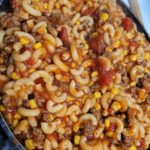
The **Old Fashioned Goulash** is more than just a quick meal; it is a celebration of resourceful and delicious home cooking. By utilizing the one-pot method, this recipe achieves a deep, cohesive flavor where the simple, quality ingredients harmonize perfectly. The technical success hinges on the accurate liquid-to-pasta ratio and careful stirring to prevent sticking. A timeless comfort food, this goulash is reliable, satisfying, and a testament to the enduring appeal of a hearty, flavorful dish that brings families together around the dinner table.
Frequently Asked Questions:
Q: Can I use pre-cooked pasta?
A: **Not recommended.** Using pre-cooked pasta means the sauce will not benefit from the starch release needed for thickening. If you must use pre-cooked pasta, you will need to reduce the liquid dramatically (omit the $\mathbf{2 \frac{1}{2} \text{ cups of water}}$ entirely) and potentially use a thickening agent like flour or cornstarch, drastically altering the final texture.
Q: Why does the recipe call for water instead of broth?
A: Water is used because the flavor is primarily derived from the meat, tomatoes, and seasoning. However, you **can substitute** the water with low-sodium beef or chicken broth for a richer flavor base. The $\mathbf{2 \frac{1}{2} \text{ cups of liquid}}$ is the critical amount needed for the pasta.
Q: How do I store leftovers without them becoming too dry?
A: The pasta will absorb remaining liquid, leading to a thicker dish. When storing, ensure there is still some liquid left. When reheating, always **add a splash of water or broth** to reconstitute the sauce and restore the desired consistency.
Q: I prefer a smoother sauce without tomato chunks. What should I do?
A: Substitute the $\mathbf{1 \text{ (28 oz) can of crushed tomatoes}}$ with another can of **tomato sauce** (or pureed tomatoes) and simply omit the optional diced tomatoes. The sauce will still be thick due to the pasta starch but will have a smoother mouthfeel.