
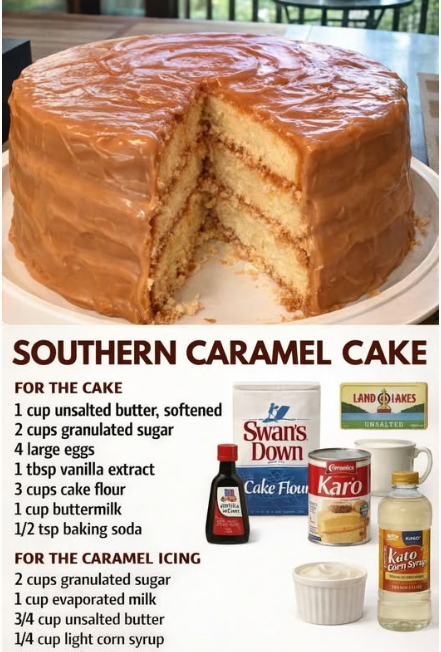
The caramel icing is where most bakers struggle. Understanding the science makes it foolproof.
- 2 Cups Brown Sugar: Unlike white sugar, brown sugar contains Molasses. Molasses adds acidity and moisture, which encourages the sugar to break down into invert sugar, preventing large crystals from forming (graininess).
- ½ Cup Evaporated Milk: This is the “secret sauce.” Evaporated milk has 60% of its water removed. This high concentration of milk solids and proteins (casein) allows for a more intense Maillard Reaction when heated with the butter and sugar, creating that “cooked” caramel flavor.
- 1 Cup Butter: In the icing, butter acts as the Crystallization Inhibitor. The fat molecules surround the sugar crystals, making it harder for them to “clump” back together as the icing cools.
The Technique: Engineering the Perfect Layer
Phase 1: The Creaming and Aeration
Cream the butter and granulated sugar for at least 5 minutes. You are building the “air-cell” foundation. Add the eggs one at a time. If the batter looks curdled, don’t worry—the flour addition will stabilize it.
Phase 2: The Alternating Addition
Start and end with the flour when adding the buttermilk. The “Rule of Three”: Flour-Buttermilk-Flour. This prevents the batter from becoming over-saturated with liquid, which could lead to a “rubbery” bottom layer.
Phase 3: The Stovetop Caramelization
Combine butter, brown sugar, and evaporated milk in a heavy-bottomed saucepan. Bring to a boil, then simmer for 3–5 minutes. The “Soft Ball” Secret: You are looking for a state where the sugar has fully dissolved into the milk fats. If you boil it too long, it will become hard candy; too short, and it will be soup.
Phase 4: The Cooling Emulsion
Remove from heat and stir in the vanilla. Let it cool for 10 minutes before adding the powdered sugar. The “Sifting” Rule: Sift your powdered sugar! Even the smallest lump will be highlighted by the smooth caramel. Beat with a hand mixer until it reaches “spreading consistency.” If it gets too thick, add a teaspoon of milk; if too thin, more sugar.
Phase 5: The “Flash” Frosting
Caramel icing sets FAST. You must frost the cake while the icing is still slightly warm. This allows the icing to “flow” over the edges, creating that professional, smooth Southern finish. Once it sets, it becomes a semi-firm “shell” that protects the moist cake inside.
Chef’s Tips for a “Blue Ribbon” Cake
- Room Temp Everything: Ensure your eggs and buttermilk are not cold. Cold liquids will seize the creamed butter, resulting in a dense, heavy cake.
- The “Salt Lift”: Even though the recipe doesn’t list it, a tiny pinch of salt (1/4 tsp) in the icing will heighten the caramel notes and prevent the sweetness from being “cloying.”
- The Parchment Secret: Line your pans with parchment paper. This cake is high in sugar, and the edges love to stick to the pan.
Holiday Variations
| Variation | The Twist | The Vibe |
|---|---|---|
| Salted Caramel | Sprinkle Flaky Sea Salt between the layers. | Modern, sophisticated, and addictive. |
| Burnt Butter Caramel | Brown the butter for the icing before adding sugar. | Deep, nutty, and incredibly rich. |
| Pecan Praline | Fold 1 cup toasted pecans into the icing. | A crunchy, “New Orleans” style finish. |
Conclusion: A Christmas Eve Legend
The Southern Caramel Cake is more than a dessert; it is an heirloom of culinary chemistry. By mastering the delicate balance of buttermilk acidity and the thermal breakdown of brown sugar, you create a cake that defies the laws of “too sweet.” On this Christmas Eve 2025, as the golden icing catches the light of the holiday candles, you’re serving a slice of tradition that is as structurally sound as it is delicious. Don’t lose this recipe—it is the one they will ask for every year. Enjoy!
Frequently Asked Questions
- My icing is grainy. Can I fix it?
- Yes! If the icing is grainy, it means the sugar didn’t fully dissolve. Put it back on very low heat with a tablespoon of evaporated milk and whisk constantly until the crystals melt. Do not let it boil again.
- Can I use a cake mix for the base?
- You can use a yellow cake mix as a shortcut, but substitute the water for buttermilk and the oil for melted butter to maintain the “Southern” flavor profile.
- How do I store this?
- Because of the sugar content in the icing, this cake keeps remarkably well at room temperature in a cake dome for 3–4 days. The icing acts as a vacuum seal for the moisture.
Would you like me to suggest a “Spiced Apple Compote” to serve alongside this cake, or perhaps show you how to turn this into “Caramel Cake Trifle”?
Related posts:
 Mastering the Strawberry Honeybun Cake with Strawberry Cream Icing
 The Lone Star Classic: Authentic Texas Sheet Cake
 Homemade Chocolate Buttercream: The Physics of the Perfect Peak
 Decadence Defined: Mastering the Ultimate Caramel Turtle Poke Cake
 Strawberry Honeybun Cake: Engineering the Ultimate Hybrid Dessert
 White German Chocolate Cake with a Cheesecake Center
