
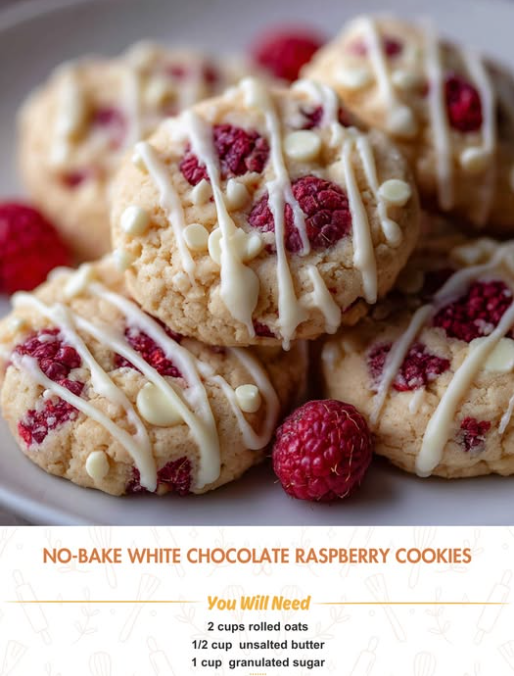
The key to the no-bake cookie is the controlled crystallization of the sugar base:
I. The Syrup Base (The Setting Agent):
- **1/2 cup (120 g)** unsalted butter
- **1 cup (200 g)** granulated sugar
- **1/2 cup** milk (whole milk or heavy cream recommended for richness)
- **Pinch of salt** (to balance the intense sweetness)
II. The Structural Body:
- **2 cups (200 g)** rolled oats (quick or old-fashioned)
- **1 tsp** vanilla extract (or almond extract for depth)
III. Flavor and Finish:
- **1 cup (170 g)** white chocolate chips or chopped white chocolate (for flavor and setting)
- **1/4 cup** raspberry jam (or 1 tsp raspberry extract)
Instructions: The One-Minute Rule for Perfect Set
Phase 1: Boiling the Critical Syrup
- **Prep Ingredients:** Line a cookie sheet with parchment paper or wax paper. Measure all ingredients accurately and have them ready, as the final steps move very quickly.
- **Combine Syrup Ingredients:** In a medium saucepan, combine the **butter, granulated sugar, milk, and salt**. Stir constantly over medium heat until the butter is completely melted and the sugar is mostly dissolved.
- **Boil Vigorously (CRITICAL):** Bring the mixture to a **full, rolling boil**—a boil that continues even when you stir it. Once this rolling boil is achieved, **set a timer for exactly 60 seconds (1 minute)** and continue to boil vigorously without stirring. This precise time ensures the syrup reaches the ideal setting point.
- **Remove from Heat:** Immediately remove the pan from the heat source when the timer expires.
Phase 2: Quick Integration and Setting
- **Add Vanilla and Flavor:** Stir in the **vanilla extract** immediately. If using raspberry extract, add it now.
- **Melt White Chocolate:** Stir in the **white chocolate chips** until they are completely melted and the mixture is smooth and uniform. The residual heat from the syrup should melt the white chocolate quickly.
- **Add Raspberry Component:** If using jam, gently stir in the **raspberry jam** until just combined, allowing the color to lightly swirl through the mixture. **Do not overmix** or the color will blend too much.
- **Add Oats (The Structure):** Quickly stir in the **rolled oats** until they are evenly coated and the entire mixture is uniform and thick. You must work quickly here, as the mixture will begin to crystallize and set as soon as the oats are added.
Phase 3: Dropping and Final Set
- **Drop Quickly:** Working fast, drop rounded tablespoons of the mixture onto the prepared parchment paper. Use a second spoon or a cookie scoop to help push the mixture off the spoon.
- **Setting Time (MANDATORY):** Allow the cookies to set completely at room temperature for **at least 1 hour**, or until they are firm to the touch. For a faster set, transfer the sheet pan to the refrigerator for 30 minutes.
Serving and Storage: The Moisture Barrier
No-bake cookies can be sensitive to humidity; they must be kept in an environment that maintains their low moisture content to remain firm and chewy.
- **Serving:** Serve fully set and at room temperature.
- **Storage:** Store leftovers in an **airtight container at room temperature for up to 1 week**. If the weather is warm or humid, refrigerate them, but be aware that the refrigerator can sometimes dry them out too much.
- **Freezing:** No-bake cookies freeze well. Place set cookies in a single layer in an airtight container, separated by parchment paper. Freeze for up to **3 months**. Thaw at room temperature.
- **Note:** If the cookies become too soft (from humidity), they can sometimes be rescued by being returned to the refrigerator for a quick re-set.
Tips: Essential Rules for a Non-Sticky Cookie
The Temperature Gauge: The primary failure point is the one-minute boil (Step 3). If you are uncertain, use a candy thermometer: the mixture should reach **$114^\circ\text{C}$ ($237^\circ\text{F}$)** before being removed from the heat. This guarantees the correct soft-ball stage concentration.
Speed is Vital: Once the oats are added (Step 8), the mixture starts setting immediately. Have all bowls, spoons, and parchment paper ready. If the mixture sets in the pan, reheat it gently on the stovetop for 30 seconds to soften it enough to scoop.
Avoid the Scrape: When scooping the cookies, avoid scraping the sides and bottom of the pan excessively. The sugar that cooks closest to the metal crystallizes first and can cause the rest of the batch to crystallize unevenly, resulting in a grainy texture.
Jam Moisture Control: If using raspberry jam, ensure it is a **thick, high-pectin jam** and use a minimal amount (1/4 cup). Excess liquid from a runny jam or purée will prevent the cookies from setting properly, resulting in sticky, unstable cookies.
Variations: Customizing Flavors and Textures
The no-bake structure is adaptable to many rapid-setting flavor combinations:
- **Almond Joy:** Substitute the raspberry flavor with **coconut flakes and chopped almonds**. Use milk chocolate instead of white chocolate.
- **Peanut Butter Swap:** Substitute the white chocolate entirely with **1 cup of creamy peanut butter**. This must be stirred in immediately after removing the syrup from the heat.
- **Brown Sugar Depth:** Replace half of the granulated sugar with **light brown sugar** for a slightly richer, deeper caramel-like flavor and a marginally chewier texture.
- **Cereal Crunch:** Replace half of the rolled oats with an equal quantity of **crispy rice cereal** for an airier, lighter texture. Add the cereal at the same time as the oats.
- **Dried Fruit Inclusion:** Fold in **1/2 cup of finely chopped dried cranberries or cherries** with the oats for an extra burst of tartness and chewiness.
The Consistency Test: To confirm the mixture is setting correctly, drop a tiny spoonful onto the parchment paper before adding the oats. If it sets within a minute, the syrup is perfect. If it stays liquid, boil for another 15 seconds and test again.
Flour Integration: While not traditionally included, stirring in 1 tablespoon of **all-purpose flour** with the oats can act as a binding agent and a safety net, helping to absorb any residual moisture and ensure a firmer set.
Preventing Overflow: Use a **large saucepan** (4-quart minimum) for the syrup, as the mixture will bubble up considerably during the rolling boil (Step 3). Overflowing boiling sugar is dangerous and messy.
Scooping Consistency: Use a uniform-sized **cookie scoop** (Step 9) for dropping the mixture. This ensures every cookie is the same size, sets at the same rate, and provides a beautiful, professional presentation.
Conclusion: A Reliable Confectionery Shortcut
The No-Bake White Chocolate Raspberry Cookie is a perfect demonstration of applied sugar chemistry. Success is non-negotiable on the **60-second rolling boil**, which concentrates the syrup precisely for setting. By adhering to this critical timing and rapidly integrating the absorbent oats and sensitive flavorings, you achieve a delightful, chewy, and stable cookie. This recipe is an ideal shortcut for satisfying a craving without turning on the oven, proving that maximum flavor and perfect texture can be achieved with minimal effort.
Frequently Asked Questions (FAQ)
Q: My cookies are sticky and won’t set. What did I do wrong?
A: The mixture was not boiled long enough (less than 60 seconds of rolling boil). The syrup did not reach the correct concentration, retaining too much water. The only fix is to start a new batch and strictly adhere to the one-minute timing.
Q: My cookies are crumbly and dry. What happened?
A: The mixture was boiled too long (more than 60 seconds). The syrup over-concentrated, resulting in a hard, crystalline structure that becomes dry and crumbly upon cooling. It’s overcooked.
Q: Can I use instant oats?
A: Yes, but instant oats are very finely processed and will absorb the liquid much faster, potentially leading to a stiffer, drier cookie. Reduce the boiling time slightly (45–50 seconds) and drop the cookies immediately to compensate for the rapid absorption.
Q: Why do I add the white chocolate off the heat?
A: White chocolate is highly sensitive to heat and will scorch, seize, or become grainy if exposed to direct high heat or the residual boiling temperature for too long. Adding it off-heat allows the residual warmth of the syrup to melt it gently and smoothly.
Related posts:
 Mastering Raspberry Shortbread Thumbprint Cookies
 The Ultimate Guide to Raspberry Almond Shortbread Thumbprint Cookies
 The Quick Confection: Mastering No-Bake Salted Caramel Cookies
 The Ultimate Guide to Ultra-Soft Raspberry Christmas Snow Clouds
 Mastering No-Bake Cottage Cheese Peanut Butter Bites
 Raspberry Sugar Cookies: The Science of the “Short” Crumb
