Step 1: Dry Phase Homogenization
Preheat the oven to 350°F (175°C). Combine pecans, sugar, flour, and salt. Regulation: Ensure the pecans are evenly coated in the flour-sugar mix. This prevents the nuts from sinking to the bottom of the muffin cups due to gravitational sedimentation during the early stages of baking.
Step 2: Wet Phase Emulsification
In a secondary vessel, slightly beat the eggs before adding melted butter and vanilla. Thermal Note: Ensure the butter has cooled slightly ($<120^\circ\text{F}$) before adding to the eggs to prevent premature protein denaturation (scrambling the eggs).
Step 3: Synthesis and Agitation
Combine wet and dry ingredients. The batter will be thick. Do not over-agitate; you only want to reach interfacial contact between the dry and wet phases. Excess stirring will develop the small amount of gluten present, leading to a tough, “bready” muffin.
Step 4: Thermal Processing
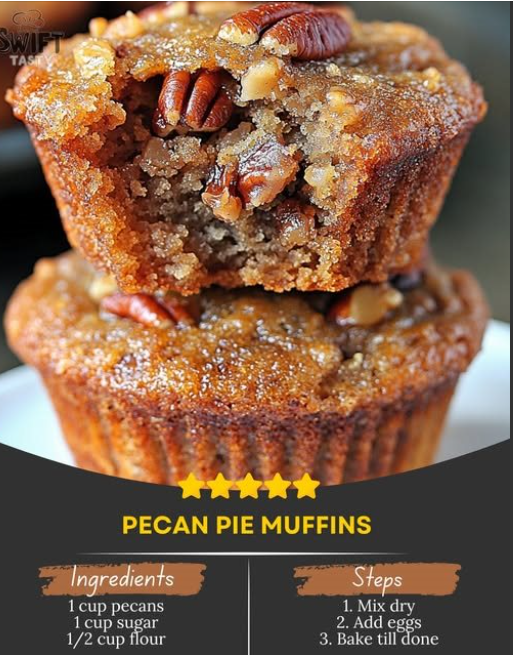
Fill greased muffin cups 2/3 full. Bake for 18–22 minutes. During this time, the surface moisture evaporates, causing the sugar to concentrate and form a crustaceous layer on the top, while the interior remains a soft custard-like matrix.
Serving and Storage: The Stabilization Curve
Service: Let cool in the pan for exactly 5 minutes. This is a critical cooling phase where the sugar begins to set. If removed too early, the muffin lacks the tensile strength to stay together. If removed too late, the cooling sugar acts as an adhesive, making the muffin difficult to extract.
Storage: Store in an airtight container at room temperature. The high sugar content acts as a natural preservative, maintaining moisture levels for up to 3 days. Reheat for 10 seconds in a microwave to restore the lipid fluidity of the butter for a “fresh-from-the-oven” mouthfeel.
Tips: Pro-Level Patisserie Nuances
- The “Toasting” Hack: Toast your pecans for 5 minutes at 350°F before adding them to the batter. This releases volatile aromatic oils and increases the depth of the “pie” flavor.
- Non-Stick Security: These muffins are high in sugar, which makes them prone to sticking. Use high-quality paper liners or a generous coating of butter/flour on the tin to ensure clean release.
- Salt Balance: Don’t skip the 1/4 tsp salt. It is essential for balancing the high sucrose levels and highlighting the earthy notes of the pecans.
Variations: Iterative Design Adjustments
| Variation | The Adjustment | The Result |
|---|---|---|
| Bourbon Pecan | Add 1 tbsp Bourbon to the wet mix. | Introduces oak and vanilla ethanol-solubles. |
| Chocolate Chip | Add 1/4 cup mini chocolate chips. | Increases lipid density and bitterness contrast. |
| Maple Infusion | Swap 2 tbsp sugar for Maple Syrup. | Enhances aromatic sweetness (adjust flour +1 tbsp). |
Tips: Optimizing the Crackly Top
Conclusion: A Triumph of Sugar Engineering
The Pecan Pie Muffin is a masterpiece of Moisture Management. By prioritizing sugar and pecans over starch, you have created a dessert that defies the standard definition of a muffin and instead delivers the essence of a Southern classic in a single bite. On this December 27, 2025, enjoy the perfectly executed results of your culinary engineering. Happy baking!
Frequently Asked Questions
- Can I use walnuts instead of pecans?
- Yes, but walnuts have a higher tannin content, which may introduce a slight bitterness. Pecans are traditionally used for their high lipid-to-protein ratio which matches the sweetness of the sugar.
- Why are my muffins “flat”?
- This is likely due to Incomplete Egg Aeration. While we don’t want a cakey muffin, beating the eggs “slightly” as instructed provides just enough air to keep the muffins from being overly gummy.
- Is the brown sugar replaceable with white sugar?
- Not recommended. White sugar lacks the acidic molasses required to interact with the protein and maintain the moist, chewy “pie” texture.
Would you like me to suggest a “Salted Caramel Drizzle” to top these with, or perhaps show you the best “Bourbon-Glazed” variation?