
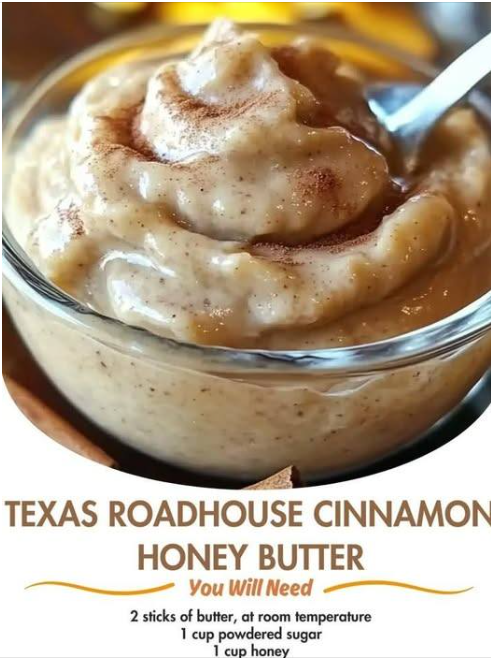
Texas Roadhouse Cinnamon Honey Butter: A Study in Stable Aeration
Introduction: The Physics of the “Whipped” Emulsion
In the hierarchy of artisanal spreads, Texas Roadhouse Cinnamon Honey Butter represents a triumph of Mechanical Aeration and Lipid Stabilization. On this Thursday, December 25, 2025—Christmas Day—this recipe serves as a festive masterclass in creating a Gas-in-Solid Foam. The technical success of this spread relies on the ability of the butter’s fat globules to trap air while maintaining a Colloidal Suspension of honey and sugar. Achieving the signature “cloud-like” texture requires precise temperature control and specific mechanical shear to ensure the sugar crystals fully dissolve into the butter’s moisture phase.
This guide explores the Plasticity of Milk Fats, the Hygroscopic Properties of honey, and the Aromatic Volatilization of cinnamon. We will examine why room-temperature butter is the critical mathematical constant for creating a stable, airy matrix.
Ingredients: The Molecular Building Blocks
- 2 Sticks of Butter (Room Temp): The Structural Scaffold. At approximately 20°C (68°F), butter reaches its Plastic Range, where it is soft enough to be manipulated but cold enough to hold air bubbles without collapsing.
- 1 Cup Powdered Sugar: The Bulk Stabilizer. Powdered sugar contains cornstarch, which acts as an Anti-Caking Agent and helps absorb excess moisture from the honey, preventing the butter from “weeping.”
- 1 Cup Honey: The Viscous Humectant. Honey provides a complex sugar profile (fructose and glucose) that binds with the butter’s water content, creating a smooth, glossy mouthfeel.
- 2 tsp Ground Cinnamon: The Hydrophobic Aromatic. Cinnamon contains Cinnamaldehyde, an essential oil that is fat-soluble, meaning it blooms and intensifies when suspended in the butter’s lipid matrix.
