Step 1: The Crust Compression
Combine crumbs, sugars, and butter. Press into a 9-inch plate and freeze. The “Mechanical Lock” Principle: Freezing the crust before adding the filling ensures that the butter fully solidifies, preventing the liquid from the filling from migrating into the crumbs and causing structural softening.
Step 2: The Aeration Phase
Beat heavy cream until stiff peaks form. The “Over-Shear” Risk: If beaten too long, the fat globules will collide and merge into butter. You are looking for a stable oil-in-water-plus-air emulsion. Keep this chilled to maintain the rigidity of the fat globules.
Step 3: The Lipid Integration
Beat the cream cheese until smooth, then incorporate sugar, peanut butter, and vanilla. The “Homogenization” Rule: The cream cheese must be softened to ensure it integrates seamlessly with the peanut butter. Lumps in this stage create localized density variances that are unpleasant in a frozen state.
Step 4: The Folding Technique
Gently fold the whipped cream and chips into the peanut butter mixture. Regulation: Do not stir aggressively. You must preserve the air-filled pockets within the cream. Aggressive mixing leads to degassing, resulting in a dense, hard-as-ice-block pie rather than a light, mousse-like texture.
Step 5: Cryogenic Setting
Pour into the crust and freeze until firm. This thermal reduction causes the fats to crystallize and lock the air bubbles in place permanently.
Serving and Storage: The Thawing Curve
Service: Thaw for 20 minutes for an ice cream-like consistency ($25^\circ\text{F}$ to $30^\circ\text{F}$) or 40 minutes for a mousse-like consistency ($35^\circ\text{F}$ to $40^\circ\text{F}$). The pie’s mouthfeel changes drastically as the fats transition from solid crystals to a semi-fluid state.
Storage: Always store in the freezer. Because of the high fat and sugar content, it will not freeze into a solid rock, but it will suffer from surface dehydration (freezer burn) if not tightly wrapped in a moisture-barrier film.
Tips: Pro-Level Cryo-Dessert Nuances
- The “Mini” Chip Factor: Using mini chocolate chips is a deliberate surface area optimization. Large chips become too hard when frozen, potentially causing discomfort during mastication. Minis provide flavor without the jarring hardness.
- Salt Balance: If your peanut butter is unsalted, add 1/4 tsp of fine sea salt. Salt acts as an ionic enhancer, making the chocolate and peanut butter flavors more pronounced at low temperatures.
- Whipping Efficiency: Chill your bowl and whisk before whipping the cream. Cold temperatures keep the fat globules in a solid state, allowing them to form the structural “mesh” that holds the air more effectively.
Variations: Iterative Design Adjustments
| Variation | The Adjustment | The Result |
|---|---|---|
| Smoky Peanut | Add 1/2 tsp Smoked Paprika to the crust. | Enhanced Phenolic Complexity. |
| Mocha Twist | Add 1 tsp Espresso Powder to the filling. | Introduces Bitter Alkaloids to balance the sugar. |
| Nutty Crunch | Swap 1/2 cup graham crumbs for crushed peanuts. | Increased Protein Density in the base. |
Tips: Optimizing the Aeration
Conclusion: A Triumph of Emulsion Engineering
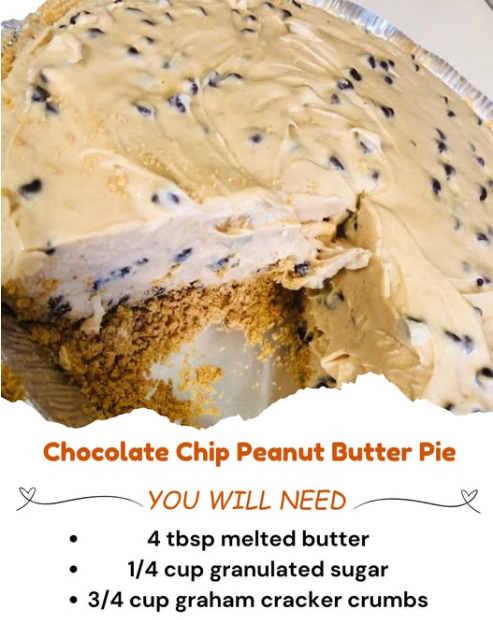
The Chocolate Chip Peanut Butter Pie is a masterclass in Material Phase Management. By balancing the density of peanut butter with the lightness of an aerated dairy foam, you create a dessert that remains stable and delicious even at sub-zero temperatures. On this December 27, 2025, enjoy the perfectly executed results of your culinary engineering. Happy freezing!
Frequently Asked Questions
- Why is my pie “grainy”?
- This is likely Sugar Recrystallization or undissolved sugar in the cream cheese. Ensure the cream cheese and sugar are beaten until the granules have fully dissolved into the fat phase.
- Can I use “natural” peanut butter?
- Caution is advised. Natural peanut butters suffer from oil separation. If used, ensure it is thoroughly homogenized before measuring, or the excess oil will destabilize the whipped cream foam.
- Is there a way to make it set faster?
- You can use a Flash Freeze method in the coldest part of your freezer (usually the back), but avoid placing it near a fan, which can cause surface dehydration and ruin the aesthetic finish.
Would you like me to suggest a “Dark Chocolate Ganache Drizzle” to finish this pie, or perhaps show you how to turn this into “Peanut Butter Pie Pops” for easier distribution?