- Role: These dairy products provide the lipid and protein matrix that creates the candy’s characteristic creamy texture and helps stabilize the sugar crystals.
- Scientific Impact:
- Heavy Cream: With a high fat content (typically 36% or more), heavy cream contributes significantly to the smooth, velvety mouthfeel. The milk proteins (casein and whey) also act as natural emulsifiers, helping to integrate the fats and water phases of the syrup, preventing separation and contributing to a fine crystalline structure.
- Unsalted Butter: Composed primarily of milk fat, butter is a powerful plasticizer. It interferes with the formation of large sugar crystals, promoting smaller, more numerous crystals that result in a smooth, non-grainy texture. The water content in butter also contributes to the overall moisture balance.
The Textural Modifiers: Baking Soda (¼ teaspoon) & Vanilla Extract (1 teaspoon)
- Role: These seemingly small additions have significant impacts on the candy’s final appearance, flavor, and texture.
- Scientific Impact:
- Baking Soda: As a pH regulator, baking soda reacts with the acidic byproducts of the caramelized sugar. This reaction produces carbon dioxide gas, which, while minimal, contributes to a slightly lighter texture and color by buffering the acidity. It also helps to prevent the caramel from becoming overly bitter.
- Vanilla Extract: Composed primarily of vanillin, vanilla extract is a potent aromatic compound. Added at the end, its volatile molecules are preserved, enhancing the overall flavor profile by providing a warm, sweet, and complex aroma that complements the caramel and nuts.
The Structural Inclusions: Chopped Walnuts or Pecans (1 ½ cups)
- Role: These nuts provide a crucial textural contrast and contribute their own distinct flavor profiles.
- Scientific Impact:
- Mechanical Strength: The hard, crunchy pieces of nuts provide a different mechanical resistance than the soft candy matrix, creating a satisfying textural experience.
- Lipid Contribution: Nuts are rich in healthy fats (lipids), which further enrich the candy, contribute to satiety, and enhance the diffusion of fat-soluble flavor compounds.
- Aromatic Compounds: Walnuts and pecans contain distinct aromatic compounds that complement the caramel and vanilla, adding depth and complexity.
Instructions: Engineering the Confectionary Process
Each step in this recipe is a controlled scientific process designed to achieve specific molecular and textural outcomes. Precision is paramount.
1. Prepare the Baking Dish: The Non-Adhesive Boundary
Grease a 9×13-inch baking dish and set it aside.
- Scientific Principle: This creates a hydrophobic layer that prevents the highly hygroscopic (water-attracting) sugar syrup from adhering irreversibly to the pan. Without greasing, the candy would form strong adhesive bonds with the metal, making removal impossible without damage.
2. Melt Sugar: The Pyrolysis Phase
In a small, heavy-bottomed saucepan, add 2 cups of sugar. Cook over low heat, stirring often, until the sugar is completely melted and golden, about 20 minutes.
- Scientific Principle: This is a controlled caramelization. Heating sugar slowly allows for uniform melting and gradual thermal decomposition. Low heat prevents scorching, which would result in bitter-tasting pyrazines and acrolein. Stirring ensures even heat distribution and prevents localized burning, creating a stable caramel with desirable color and flavor.
3. Heat Remaining Ingredients: The Cream Base Stabilization
In a large saucepan or Dutch oven, combine the remaining 4 cups of sugar and heavy cream. Simmer over low heat while the sugar in the small saucepan melts.
- Scientific Principle: Gently heating the cream and sugar together initiates the dissolution of the sugar crystals into the aqueous phase of the cream. Simmering helps to warm the mixture, preventing a sudden thermal shock when the hot caramel is added, which could cause the caramel to seize or crystallize too rapidly. The lipids and proteins in the cream also begin to homogenize, preparing for the incorporation of the caramel.
4. Combine Mixtures: The Homogenization Event
Once the sugar in the small saucepan has melted, carefully pour it into the large saucepan with the cream and sugar mixture. Stir continuously to combine.
- Scientific Principle: This step requires careful handling due to the significant temperature differential. The hot caramel rapidly mixes with the warm cream-sugar solution. Continuous stirring is essential to ensure a homogeneous mixture, preventing the denser caramel from sinking and solidifying at the bottom of the pan, or forming localized super-saturation points that could lead to premature crystallization.
5. Cook to Softball Stage: The Critical Thermal Threshold
Increase the heat to medium and cook the mixture until it reaches 244°F (softball stage) on a candy thermometer.
- Scientific Principle: This is the most critical step for texture. The ‘softball stage’ corresponds to a specific sugar concentration—typically 85-88% sucrose. At 244°F (118°C), enough water has evaporated to allow the sugar syrup to form a soft, pliable ball when dropped into cold water, yet it remains moldable. Cooking beyond this temperature leads to harder, more brittle candy (firm ball, hard ball stages), while insufficient cooking results in a runny, unset product. A candy thermometer is indispensable for precise temperature control, as even a few degrees can drastically alter the final texture.
6. Add Baking Soda: The Aeration and Neutralization
Remove the saucepan from heat and stir in the baking soda until fully incorporated.
- Scientific Principle: Removing from heat prevents further cooking past the critical softball stage. Baking soda, a base, reacts with residual acids present in the caramelized sugar (from the Maillard reaction) to produce carbon dioxide gas. This micro-aeration lightens the candy’s color and texture, giving it a slight crumbly quality. It also buffers the pH, which can influence both flavor and crystallization.
7. Add Butter and Vanilla: The Plasticizing and Aromatic Infusion
Stir in the butter and vanilla extract until the butter is completely melted and the mixture is smooth.
- Scientific Principle: Adding butter off the heat allows it to melt and disperse without separating. The milk fats in the butter act as plasticizers, interfering with the formation of large sugar crystals and contributing to a smooth, non-grainy texture. Vanilla, a volatile aromatic, is added at this stage to prevent its delicate flavor compounds from evaporating at high temperatures, ensuring its full impact on the final taste profile.
8. Rest the Mixture: The Controlled Super-saturation
Let the mixture rest for about 20 minutes.
- Scientific Principle: This crucial resting period allows the super-saturated sugar solution to cool slightly without disturbance. During this time, the sugar molecules begin to organize themselves into small, uniform crystal nuclei. Disturbing the mixture too soon (while too hot) would induce rapid, uncontrolled crystallization, leading to large, gritty sugar crystals. Allowing it to cool to a specific temperature range (around 150-160°F or 65-70°C) before stirring is vital for developing a fine-grained, smooth texture.
9. Add Nuts: The Textural and Crystalline Intervention
After resting, stir in the chopped walnuts or pecans until the mixture loses its sheen.
- Scientific Principle: Stirring at this cooler temperature promotes the formation of numerous small sugar crystals, which are characteristic of fudge and penuche. The ‘losing its sheen’ indicates that the sugar has begun to crystallize finely throughout the mixture, trapping air and light, and transforming the transparent syrup into an opaque, solid-looking mass. The nuts provide nucleation sites for crystal growth, further contributing to the fine grain.
10. Transfer to Baking Dish: The Final Molding
Pour the mixture into the prepared baking dish and spread evenly.
- Scientific Principle: Rapid transfer is necessary as the candy continues to set as it cools. Even spreading ensures uniform cooling and a consistent texture throughout the finished product. The greased dish prevents adhesion during the final stages of solidification.
11. Cool and Serve: The Solidification and Serving Phase
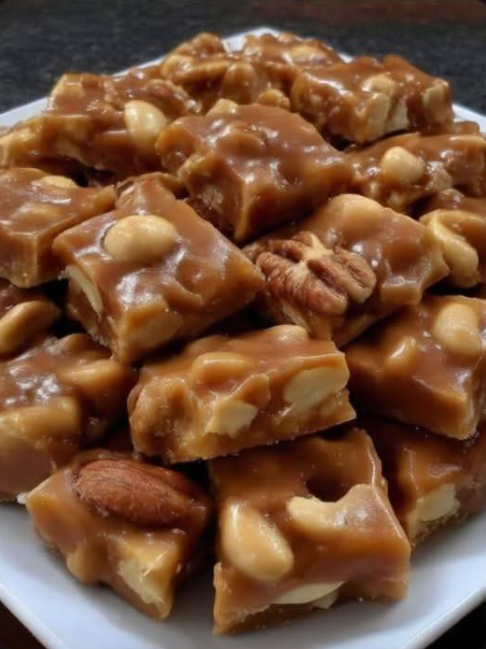
Allow the candy to cool for 1–2 hours or overnight. Once set, cut into small squares and serve.
- Scientific Principle: Cooling allows the sugar crystals to fully develop and the lipid matrix to solidify. This complete phase transition from a liquid to a stable solid is essential for achieving the firm yet tender texture that allows the candy to be cut cleanly into squares without crumbling or sticking excessively.
Service and Storage Tips: Preserving Optimal Condition
Proper handling after preparation is essential for maintaining the Oklahoma Nut Candy’s desired texture and flavor.
- Serving Precision: For the cleanest cuts, ensure the candy has fully set. A sharp, non-serrated knife can be warmed slightly under hot water and dried before slicing, which helps to melt a micro-layer of the candy as it cuts, reducing drag and yielding smoother edges.
- Airtight Storage: Store the candy in an airtight container at room temperature. The primary enemy of this confection is moisture. Sugar is highly hygroscopic; if exposed to air, it will absorb atmospheric moisture, leading to a sticky, weeping surface (a phenomenon known as ‘sugar sweat’ or ‘syneresis’). Lining the container with parchment or wax paper between layers can further protect it.
- Extended Shelf Life: If stored correctly, Oklahoma Nut Candy can last for up to 2-3 weeks at room temperature. Refrigeration is generally not recommended as the fluctuating temperatures and higher humidity can accelerate sugar crystallization and lead to a firmer, less desirable texture.
Variants: Iterative Flavor Design and Textural Adjustments
The core principles of Oklahoma Nut Candy can be adapted to create a range of delightful variations:
| Variant Name | Ingredient Adjustment | Scientific Rationale & Resultant Texture/Flavor |
|---|---|---|
| Maple Pecan Delight | Substitute 1/4 cup of sugar with pure maple syrup (boiled with the cream/sugar). Use pecans. | Maple syrup introduces additional complex sugars (fructose, glucose) and distinct aromatic compounds (maltol, furaneol). This will create a slightly softer set due to maple syrup’s higher invert sugar content and infuse a deep, earthy maple flavor. |
| Chocolate Swirl | After removing from heat (before adding butter/vanilla), quickly stir in 1/2 cup semi-sweet chocolate chips until just melted. Swirl lightly. | Chocolate chips, primarily cocoa solids and cocoa butter, introduce a new lipid phase and bitter-sweet notes. The rapid stirring creates a marbled effect, with pockets of firm chocolate contrasting the creamy candy matrix. The cocoa butter contributes to a firm set. |
| Spiced Walnut | Add 1/2 teaspoon ground cinnamon and 1/4 teaspoon ground nutmeg with the cream and sugar. Use walnuts. | Cinnamon and nutmeg are volatile aromatics (containing cinnamaldehyde and eugenol/sabinene, respectively). These compounds infuse the candy with warm, spicy notes that complement the caramel and walnuts, enhancing the overall sensory experience without affecting the physical set. |
| Brown Butter & Bourbon | Brown the butter before adding to the cream/sugar mixture. Add 1 tablespoon bourbon with the vanilla. | Browning butter develops nutty, complex flavors (Maillard reaction products). Bourbon adds additional volatile aromatics and a subtle alcoholic warmth. The alcohol will mostly evaporate during cooking, leaving behind its flavor essence. |
Tips: Pro-Level Confectionery Nuances
Achieving perfection in candy making often comes down to attention to detail and understanding subtle cues:
- Heavy-Bottomed Cookware: Always use heavy-bottomed saucepans. These provide superior thermal mass and distribute heat more evenly, preventing scorching of the sugar and ensuring a controlled boil. Thin-bottomed pans are prone to hot spots that can ruin the candy.
- Candy Thermometer Calibration: Calibrate your candy thermometer regularly. Place it in rapidly boiling water; it should read 212°F (100°C) at sea level. If not, adjust your target temperature accordingly. A few degrees off can mean the difference between perfect softball and brittle hard-crack candy.
- The “Washing Down” Technique: During the initial boiling of the cream and sugar, sugar crystals can form on the sides of the pan. These stray crystals can act as “seed crystals” that initiate premature, large-grain crystallization in the bulk of the candy, leading to graininess. To prevent this, dip a pastry brush in warm water and gently wash down the sides of the pan during the boil.
- Humidity Awareness: Candy making is sensitive to humidity. On very humid days, sugar has an increased tendency to absorb moisture and can struggle to reach the desired softball stage, or result in a stickier candy. If possible, avoid making candy on excessively humid days.
- Don’t Scrape the Pan: When transferring the finished candy mixture, avoid scraping the last bits from the bottom of the saucepan. These often contain larger, less desirable sugar crystals that can compromise the smooth texture of the rest of the batch.
- Nut Preparation: For a deeper, more pronounced nutty flavor, lightly toast your chopped walnuts or pecans in a dry skillet over medium-low heat for 5-7 minutes, or until fragrant, before adding them to the candy. This enhances their natural volatile oils.
Conclusion: A Triumph of Applied Thermodynamics and Flavor Chemistry
Oklahoma Nut Candy is a culinary testament to the power of precision and understanding the scientific principles that govern food. From the controlled pyrolysis of sugar for caramel to the delicate management of crystallization and the stabilizing effect of dairy lipids, every step is a deliberate act of applied thermodynamics and flavor chemistry. This recipe, far from being just a list of instructions, is a guided tour through the molecular transformations that create a truly exceptional confection.
By mastering the softball stage, embracing the textural contributions of butter and heavy cream, and appreciating the aromatic nuances of vanilla and toasted nuts, you produce a candy that is rich, tender, and irresistibly satisfying. On this December 26, 2025, as you share these perfectly crafted squares, you are not just offering a sweet treat, but a piece of culinary heritage, engineered to delight the senses and honor the intricate dance of ingredients under heat. Enjoy the perfectly executed results of confectionery science – a true triumph of flavor and texture.
Frequently Asked Questions
- Why is my candy grainy and not smooth?
- This is a common issue known as Premature Crystallization or Uncontrolled Nucleation. It usually occurs if the mixture was stirred too vigorously or too early (when still very hot) after reaching the softball stage, or if sugar crystals on the sides of the pan fell back into the solution. The resting period (Step 8) is crucial for forming fine, even crystals.
- Can I use light cream instead of heavy cream?
- It is highly unrecommended. Light cream has a significantly lower Lipid Concentration (typically 18-30% fat) compared to heavy cream (36% or more). The higher fat content of heavy cream is essential for achieving the rich, creamy texture and helps to interfere with large sugar crystal formation, contributing to the smooth structural set of the candy.
- Is the baking soda really necessary, and what does it do?
- Yes, it’s quite important for this specific type of candy. Baking soda acts as a pH Buffer and Leavening Agent. It neutralizes some of the acids formed during sugar caramelization, which helps to prevent the candy from becoming too dark or tasting overly bitter. Additionally, the small amount of carbon dioxide gas released creates tiny air pockets, contributing to a slightly lighter, more tender, and less dense texture.
- My candy stuck to the pan, even though I greased it. Why?
- This often indicates that the candy was either not cooked to the precise Softball Stage (remaining too soft and sticky) or, more likely, the greasing agent was insufficient or unevenly applied. Ensure a thorough, even coating of butter or cooking spray. Alternatively, lining the pan with parchment paper after greasing provides an extra non-stick layer, making removal much easier.
- Can I make a larger batch?
- While it’s possible, scaling up candy recipes requires careful consideration. Larger volumes take longer to reach the target temperature, and they retain heat longer, increasing the risk of overcooking past the softball stage. If you do scale up, ensure your saucepan is significantly larger to prevent boil-overs, and be extra vigilant with your candy thermometer.