
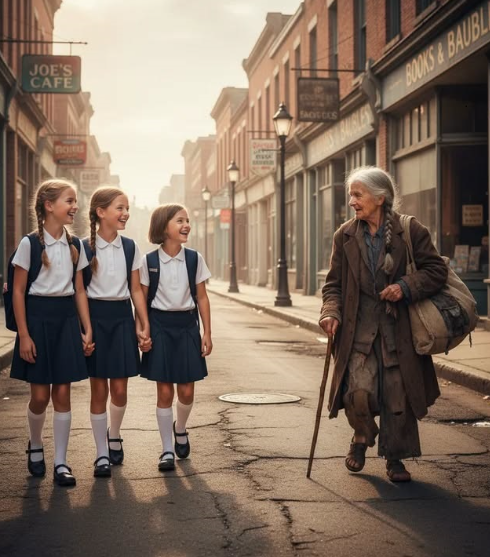
That night, Clara stood in the doorway of her parents’ room. “Why didn’t you tell me I was adopted?”
The air dropped to zero degrees. Mark and Elaine exchanged a look of pure, agonizing guilt.
“We were going to, sweetheart,” Elaine choked out. “The agency said your biological mother… she was unstable. She abandoned you at a downtown shelter when you were two. We kept it quiet to protect you.”
“She said I have my father’s eyes,” Clara challenged. “She knew about the birthmark. Why did she call me the Star?”
Mark sighed, defeated. “We named you Clara. The name on your adoption papers was… Star. We changed it.”
Clara felt the familiar story cracking under the weight of specific, verifiable details. That night, she couldn’t sleep. She retrieved her old baby box from the attic—the one labeled Mark & Elaine’s Memories. Inside, buried under first photos and baby shoes, she found a small, faded yellow silk blanket.
The next afternoon, Clara went back to the park. Lydia was waiting.
“You’re not crazy,” Clara said, her voice shaking. “But you need to tell me the truth. All of it.”
Lydia’s composure returned. She pulled the white teddy bear closer. “They said I was unfit. They said I was violent. But I was trapped, Clara. After your father died, I had no family. I had to leave you somewhere safe.”
She reached inside the teddy bear, ripping a seam with practiced ease. Inside the bear’s worn cotton stuffing, she retrieved a plastic-sealed key and a faded, official-looking document.
“This is the police report,” Lydia whispered, tears streaming down her face. “Your father didn’t die in an accident. He was murdered. He was a journalist, Clara. He was investigating corruption in the city’s housing project, and they wanted his files.”
Clara gasped. “What does that have to do with me?”
“I was running with you, trying to keep you safe. They found us. I was beaten badly and hospitalized. When I woke up months later, the system had declared me insane, unfit, and your adoption was finalized,” Lydia revealed, handing over the sealed document. “They didn’t just take you; they fabricated my history to silence me.”
Lydia pointed to the key. “This key opens the lockbox at the old train station. It holds your father’s files. The ones they thought they destroyed.”
Clara stared at the documents—the official police letterhead, the falsified hospitalization notes, the key. It was proof not just of a tragic adoption, but of a calculated, criminal conspiracy.
The Real Danger
Clara realized the truth: her parents hadn’t adopted her because they were afraid of her birth mother’s illness. They adopted her because they were protecting her from a murder investigation.
She went home and confronted Mark, showing him the key and the report.
Mark went pale, his composure finally shattering. “Lydia didn’t abandon you, Clara. She brought you to our shelter—the one we managed. She told us everything about the danger. She begged us to disappear with you.”
Elaine rushed in, distraught. “We couldn’t turn her in, Clara. She was our friend. But we knew if the system found you, they’d use you to lure her out, or worse, put you in foster care where the people who killed your father would find you.”
Mark continued, voice heavy with years of fear: “We chose the closed adoption route. We changed your identity. We lied to you—and to the authorities—to give you a stable life. We knew the risk was too great to let you go.”
The “danger” they warned her about wasn’t Lydia’s instability; it was the people who thought Lydia and her daughter were dead.
Clara stood in silence, the truth far more overwhelming than any lie. Her heart, once torn by betrayal, was now flooded with the realization of the immense sacrifice both women had made. Lydia—her biological mother—had given up her child’s freedom to ensure her survival. Mark and Elaine—her adoptive parents—had risked prison and ruin to guarantee her safety.
Clara hugged Mark and Elaine fiercely. “You didn’t just adopt me,” she whispered. “You saved my life.”
The next day, Clara returned to the park with the key. But Lydia wasn’t there. Only the old bench remained.
Clara waited, and then she understood. Lydia hadn’t stayed for reconciliation. She had waited only long enough to pass on the one thing that mattered: her husband’s lost truth. She had completed her mission.
Clara didn’t call the police immediately. She went home, held the key, and looked at her adoptive parents—her protectors. She knew the secret was now hers.
A week later, a news headline caught her eye: Journalist’s 17-Year-Old Murder Case Reopened.
Clara smiled faintly. She hadn’t gone to the authorities. She had simply mailed the key and the police report, along with an anonymous note mentioning “the Star files,” to the city’s biggest investigative newspaper.
Lydia was gone, but her truth would finally find justice. And Clara, the girl with two mothers and a secret past, had finally found her true legacy: fighting for the truth, just like her father. The star on her back no longer felt like a secret—it felt like a mission.
Related posts:
 My Sister Laughed at My Call Sign Until ‘Reaper Zero’ Brought the SEAL Admiral to Tears
 The Billionaire’s Reply That Moved Everyone to Tears
 My Dad Sold My Grandpa’s Military Heirloom to Fund My Brother’s Wedding
 The Billionaire’s Baby Wouldn’t Stop Crying on the Plane — Until a Teen from Coach Did the Unimaginable
 You just worked a 16 hour shift And you come home to this … what you doing
 Mastering Pioneer Woman’s Fruitcake Cookies
