
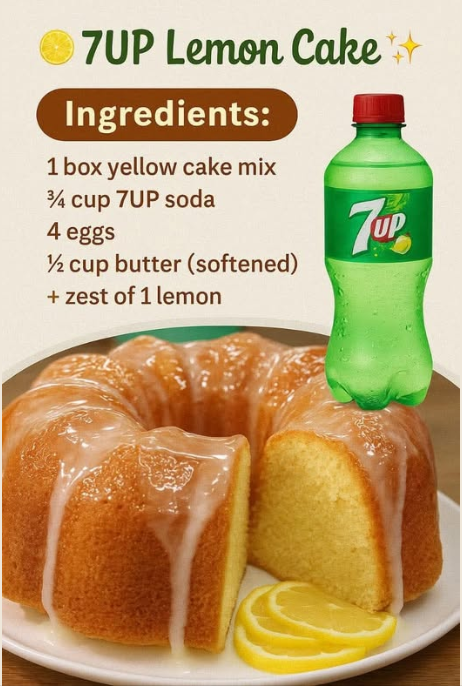
The Carbonation Secret: Mastering 7UP Lemon Cake
Introduction: The Chemistry of Carbonated Leavening
The **7UP Lemon Cake** is a culinary masterpiece of modification, transforming a standard **1 box yellow cake mix** into a moist, vibrant dessert. The brilliance lies in the replacement of standard liquid (water or milk) with **¾ cup 7UP soda**, a lemon-lime flavored, carbonated soft drink.
This technique is governed by three specific regulations: **Acidic Activation, Carbonation Aeration, and Fat-Zest Emulsification.**
The first regulation, **Acidic Activation**, is key. 7UP, like most sodas, contains citric acid. When combined with the leavening agents (baking powder/soda) already present in the cake mix, this acid triggers a vigorous chemical reaction. The immediate release of carbon dioxide gas ensures rapid expansion and a finer internal crumb structure than relying solely on the leavening system of the mix itself.
The second regulation, **Carbonation Aeration**, is the unique contribution of the soda. Beyond the chemical reaction, the actual bubbles of **carbon dioxide** in the **¾ cup 7UP** are incorporated into the batter. This mechanical aeration provides extra lift and helps separate the flour and fat molecules during the initial mixing, reducing the opportunity for gluten development. The result is a cake that is exceptionally **tender and light**, often referred to as having a “velvet” crumb.
The third regulation, **Fat-Zest Emulsification**, addresses flavor and moisture. The combination of **½ cup butter (softened)** and **4 eggs** already provides richness, but the addition of the **zest of 1 lemon** is crucial. Zest contains essential oils that are fat-soluble. By creaming or mixing the softened butter with the zest first, the oils are fully dispersed throughout the fat base, ensuring the bright, fresh lemon flavor is perfectly and evenly distributed through every bite of the finished cake.
