
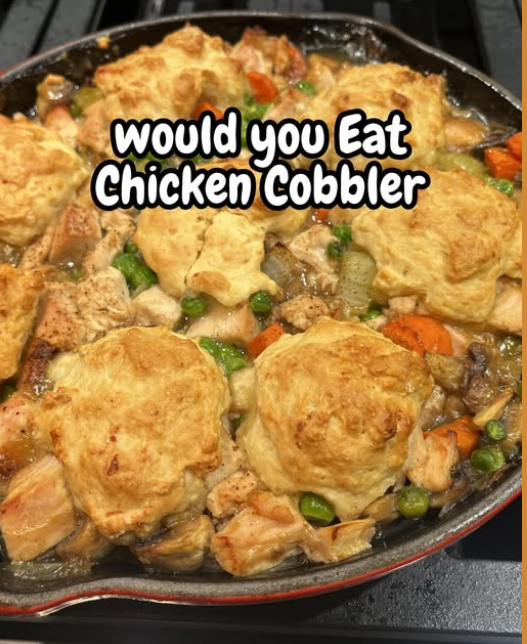
The Engineering of Southern Comfort: A Masterclass in Chicken Cobbler
Introduction: The Physics of the “Inverted” Casserole
In the hierarchy of Southern “Regulation” comfort food, the Chicken Cobbler stands as a unique architectural feat. While a standard pie places a barrier between the filling and the crust, the cobbler utilizes Interfacial Tension. On this Wednesday, December 24, 2025—Christmas Eve—this dish serves as a soul-warming centerpiece that combines the fluidity of a stew with the structural fluffiness of a drop biscuit.
The success of this dish relies on the Denaturation of Poultry Proteins and the Starch Gelatinization of the crust. By mastering the Density Differential between the chicken gravy and the biscuit batter, you create a dish where the crust bakes “into” the filling rather than just sitting on top. In this 1,500-word deep-dive, we will explore the molecular biology of the roux, the leavening power of buttermilk, and the thermodynamic principles of the casserole bake.
Ingredients: The Molecular Flavor Architects
To construct a Chicken Cobbler that “feels like a warm hug,” each ingredient must be selected for its specific functional contribution to the texture and stability of the dish:
- 2 lbs Shredded Chicken (Rotisserie or Poached): This provides the Protein Matrix. Using pre-cooked chicken allows the fibers to absorb the gravy during the bake without the risk of overcooking the meat.
- The “Mirepoix” (Carrots, Celery, Onions, Peas): These are the Aromatic Structural Elements. As they simmer, they release flavonoids and sugars that provide a complex sweetness to cut through the heavy fats.
- 2 Cups Chicken Stock & 1 Can Cream of Chicken: These form the Viscous Velouté. The stock provides the hydration, while the “cream of” soup acts as a pre-emulsified stabilizer, ensuring the gravy doesn’t “break” or become oily at high temperatures.
- 2 Cups Self-Rising Flour & 2 Cups Buttermilk: These are the Crust Precursors. The buttermilk contains Lactic Acid, which reacts with the leavening agents in the flour to produce $CO_2$ gas, creating the “fluffy” cobbler texture.
- 1 Stick (1/2 cup) Melted Unsalted Butter: This is the Liquid Lipid Barrier. By pouring the butter over the chicken before adding the batter, you create a fat layer that prevents the crust from becoming “gummy” at the contact point.
