
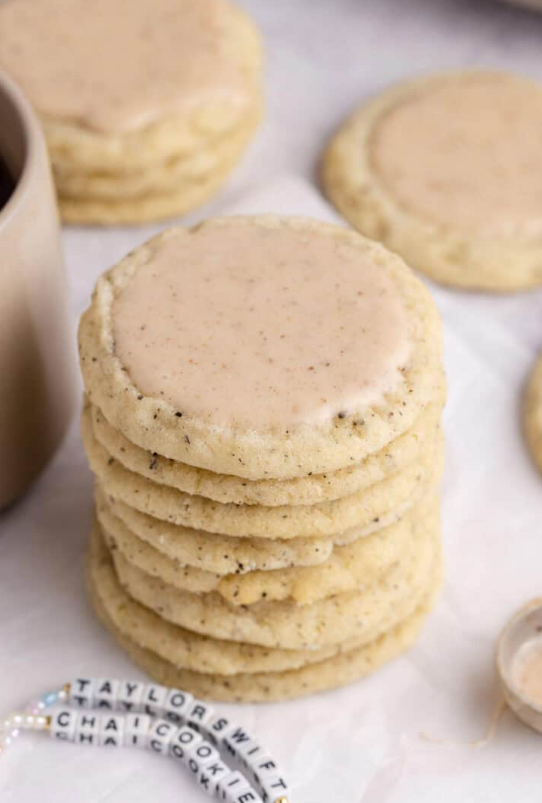
The Perfect Holiday Treat: Mastering Taylor Swift Chai Cookies
Introduction: The Engineering of a Perfect Cookie Texture
This recipe for **Taylor Swift Chai Cookies** is a masterclass in cookie texture, utilizing both **solid butter** and **liquid vegetable oil** to achieve a unique result. The butter, when creamed, incorporates air, which contributes to lift and structure. The oil, a liquid fat, ensures the cookies remain exceptionally tender and chewy by thoroughly coating the flour proteins, inhibiting gluten development. This dual-fat approach is the secret to a soft, melt-in-your-mouth final product.
The entire baking process is governed by the proper initial mixing technique, specified by **The Fat Temperature and Creaming Mandate**. The butter must be perfectly at room temperature ($68^\circ\text{F}$ to $70^\circ\text{F}$) to maximize air incorporation during the creaming process, creating the necessary lift.
Success requires adherence to three core regulations: **The Fat Temperature and Creaming Mandate, The Leavening and Hydration Protocol, and The Glaze Viscosity Principle.**
The first regulation, **The Fat Temperature and Creaming Mandate** (Instruction 2 & 3), builds the structure. Creaming the **butter and sugars** together until light and fluffy (Instruction 2) mechanically incorporates air bubbles. The subsequent addition of the **oil** (Instruction 3) prevents the butter from creating too firm a structure, leading to a moist, soft cookie instead of a crisp one.
The second regulation, **The Leavening and Hydration Protocol** (Instruction 5), controls spread and rise. The **baking soda** provides the necessary lift. Crucially, the **long chill time** (Instruction 5) is essential. It solidifies the fats, preventing the cookie from spreading too quickly when it hits the hot oven, ensuring a thicker, chewier cookie center. The chill also allows the **chai tea leaves** to fully hydrate and infuse the dough.
The third regulation, **The Glaze Viscosity Principle** (Instruction 9), ensures a stable, shiny finish. The **icing sugar** must be sifted to eliminate clumps, and the **eggnog** (the liquid) should be added slowly until the glaze is thick enough to coat the back of a spoon but thin enough to drip slowly. This prevents the glaze from running off the cookie or being too chalky.
Ingredients: Defining Structure, Moisture, and Spice
The full components for approximately $20\text{–}24$ cookies:
I. The Cookie Dough:
- **$250\text{ grams}$** all-purpose flour ($\approx 2\text{ cups}$) (Structure)
- **$2\text{ bags}$** chai tea, cut open and leaves removed (Flavor infusion)
- **$\frac{1}{2}\text{ teaspoon}$** baking soda (Leavening agent)
- **$\frac{1}{4}\text{ teaspoon}$** sea salt (Flavor balance)
- **$1\text{ stick}$** butter, unsalted and room temperature (Structural fat, creaming)
- **$\frac{1}{2}\text{ cup}$** vegetable oil (Moisture fat, tenderness)
- **$100\text{ grams}$** granulated sugar ($\approx \frac{1}{2}\text{ cup}$) (Spread, sweetness)
- **$60\text{ grams}$** icing sugar ($\approx \frac{1}{2}\text{ cup}$) (Tenderness, softness)
- **$1\text{ large}$** egg, room temperature (Binder, richness)
- **$2\text{ teaspoon}$** pure vanilla extract (Aromatic flavor)
II. Rolling Mix & Glaze:
- **$2\text{ tablespoon}$** granulated sugar (Rolling coat crunch)
- **$2\text{ teaspoon}$** ground cinnamon (Rolling coat spice)
- **$180\text{ grams}$** icing sugar ($1\frac{1}{2}\text{ cups}$, sifted) (Glaze base)
- **$2\text{ tablespoon}$** eggnog or as needed (Glaze liquid/flavor)
- **$\frac{1}{4}\text{ teaspoon}$** ground nutmeg (Glaze spice)
- **$\frac{1}{4}\text{ teaspoon}$** ground cinnamon (Glaze spice)
III. Equipment:
- Stand Mixer, Measuring Cups and Spoons, Mixing Bowl, Parchment Paper, Baking Sheet, $1\frac{1}{2}\text{ Tablespoon}$ Cookie Scoop.
