
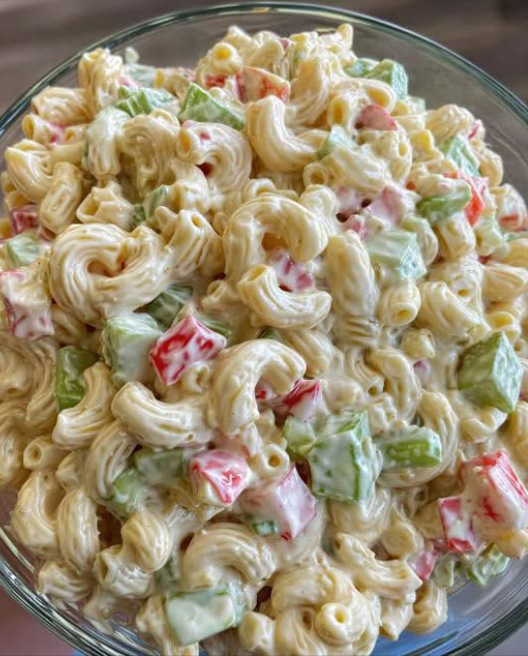
🍯 Vinaigrette Emulsion: The Science of Honey Mustard Pasta Salad
📋 Complete Recipe Ingredients
| Component | Quantity | Functional Role |
| Pasta | ||
| Pasta of your choice (e.g., rotini, fusilli) | $8 \text{ ounces}$ | Provides bulk and structure; vehicle for the dressing |
| Dressing Base | ||
| Honey | $\frac{1}{4} \text{ cup}$ | Sweetener; emulsifier stabilizer (sugar) |
| Dijon Mustard (recommended) | $3 \text{ tablespoons}$ | Primary emulsifier (mustard mucilage) and flavor |
| White Wine Vinegar (recommended) | $2 \text{ tablespoons}$ | Provides crucial acidity for balance and flavor |
| Extra Virgin Olive Oil | $\frac{1}{2} \text{ cup}$ | Fat component; creates the emulsion; richness |
| Seasoning | ||
| Salt | $\frac{1}{2} \text{ teaspoon}$ | Flavor enhancer; controls saltiness |
| Black Pepper | $\frac{1}{4} \text{ teaspoon}$ | Aromatic complexity |
| Optional Inclusions | ||
| Broccoli florets, cooked chicken, red onion, feta cheese | Assorted | Provides texture, protein, and visual contrast |
👩🔬 Dressing Chemistry: Creating a Stable Emulsion
The key to this pasta salad is the Honey Mustard Vinaigrette, which is a classic example of an emulsion—a stable suspension of two immiscible liquids (oil and vinegar/water).
The Role of Mustard as an Emulsifier
The $\mathbf{3 \text{ tablespoons of mustard}}$ is the most important ingredient for the dressing’s stability. Mustard contains mucilage (a type of gum or fiber) and protein, which are powerful emulsifiers.
-
These molecules have both $\mathbf{\text{hydrophilic}}$ (water-loving) and $\mathbf{\text{lipophilic}}$ (fat-loving) parts.
-
When the dressing is whisked (Step 2), the emulsifiers surround the tiny droplets of $\mathbf{\frac{1}{2} \text{ cup of olive oil}}$, preventing them from coalescing and separating from the $\mathbf{\text{vinegar and honey mixture}}$. This results in a smooth, creamy, and stable dressing that clings beautifully to the pasta.
