
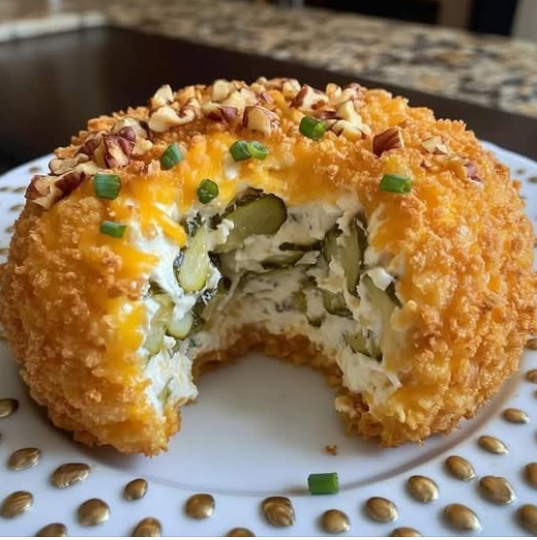
Tangy Cohesion: The Science of the Dill Pickle Cheese Ball 🥒🧀
The **Dill Pickle Cheese Ball** is a study in **cheese plasticity** and **fat binding**. The success of the final shape and texture relies entirely on the $\mathbf{8 \text{ oz of softened cream cheese}}$. Cream cheese is an **emulsion**—a matrix of milk fat droplets dispersed in a protein and water network. When softened to room temperature ($\mathbf{65^{\circ}\text{F}}$ to $\mathbf{70^{\circ}\text{F}}$), the milk fat becomes highly malleable, achieving maximum **plasticity**. This makes it the perfect binder for the chunky $\mathbf{\frac{1}{4} \text{ cup of chopped dill pickles}}$ and $\mathbf{1 \text{ cup of shredded cheddar}}$.
The key scientific principle here is that the cream cheese fat matrix completely encapsulates the other ingredients, binding them into a cohesive, non-crumbling mass. The $\mathbf{\frac{1}{4} \text{ cup of finely chopped dill pickles}}$ introduces a significant amount of $\mathbf{\text{water and acidity}}$ (from the vinegar brine). The shredded cheese and the $\mathbf{\frac{1}{2} \text{ tsp of onion/garlic powder}}$ help absorb any excess moisture, preventing the mixture from becoming too loose. The final **chilling step** (Step 6) is essential; it re-hardens the milk fat, setting the ball’s shape and ensuring it holds together firmly when served.
Phase I: Plasticity and Ingredient Dispersion
The first steps ensure the perfect binder consistency and even flavor distribution.
Softening the Binder
The $\mathbf{8 \text{ oz of cream cheese}}$ must be fully softened to room temperature ($\mathbf{65^{\circ}\text{F}}$ to $\mathbf{70^{\circ}\text{F}}$) before mixing (Step 2).
* **Cold Cream Cheese** will tear instead of mix, resulting in a lumpy, uneven ball.
* **Soft Cream Cheese** achieves maximum **plasticity**, allowing the $\mathbf{1 \text{ cup of shredded cheddar}}$ and $\mathbf{\text{dill pickles}}$ to be fully dispersed and encased within the fat matrix.
Moisture Management
The $\mathbf{\frac{1}{4} \text{ cup of dill pickles}}$ should be **finely chopped** and ideally $\mathbf{\text{patted dry}}$ with a paper towel before mixing (Step 3). Excess pickle brine ($\mathbf{\text{vinegar and water}}$) can prevent the fat from binding properly, resulting in a softer, looser cheese ball that struggles to hold its shape upon chilling. The fine chopping ensures that the sharp, acidic flavor is distributed throughout the cheese base.
