
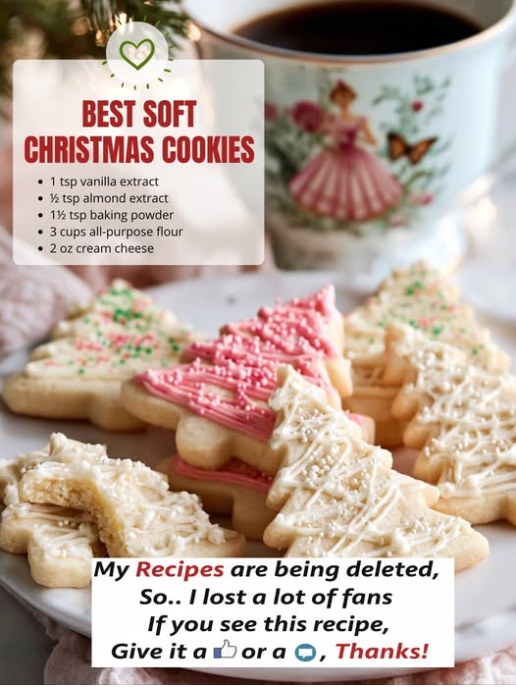
The Science of the Soft-Center Christmas Cookie
Analyzing the role of cream cheese and double-extract aromatics in high-moisture confectionery.
Introduction: The Cream Cheese “Secret Weapon”
What makes a cookie “the softest”? It comes down to **Water Activity ($a_w$)**. In a standard sugar cookie, the butter melts and the water evaporates, leaving a crisp structure. By adding **2 oz of Cream Cheese**, we introduce emulsifiers and fats that have a higher affinity for water. This keeps the moisture trapped within the starch matrix, resulting in a “melt-in-your-mouth” texture that lasts for days.
Technically, the **Almond and Vanilla Extract** combination creates a complex “Bakery Profile.” Vanilla provides the deep, woody base notes, while almond extract contains benzaldehyde, which provides the high-frequency, sweet floral aroma that signals “high-end pastry” to the brain.
Success with this recipe relies on two critical factors: Creaming Time (aerating the fats to create micro-pockets) and The Bake Window (removing the cookies before the sugars fully caramelize).
Ingredients: The Structural Matrix
The Dry Foundation
- 3 Cups All-Purpose Flour: The gluten-providing scaffold.
- 1 ½ tsp Baking Powder: The leavening gas source ($CO_2$).
- 1 Cup Granulated Sugar: The hygroscopic sweetener.
The Lipid & Aromatic Phase
- 1 Cup Unsalted Butter: The primary shortening fat.
- 2 oz Cream Cheese: The moisture-retaining stabilizer.
- 1 Large Egg: The protein binder and emulsifier.
- Vanilla & Almond Extracts: The aromatic catalysts.
