
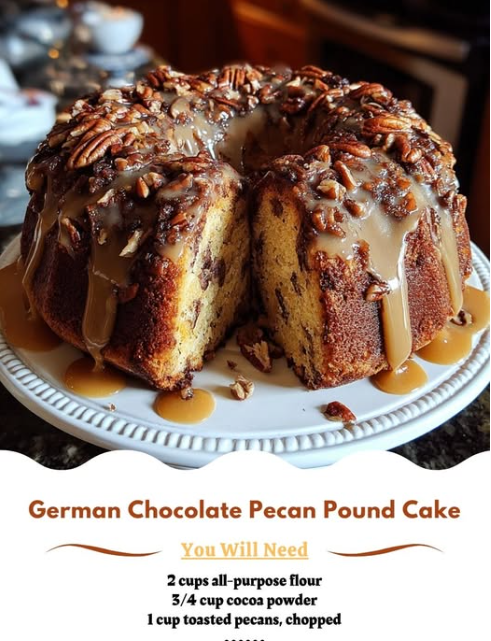
The Ultimate German Chocolate Pecan Pound Cake
A deep dive into the richest, nuttiest, and most decadent pound cake you will ever bake.
A Story of Flavor: The Samuel German Legacy
Before we pick up a spatula, we must address one of the most common misconceptions in the baking world: German Chocolate Cake is not from Germany. The name actually honors Samuel German, an American baker who created a unique style of dark baking chocolate for the Baker’s Chocolate Company in 1852. His goal was to make a chocolate that was sweeter and more convenient for home cooks.
Over a century later, in 1957, a home baker in Texas sent a recipe to a Dallas newspaper featuring Samuel’s chocolate and a gooey coconut-pecan frosting. The rest, as they say, is history. While the original was a light, airy layer cake, our version transforms these iconic flavors into a Pound Cake. Why a pound cake? Because the dense, buttery crumb provides a more substantial “canvas” for the intense cocoa and the crunchy, toasted pecans.
The Science of the Perfect Crumb
A pound cake is traditionally defined by a ratio of one pound each of flour, butter, sugar, and eggs. However, when we introduce cocoa powder, the chemistry changes. Cocoa is a drying agent; it absorbs moisture faster than flour. To ensure our German Chocolate Pound Cake stays “velvety” rather than “chalky,” we utilize three specific techniques:
- The Buttermilk Acid-Base Reaction: The acidity in buttermilk tenderizes the gluten in the flour, resulting in a finer, softer bite.
- Room Temperature Emulsification: When butter, eggs, and dairy are at the same temperature (approx. 70°F), they form a stable emulsion that traps air. If your eggs are cold, the butter will “clump,” and your cake will have holes in the middle.
- The Maillard Reaction: By toasting the pecans before adding them to the batter, we initiate the Maillard reaction, which creates hundreds of new flavor compounds that raw pecans simply don’t possess.
Ingredients Breakdown
This recipe is designed for a standard 10-12 cup Bundt pan or two large loaf pans.
The Dry Mix
- 2 Cups All-Purpose Flour: Sifted to ensure no lumps.
- 3/4 Cup Dutch-Processed Cocoa Powder: This provides a darker color and smoother flavor than “natural” cocoa powder.
- 1/2 tsp Sea Salt: Salt is the “volume knob” for chocolate—it makes the cocoa flavor much louder.
- 1 tsp Baking Powder & 1/2 tsp Baking Soda: For that perfect, gentle rise.
The Wet Components
- 1 Cup (2 sticks) Unsalted Butter: Must be high-quality (80%+ butterfat if possible).
- 2 Cups Granulated Sugar: Creates the “crispy” exterior characteristic of a good pound cake.
- 4 Large Eggs: Pasture-raised eggs will give the cake a richer, deeper hue.
- 1 Cup Full-Fat Buttermilk: Do not use fat-free; the fat is necessary for the crumb.
- 2 tsp Vanilla Bean Paste: Or vanilla extract, for that floral aromatic background.
The Texture Mix-ins
- 1 Cup Toasted Pecans: Chopped into varied sizes for different “crunches.”
Phase-by-Phase Instructions
Step 1: The Pecan Toasting
Preheat your oven to 350°F (175°C). Spread your chopped pecans on a baking sheet and toast for 5–8 minutes. You should be able to smell them from across the kitchen. Once toasted, set them aside to cool. Adding hot nuts to cold batter can cause the butter to melt prematurely.
