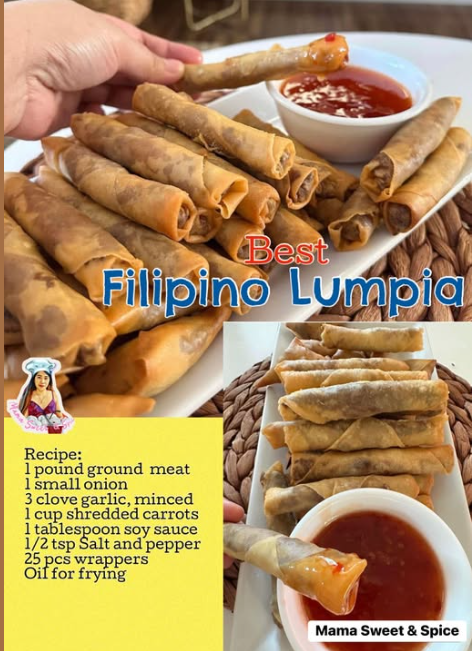
Step 1: Preparing the Lumpia Filling
- **Mix Ingredients:** In a large bowl, combine the **ground pork (or meat mix), minced carrots, water chestnuts/jicama, onion, garlic, soy sauce, sesame oil, black pepper, and the large egg**.
- **Mix Thoroughly:** Use your hands to mix the ingredients together until everything is uniformly distributed. Do not overmix; mix just until the ingredients are cohesive.
- **No Cooking Required:** The filling is not cooked prior to wrapping. This ensures a juicier texture when cooked inside the wrapper.
Step 2: The Art of Wrapping (Lumpiang Shanghai Style)
- **Prepare Wrappers:** Thaw the wrappers completely in the refrigerator. Separate them carefully (they can tear easily). Prepare a small dish with the **egg white** for sealing.
- **Position:** Lay one wrapper flat on a clean, dry surface, with a corner pointing toward you (diamond orientation).
- **Portion Filling:** Place approximately **1 heaping tablespoon** of the filling mixture horizontally across the wrapper, about 1-2 inches from the corner closest to you. Shape the filling into a tight, thin log.
- **Roll and Seal:**
- Fold the corner closest to you tightly over the filling.
- Fold the left and right corners inward toward the center, ensuring the sides are straight and tight against the filling.
- Roll the lumpia forward, maintaining a tight, compact cylinder.
- Stop when you have about 1 inch left. Brush the remaining wrapper edge lightly with the **egg white** and finish rolling to seal.
- **Set Aside:** Place the finished lumpia on a parchment-lined tray and cover with plastic wrap to prevent drying. Repeat until all filling is used (this usually yields 40–50 lumpia).
Step 3: Frying for Maximum Crispness
- **Heat Oil:** In a deep skillet or pot, heat the **neutral oil** to **$325^{\circ}\text{F}$ ($160^{\circ}\text{C}$)**. A lower temperature is key; it allows the wrapper to crisp slowly while the meat filling cooks thoroughly.
- **Fry in Batches:** Fry the lumpia in small batches (about 8–10 at a time) to avoid dropping the oil temperature.
- **Cook Through:** Fry for **7–10 minutes**, turning frequently, until the wrappers are a deep golden brown and completely crisp. The long, low-temperature cook ensures the pork inside is fully done.
- **Drain and Serve:** Remove the lumpia with tongs or a slotted spoon and drain on a wire rack or paper towels. Serve immediately with **sweet chili sauce** while still hot and crunchy.
Serving and Storage: The Freezer-Friendly Secret
The Sweet Chili Dip
Lumpia is almost never served without **Sweet Chili Sauce**. The combination of the savory, salty filling and the sweet, slightly spicy tang of the sauce is essential. Other popular dips include a simple **vinegar-garlic dipping sauce** (a mixture of white vinegar, minced garlic, and pepper) or even a spiced ketchup blend.
Freezing Instructions (Ideal for Prep)
Lumpia is one of the best appetizers to prepare ahead of time:
- **Flash Freeze:** Lay the uncooked, wrapped lumpia in a single layer on a parchment-lined baking sheet. Place the sheet in the freezer for 2–3 hours until the lumpia are completely frozen solid.
- **Store:** Transfer the frozen lumpia to a large, airtight freezer bag. They can be stored for up to **3 months**.
- **Frying from Frozen:** Do not thaw the lumpia before cooking. Increase the frying time by 2–3 minutes and start with oil at $300^{\circ}\text{F}$ ($150^{\circ}\text{C}$) to allow the frozen meat to come to temperature slowly without burning the wrapper.
Tips: Achieving the Ultimate Crunch
Tip 1: The Dry Filling Rule
Ensure your vegetable mince (especially the carrots and water chestnuts) is patted dry before mixing into the meat. If the filling is too moist, the wrapper will become soggy while sitting, leading to breaks and oil seepage during frying.
Tip 2: Wrapper Type Matters
Always use the **thin, translucent spring roll wrappers** (often labeled as “Lumpia Wrappers” or “Vietnamese/Chinese Spring Roll Wrappers”). Do not use the thick, heavy flour-based **egg roll wrappers**; they create a dense, chewy crust that is not the signature texture of classic Filipino Lumpia.
Tip 3: The Rolling Board
Use a clean, smooth, dry cutting board or large plate for wrapping. If your surface is damp or sticky, the delicate wrappers will tear when you try to roll them tightly.
Variations: Customizing Meat and Veggies
1. Lumpiang Gulay (Vegetable Lumpia)
Substitute the ground meat with a mix of **shredded cabbage, green beans, and bean sprouts**. Cook the vegetable filling briefly in a wok to reduce moisture before cooling and wrapping. Season heavily with garlic, onion, and soy sauce.
2. Shrimp and Pork Blend
Replace half of the ground pork ($\frac{1}{2}$ lb) with **finely minced raw shrimp**. This adds a delicate, savory seafood flavor that elevates the lumpia for special occasions.
3. Lumpiang Sariwa (Fresh Lumpia)
For a non-fried version, use the same filling ingredients but substitute the fried wrappers with **thin crepes**. Serve fresh and soft, topped with a thick, sweet peanut sauce instead of chili sauce.
Advanced Tips: Oil Management and Seasoning
Tip 4: Low-Temperature Frying
The single most important factor for success is maintaining the **$325^{\circ}\text{F}$ ($160^{\circ}\text{C}$) oil temperature**. A meat-filled lumpia requires a longer cook time to ensure the raw pork is safe to eat. Frying at a lower heat for 7–10 minutes allows the heat to penetrate the filling thoroughly without burning the thin wrapper.
Tip 5: Enhancing Umami
To deepen the umami flavor, stir in **$\frac{1}{2}$ teaspoon of MSG (monosodium glutamate)** or **1 teaspoon of mushroom powder** into the filling mix along with the salt and pepper. This is traditional in many commercial Filipino recipes and significantly boosts the savory, meaty taste.
Tip 6: Storing Uncooked Lumpia
If preparing ahead of time but not freezing, wrap the uncooked lumpia in plastic wrap, then place them in an airtight container in the refrigerator for up to **1 day**. Ensure they are completely sealed to prevent the wrappers from drying out or absorbing moisture from the air.
Conclusion: The Irresistible Bite-Sized Delight
Crispy Filipino Lumpia is the ultimate crowd-pleaser, delivering a satisfying crunch and a savory, aromatic filling in every perfect bite. By following the crucial steps—preparing a dry, well-seasoned filling, executing a tight roll, and mastering the low-and-slow frying temperature—you can successfully replicate this beloved, authentic Filipino appetizer.
Perfect for parties, holidays, or simple snacking, these golden spring rolls are a delicious, convenient, and essential addition to your culinary repertoire.
Frequently Asked Questions: Troubleshooting and Prep
Q: Why are my lumpia brown but the filling is still raw?
A: The oil temperature was **too high** (above $350^{\circ}\text{F}$ or $175^{\circ}\text{C}$). The wrapper cooked too fast, trapping the heat and leaving the dense meat filling raw. Reduce the temperature to $325^{\circ}\text{F}$ ($160^{\circ}\text{C}$) and fry longer (7–10 minutes).
Q: My wrappers are tearing when I roll them. Why?
A: The wrappers may be **too cold** (not fully thawed) or your **rolling board is too sticky/damp**. Ensure the wrappers are pliable and that the surface you are working on is completely dry.
Q: What is the best dipping sauce?
A: **Sweet Chili Sauce** (the bottled kind) is the universal favorite. For a traditional Filipino dipping sauce, mix $\frac{1}{2}$ cup white vinegar with 2 cloves minced garlic, 1 teaspoon sugar, and $\frac{1}{2}$ teaspoon freshly cracked black pepper.
Q: Can I use ground chicken or turkey?
A: Yes, but chicken and turkey are leaner. To prevent a dry filling, add 1 tablespoon of **melted butter** or **neutral oil** to the meat mix before wrapping, and ensure you use the entire egg as a binder.