
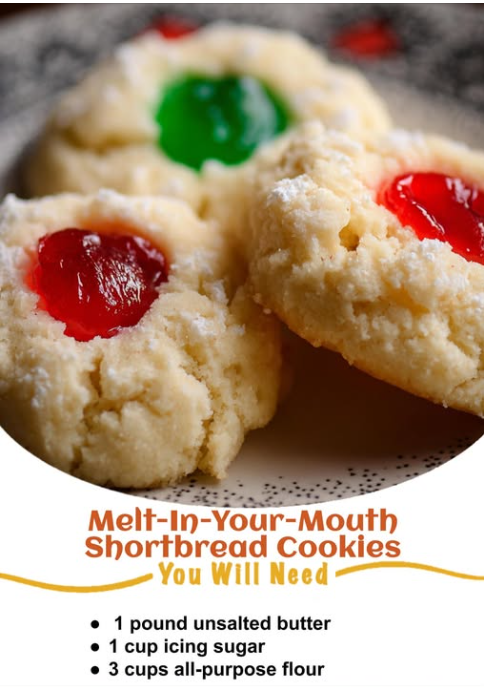
The Ultimate Guide to Melt-in-Your-Mouth Shortbread
Introduction: The Science of “Short” Crumb
Shortbread is a cookie defined by its crumb structure. The term “short” refers to the high fat content (like shortening or butter), which coats the flour particles, inhibiting gluten formation and creating a delicate, tender, melt-away texture.
The **Melt-in-Your-Mouth Shortbread** is the pinnacle of this baking category, moving beyond traditional Scottish shortbread by employing a simple but powerful ingredient swap: replacing a portion of the flour with **cornstarch**. The unique composition—**1 part sugar, 2 parts fat, 3 parts flour/starch**—is the classic ratio, but here, the starch is the true hero.
Success requires adherence to three core regulations: **The Creaming and Low-Gluten Binding Method, The Zero-Stretch Protocol, and The Pale-Bake Standard.**
The first regulation, **The Creaming and Low-Gluten Binding Method** (Instructions 2 & 3), determines the texture. The **1 pound of unsalted butter** must be perfectly creamed with the **1 cup of icing sugar** to incorporate air, but the mixing must stop the instant the **all-purpose flour and cornstarch** are added. Over-mixing activates gluten, resulting in tough, chewy shortbread. The added **$\frac{1}{2}$ cup cornstarch** significantly lowers the overall gluten content, guaranteeing tenderness.
The second regulation, **The Zero-Stretch Protocol** (Instruction 4), ensures the cookies maintain their shape. High-fat doughs tend to spread and distort when baked warm. This shortbread dough requires a **30-minute chilling period** to re-solidify the butter. Baking from cold locks the butter structure in place, ensuring the edges are sharp and the texture remains “short.”
The third regulation, **The Pale-Bake Standard** (Instruction 5), preserves the delicate flavor. Unlike many cookies, shortbread should **not** turn golden brown. The cookies are baked at a low temperature ($325^\circ\text{F} / 160^\circ\text{C}$) for a longer duration until they are firm to the touch but retain a very pale, buttery color. This slow, low bake cooks the dough without browning the sugars, retaining the pure, sweet butter flavor.
Ingredients: Defining Structure and Flavor
The essential components for the shortbread:
I. The Structural Base:
- **1 pound (4 sticks)** unsalted butter, softened to room temperature (The key to tenderness)
- **1 cup** icing sugar (powdered sugar), sifted (For melt-in-your-mouth texture)
II. The Dry Blend:
- **3 cups** all-purpose flour
- **$\frac{1}{2}$ cup** cornstarch (The secret ingredient for extreme tenderness)
III. Flavoring:
- **1 teaspoon** pure vanilla extract (For aromatic depth)
- **$\frac{1}{4}$ teaspoon** salt (To balance sweetness)
- Optional: Glacé cherries, sprinkles, or coarse sugar for topping
