
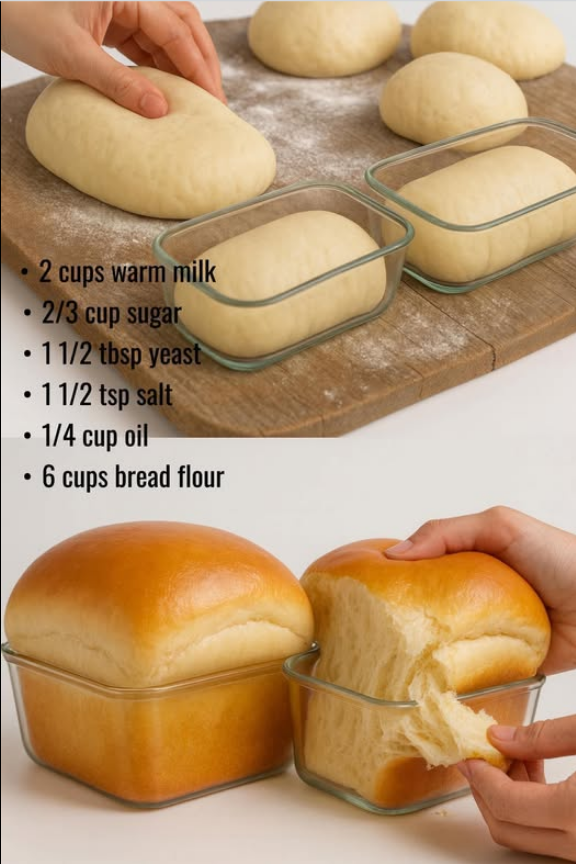
Phase 1: The Bloomed Emulsion
Mixing milk, sugar, and yeast at approximately 105°F (40°C) is a Metabolic Trigger. The foam indicates that the yeast has exited its dormant state and is ready for integration. If no foam appears, the “biological engine” has failed, and the dough will not rise.
Phase 2: Mechanical Gluten Development
Kneading for 8–10 minutes is a process of Polymer Alignment. You are stretching the protein strands into a cohesive, elastic mesh. By the end of this phase, the dough should pass the “Windowpane Test,” meaning it can be stretched thin enough to see light through without tearing.
Phase 3: Proofing & Gas Entrapment
During the two rising phases, the yeast inflates the protein mesh. The second rise in the loaf pans is critical for Oven Spring. The temperature of 350°F (175°C) initiates the Maillard reaction on the crust while the internal gas expands one final time before the proteins coagulate and “set” the shape.
4. Service and Storage: Post-Bake Management
The high sugar and milk content in this bread make it highly Hygroscopic (moisture-absorbing). Cooling completely is necessary to prevent “internal gumminess” caused by trapped steam.
| State | Texture Observation | Stability Limit |
|---|---|---|
| Fresh (1 hr post-bake) | Maximum softness; sweet aromatic profile. | Best for sandwiches. |
| Day 2–3 | Slightly firmer; excellent for toasting. | Store in an airtight bag. |
| Day 5+ | Starch retrogradation begins (staling). | Ideal for French Toast or Bread Pudding. |
5. Tips: Managing the Crumb Density
- The Flour Variable: Depending on the humidity of your environment, you may need slightly more or less than 6 cups of flour. Add the final cup slowly until the dough clears the sides of the bowl.
- The Hollow Tap: To confirm the bread is finished, tap the bottom of the loaf. A hollow sound indicates that the internal moisture has evaporated sufficiently to create a stable air-cell structure.
Conclusion: The Mastered Loaf
This Quick White Bread is a triumph of Predictable Fermentation. By providing ample fuel and a strong protein scaffold, you create a reliable, high-volume loaf that outperforms commercial alternatives. Master the knead and the proof, and you master the table. Enjoy your homemade bread!
Frequently Asked Questions
Q: Why did my bread collapse in the oven?
A: This is usually due to Over-Proofing. If the yeast produces too much gas during the second rise, the gluten scaffold becomes over-stretched and “exhausted,” causing it to fail when hit by the high heat of the oven.
Q: Can I use All-Purpose flour?
A: Yes, but the loaf will be shorter and less “chewy.” Because AP flour has less protein, the structure is weaker and cannot hold as much gas as bread flour.
Would you like me to provide a recipe for a “Honey-Cinnamon Butter” to pair with this warm bread, or perhaps show you how to turn this dough into “Dinner Rolls”?
Related posts:
 The Ultimate Guide to No-Knead Garlic Bread
 The Ultimate No-Knead Sandwich Bread: Light, Fluffy, and Foolproof
 Too Easy Lazy Day Bread: The 5-Minute No-Knead Revolution
 The Ultimate Versatility: Mastering the Crazy Dough Recipe
 Soft Homemade Bread Dough
 The Ultimate Guide to Homemade Krispy Kreme-Style Yeast Donuts
