
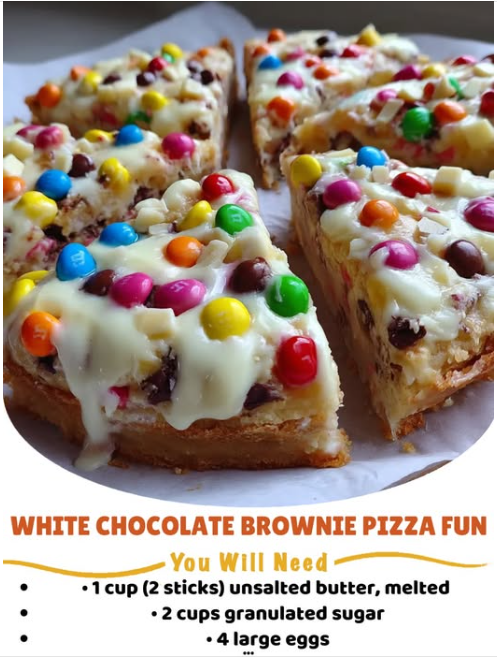
The White Chocolate Brownie Pizza: A Masterclass in Sweet-Savory Stratification
Introduction: The Physics of the “Edge-to-Center” Gradient
In the culinary world, a brownie “pizza” is more than a novelty shape; it is an exercise in Thermal Gradients. On this Thursday, December 25, 2025—Christmas Day—this dessert serves as a festive, communal experience. Because the pizza is baked in a round format, the heat travels from the perimeter to the center in a Centripetal Pattern. This creates a spectrum of textures: from the Glassy, Dehydrated Edge to the Soft, Viscous Center.
This guide explores the Lipid Emulsification of melted butter, the Sucrose Saturation required for a “crackle” top, and the Elasticity of Gluten in a low-moisture environment. We will examine why white chocolate—essentially a sweetened lipid—behaves differently in a batter than dark chocolate solids.
Ingredients: The Molecular Building Blocks
- 1 Cup (2 Sticks) Unsalted Butter (Melted): This is your Fat Base. Melting the butter releases its water content (approx. 15%), which is essential for dissolving the sugar and creating the “chew” characteristic of a brownie rather than the “crumb” of a cake.
- 2 Cups Granulated Sugar: A Hygroscopic Texturizer. The high sugar-to-flour ratio is what creates the dense, fudgy interior. During the bake, the sugar migrates to the surface, where it dries out to form a thin, meringue-like crust.
- White Chocolate Chips/Chunks: These provide Creamy Lipid Pockets. White chocolate is composed of cocoa butter, milk solids, and sugar. Because it lacks cocoa solids, it melts at a lower temperature, creating a “buttery” mouthfeel that anchors the toppings.
- Large Eggs (Emulsifiers): Eggs provide the Structural Protein. The yolks contain Lecithin, which binds the butter to the sugar-water solution, ensuring the pizza doesn’t become oily.
- Colorful Candies & Toppings: These provide Textural Disruptors. In a “Mono-textural” brownie, the palate can become fatigued; the candies introduce Crunch and Acidity to balance the high sugar load.
