Precision in weighing ingredients (especially the flour and fat components) is vital for controlling the cookie’s spread.
| Component | Quantity (Metric/Volume) | Functional Role and Technical Insight |
|---|---|---|
| **The Base Dough (Fat & Flavor)** | ||
| **Cream Cheese, softened** | 115g / $\approx \frac{1}{2}$ cup | **Tang & Tenderness:** Adds acidity for flavor and moisture for a cakey, soft crumb. Must be softened to emulsify. |
| **Unsalted Butter, softened** | 55g / $\approx \frac{1}{4}$ cup | **Shortening:** Provides necessary creaming ability and richness. |
| **Granulated Sugar** | 75g / $\approx \frac{1}{3}$ cup | **Crispness & Sweetness:** Contributes to the spread and the slight crispness of the edge. |
| **Packed Brown Sugar** | 75g / $\approx \frac{1}{3}$ cup | **Chewiness & Moisture:** Molasses content ensures a chewy texture and prevents dryness. |
| **Structure and Leavening** | ||
| **All-Purpose Flour** | 125g / $\approx 1$ cup | **Structure:** Measured by weight is critical for consistency. |
| **Baking Powder** | $\frac{1}{2}$ teaspoon | **Leavening:** Provides the lift needed for a thick, puffy cookie. |
| **Large Egg** | 1 | **Emulsifier/Binder:** Binds fat and water; coagulation sets the final structure. |
| **The Core** | ||
| **Soft Caramels, unwrapped** | 10-12 pieces | **Gooey Center:** Must be soft, store-bought caramels that melt fully without becoming brittle. |
Instructions: The Encapsulation Method
The key to these cookies is the **encapsulation method**, which ensures the caramel remains a gooey, molten core rather than melting out into the cookie sheet.
- **Creaming the Fats:** In a large bowl, cream the **115g softened cream cheese** and **55g softened butter** until smooth and combined. Add the **75g granulated sugar** and **75g packed brown sugar** and beat until light and fluffy (3-4 minutes). Proper creaming incorporates air, which contributes to the final lift.
- **Wet Ingredients:** Beat in the **1 large egg** until fully incorporated, followed by the **1 tsp vanilla extract**. Scrape down the sides of the bowl.
- **Dry Ingredients:** In a separate bowl, whisk together the **125g all-purpose flour**, **$\frac{1}{2}$ tsp baking powder**, and **$\frac{1}{4}$ tsp salt**. Gradually add the dry ingredients to the wet ingredients, mixing only until just combined. **Do not overmix.**
- **Chill (Crucial):** Cover the dough and refrigerate for a minimum of **1 hour**. Chilling is essential to solidify the high-fat dough and prevent excessive spread during baking.
- **Preheat and Prep:** Preheat the oven to **$350^{\circ}\text{F}$ ($175^{\circ}\text{C}$)**. Line baking sheets with parchment paper.
- **Caramel Encapsulation:** Scoop the chilled dough into $\mathbf{1.5 \text{-inch balls}}$. Flatten each ball slightly in your palm. Place **one unwrapped soft caramel** in the center. Carefully fold the dough around the caramel, sealing it completely so none of the caramel is exposed. Roll into a smooth ball.
- **Bake:** Place the sealed dough balls 2 inches apart on the prepared baking sheets. Bake for **10–12 minutes**. The cookies are done when the edges are set and lightly golden, and the centers look soft and slightly puffy. **Do not overbake.**
- **Cool and Set:** Sprinkle immediately with **flaky sea salt** (optional). Cool on the baking sheet for **5 minutes** before transferring to a wire rack. This allows the hot, molten caramel core to slightly cool and stabilize.
Serving and Storage: The Warm Center Experience
Optimal Serving and Reheating
The ultimate enjoyment of this cookie comes from experiencing the warm, gooey caramel center.
- **Warm Serve:** These cookies are at their absolute best when served slightly warm, within an hour of coming out of the oven, or gently reheated.
- **Reheating:** Microwave a cooled cookie for $\mathbf{10 \text{ to } 15 \text{ seconds}}$ to re-liquefy the caramel center, providing the fresh-baked texture.
- **Flavor Pairing:** Serve with a rich, dark espresso or a scoop of vanilla ice cream. The acidity of the cheesecake cookie dough cuts through the sweetness of the caramel beautifully.
Storage and Longevity
The high fat and sugar content contribute to good stability, but the caramel filling dictates certain storage rules.
- **Room Temperature:** Store cooled cookies in an airtight container for up to **5 days**. The cookies may firm up, but they can be easily softened via reheating.
- **Freezing Baked Cookies:** Freeze cooled cookies in an airtight, freezer-safe container for up to **2 months**. They should be separated by parchment paper. Thaw at room temperature and reheat briefly before serving. The caramel structure remains stable during the freezing process.
- **Freezing Dough:** The prepared, caramel-filled dough balls (Step 6) can be frozen unbaked. Freeze solid on a sheet pan, then transfer to a freezer bag. Bake from frozen, adding $\mathbf{3 \text{ to } 5 \text{ minutes}}$ to the baking time.
Tips: Mastering the Cheesecake Dough
Tip: The Temperature of Fats
The **cream cheese and butter must be fully softened** to room temperature. If they are cold, the creaming process will fail to fully emulsify the ingredients, resulting in a grainy dough that spreads unevenly and may separate during baking.
Technical Pointers
- **Accurate Weighing:** Use a kitchen scale to measure the $\mathbf{125\text{g of flour}}$. Due to the high-moisture dough, the flour ratio is extremely sensitive. Too much flour will result in a dense, dry cookie; too little will cause the cookie to spread excessively.
- **Sealing the Caramel:** The most common failure is the caramel leaking out. Ensure the dough is **sealed completely** around the caramel (Step 6). The dough acts as a pressure vessel; any hole will allow the molten caramel to escape and burn on the sheet pan.
- **Don’t Overbake:** Overbaking is the enemy of chewiness. The cookies should look slightly underdone and puffy when pulled from the oven. The **residual heat** (carryover cooking) will finish the baking process on the sheet pan, guaranteeing a soft center.
- **Preventing Spread:** If your cookies still spread too much after chilling, roll the dough balls into **cylinders** rather than spheres. This vertical orientation slows horizontal spread and promotes a thicker cookie.
Variations: Adjusting the Flavor Matrix
The cheesecake cookie dough provides a rich, versatile base that pairs well with numerous fillings and inclusions.
Filling and Topping Swaps
- **Salted Caramel Pretzel:** Mix $\mathbf{\frac{1}{4} \text{ cup of crushed pretzels}}$ into the dough for a savory crunch. Finish the baked cookie with a pinch of flaky sea salt.
- **Chocolate Cheesecake:** Replace the caramel filling with a **large milk or dark chocolate chip**. Drizzle the cooled cookies with melted chocolate for a double chocolate effect.
- **Spiced Apple Center:** Use a spoonful of **thick, spiced apple butter** (or pie filling) instead of caramel. Add $\mathbf{\frac{1}{2} \text{ teaspoon of ground cinnamon}}$ to the cookie dough for warmth.
Dough Adjustments
- **Lemon Zest:** Add $\mathbf{1 \text{ teaspoon of fresh lemon zest}}$ to the butter/cream cheese mixture during creaming. This amplifies the “cheesecake” tang and adds a vibrant aroma.
- **Graham Cracker Crumbs:** Replace $\mathbf{1 \text{ tablespoon of the flour}}$ with $\mathbf{1 \text{ tablespoon of finely ground graham cracker crumbs}}$. This adds a subtle, authentic “crust” flavor to the cookie dough.
Tips: Advanced Dough Management
Tip: The Texture of the Caramel Center
To ensure a soft, flowing center, use **soft, buttery caramels** (like those found in individually wrapped bags). Hard, brittle caramels will often melt and set too hard after cooling. For a truly professional touch, use a $\mathbf{\frac{1}{2} \text{ teaspoon of thick, jarred caramel sauce, frozen into small discs}}$, as the center.
Troubleshooting and Technique
- **Dough is Too Sticky:** If the dough is too soft or sticky to handle even after chilling, add $\mathbf{1 \text{ to } 2 \text{ tablespoons of extra flour}}$. This is often necessary if the cream cheese had a high moisture content. Alternatively, chill the dough for an additional 30 minutes.
- **Caramel Leaked and Burned:** If the caramel melted and pooled on the pan, the encapsulation seal broke. Ensure the dough completely encases the caramel square and the **entire surface is sealed** before baking. Leaking caramel often results in a very smoky oven.
- **Hard Edges:** If the edges are too crisp or hard, the cookie was overbaked. Check the cookie at the 10-minute mark and ensure the internal temperature has not exceeded $\mathbf{205^{\circ}\text{F}}$ before pulling it from the oven.
- **Baking Soda vs. Baking Powder:** We rely on **baking powder** because the acidity of the cream cheese provides the necessary trigger for the powder’s dual action, guaranteeing lift and preventing a flat cookie. Adding more baking soda would require more acid (like buttermilk or vinegar) and change the flavor.
Conclusion: A Decadent Lesson in Emulsion
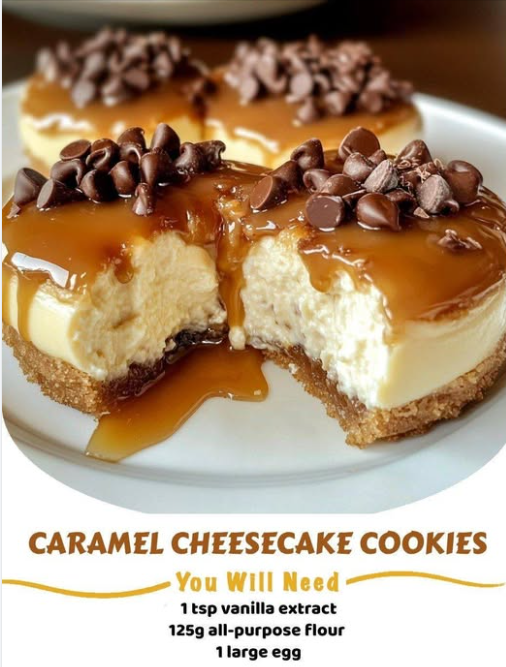
The **Caramel Cheesecake Cookie** is a sophisticated achievement in controlled dough chemistry. The recipe masterfully utilizes the protein and moisture content of the cream cheese to create a tender, thick cookie structure that perfectly cradles the molten caramel filling. The contrast between the tangy, cakey crumb and the sweet, chewy toffee center provides a multi-sensory experience that is both familiar and exciting. By paying meticulous attention to ingredient temperatures, flour measurement, and the crucial encapsulation step, one can reliably produce a truly indulgent and visually impressive dessert.
Frequently Asked Questions:
Q: Do I have to chill the dough?
A: **Yes, chilling is mandatory.** The high fat and moisture content (from the butter and cream cheese) requires chilling to solidify the fats. Chilled fat melts slower in the oven, preventing excessive spread and ensuring the cookie remains thick enough to hold the caramel center.
Q: Can I use low-fat cream cheese?
A: **It is not recommended.** Full-fat cream cheese provides the necessary stability, richness, and structure. Low-fat cream cheese has a higher water and starch content, which can lead to a slightly tougher cookie and may cause the dough to separate during creaming or spreading excessively during baking.
Q: Why is my caramel hard after the cookies cool?
A: This is due to the **type of caramel used**. If the caramel contained insufficient fat or too high a sugar concentration, it will set into a hard candy rather than a soft chew. Ensure you use soft, individually wrapped caramels or high-quality soft caramel candy.
Q: Can I make the caramel filling fully from scratch?
A: **Yes**, but it must be cooked to the **soft-ball stage ($\approx 245^{\circ}\text{F}$)**, then cooled and cut into squares. Using pre-made soft caramels simplifies the process significantly and provides a more reliable final chew.