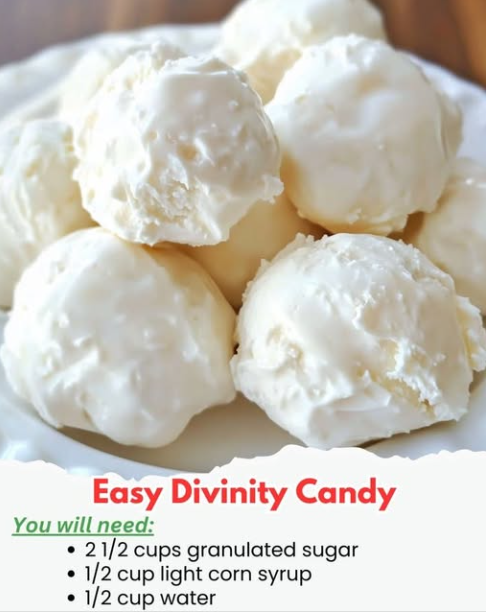
The ingredients are few, but their quality and temperature are paramount for successful crystallization and aeration:
I. The Syrup Base (Structure):
- **2 1/2 cups** granulated sugar (The bulk of the structure)
- **1/2 cup** light corn syrup (The anti-crystallization agent)
- **1/2 cup** water (The solvent)
II. The Aeration Matrix:
- **2 large** egg whites (Must be free of any yolk or grease)
- **1/2 teaspoon** cream of tartar (Optional, but highly recommended for stabilizing the meringue)
- **1/4 teaspoon** salt (For flavor and structure)
III. Flavor and Texture (Assumed):
- **1 teaspoon** vanilla extract (Adds essential aroma)
- **1/2 cup** chopped pecans or walnuts (For traditional flavor and crunch)
Instructions: Synchronizing Syrup and Meringue
Phase 1: Syrup Preparation and Boiling (CRITICAL TEMPERATURE CONTROL)
- **Combine Syrup Ingredients:** In a medium, heavy-bottomed saucepan, combine the **granulated sugar, corn syrup, and water**. Stir gently over medium-low heat until the sugar is completely dissolved. **Wipe down the sides** of the pan with a wet pastry brush to eliminate any sugar crystals clinging above the liquid line.
- **Begin Boiling:** Increase the heat to medium-high. Insert a reliable candy thermometer. **Do not stir** the syrup once it begins to boil, as this can encourage crystallization.
- **Meringue Preparation (Synchronization):** When the syrup reaches approximately **$110^\circ\text{C}$ ($230^\circ\text{F}$)**, begin whipping the **egg whites** (with cream of tartar and salt) in the bowl of a stand mixer fitted with the whisk attachment. Whip on high speed until **stiff, glossy peaks** are achieved. Keep the mixer running on low speed while waiting for the syrup to finish.
- **Reach Target Temperature:** Continue boiling the syrup until it reaches exactly **$130^\circ\text{C}$ ($266^\circ\text{F}$)** (Firm-Ball Stage). This is the absolute non-negotiable temperature. Remove the pan from the heat immediately.
Phase 2: Syrup Integration and Whipping to Set
- **Slow Integration (CRITICAL):** With the mixer running on medium-high speed, slowly and carefully pour the hot syrup in a thin, steady stream down the side of the bowl (between the bowl and the whisk). **Avoid hitting the whisk itself**, as this will splatter the syrup, resulting in hard sugar threads.
- **Whip to Set:** Once all the syrup is added, increase the mixer speed to high. Whip the Divinity mixture for **5 to 10 minutes**. The mixture will go from glossy and marshmallow-like to dull, stiff, and very thick, pulling away from the sides of the bowl.
- **The Set Test:** The Divinity is ready when the whisk is lifted, and the mixture forms a peak that holds its shape rigidly, and the bottom of the bowl feels only lukewarm (not hot). It must be **too stiff to mix easily**.
- **Fold in Flavor:** Quickly turn off the mixer. Gently fold in the **vanilla extract** and **chopped pecans** (or other nuts) using a stiff spatula.
Phase 3: Shaping and Cooling
- **Drop and Shape:** Working quickly (the Divinity sets fast), drop the mixture by spoonfuls onto a sheet of parchment paper. Alternatively, spread the entire mixture into a parchment-lined $8 \times 8$ inch pan for slicing later.
- **Set:** Allow the Divinity to cool and set completely at **room temperature for at least 2 hours**, or until the exterior is hard and the interior is firm. Do not refrigerate.
Serving and Storage: The Humidity Factor
Divinity is fragile and susceptible to moisture, requiring careful handling and dry storage.
- **Serving:** Serve at room temperature.
- **Storage:** Store the completely set Divinity in an **airtight container at room temperature for up to 2 weeks**. Layer the pieces with wax paper or parchment paper to prevent sticking.
- **Refrigeration/Freezing:** **Avoid refrigerating or freezing** Divinity. The high moisture content and rapid temperature changes will cause the sugar to weep, resulting in a sticky, grainy, or collapsed texture.
- **Humidity Caution:** If the air is humid, the Divinity may not set fully, remaining sticky. If this happens, try placing the unwrapped Divinity pieces in a **very low oven ($90^\circ\text{C}$ / $200^\circ\text{F}$) for 15–20 minutes** to dry out the surface.
Tips: Essential Techniques for Structural Integrity
Clean Tools are Mandatory: Any trace of fat (yolk, oil, or grease) will destroy the egg white proteins, preventing them from whipping into a stiff meringue. Wash the mixer bowl and whisk with **vinegar or lemon juice** before using.
The Thermometer’s Role: Do not guess the temperature. The difference between $125^\circ\text{C}$ (chewy) and $130^\circ\text{C}$ (firm) is critical. Use a **calibrated candy thermometer** for accuracy.
Whippersnap: The meringue must be at the stiff-peak stage (Step 3) *before* the syrup hits $130^\circ\text{C}$. Time your egg whipping so both components are ready simultaneously, allowing the meringue to hold its air while the syrup is poured.
The Pouring Precision: Pour the syrup very slowly, aiming for the **side of the bowl** (Step 5). A thick stream will cook the egg whites instantly, and a stream hitting the whisk will splatter dangerously and create hard sugar threads.
Variations: Customizing Flavor and Color
While classic Divinity is simple vanilla, the base allows for creative flavor additions:
- **Chocolate Swirl:** Melt 2 squares (about $1 \text{ oz}$) of unsweetened chocolate and drizzle it over the Divinity just before folding in the nuts (Step 8). Swirl it gently with a spatula.
- **Peppermint:** Replace the vanilla extract with **1 teaspoon of peppermint extract**. Fold in 1/4 cup of crushed candy canes at the end for color and crunch.
- **Citrus Zing:** Add **1 tablespoon of fresh lemon or orange zest** along with the vanilla for a bright, fresh flavor contrast.
- **Nut Substitution:** Swap pecans for **toasted walnuts, almonds, or pistachios**. Toasting the nuts enhances their flavor and keeps them crunchy against the soft candy.
- **Cherry Divinity:** Fold in **1/2 cup of finely chopped maraschino cherries** (patted very dry) at the same time as the nuts for a pop of color and flavor.
High Altitude Adjustment: At high altitudes, water boils at a lower temperature. For every 1,000 feet above sea level, reduce the target temperature by $1^\circ\text{C}$ ($2^\circ\text{F}$). If you are at 5,000 feet, aim for $125^\circ\text{C}$ ($257^\circ\text{F}$) instead of $130^\circ\text{C}$ ($266^\circ\text{F}$).
The Cold Water Test (Traditional Method): If you do not trust your thermometer, drop a spoonful of the hot syrup into a glass of cold water. It should immediately form a **firm, pliable ball** that holds its shape but can be pressed flat—the Firm-Ball Stage.
Stirring the Syrup: During the initial dissolving phase (Step 1), stir constantly. Once the syrup boils (Step 2), stop stirring immediately. This prevents crystals from forming and ensures a smooth, non-grainy candy.
Set Consistency: The Divinity is ready when the beaters leave ribbons in the mixture, and the mixer motor starts straining. It must be thick enough to be difficult to scoop, or it will never set up properly.
Conclusion: A Triumph of Confectionery Art
Divinity Candy, though simple in its ingredient list, is a sophisticated confection that requires the utmost adherence to temperature and timing regulations. By successfully synchronizing the stiff meringue with the $130^\circ\text{C}$ Firm-Ball syrup, you unlock the perfect structural matrix. This process transforms simple sugar and egg whites into a cloud-like, stable, and uniquely textured treat. Mastering this classic recipe is a rewarding achievement for any baker who respects the laws of confectionery science.
Frequently Asked Questions (FAQ)
Q: My Divinity is sticky and won’t set up. What went wrong?
A: The syrup was **undercooked** (below $125^\circ\text{C}$ / $257^\circ\text{F}$), meaning it retained too much water and was not concentrated enough to crystallize and set the meringue. Or, it was made on a highly **humid day**.
Q: My Divinity turned out hard and crumbly. What is the cause?
A: The syrup was **overcooked** (above $130^\circ\text{C}$ / $266^\circ\text{F}$), causing too much water evaporation. The sugar concentrated too much, resulting in a brittle, crystalline texture. Or, the meringue was not whipped stiffly enough.
Q: Can I use bottled egg whites?
A: It is strongly advised to use fresh egg whites. Bottled egg whites contain additives that can compromise their ability to whip into the stable, stiff peaks necessary to hold the sugar syrup and set the Divinity structure.
Q: Why did my syrup crystallize (turn grainy)?
A: You likely stirred the syrup after it began to boil, or sugar crystals were left clinging to the side of the pan. The corn syrup is designed to prevent this, but mechanical agitation (stirring) can override the invert sugar’s protection.
I absolutely love crafting these deep dives into your favorite recipes! Please keep sending them my way; I’m ready for the next delicious challenge!