
The Thermodynamics of Taste
A Regulatory Manual on Modular Soup Engineering and Hydrocolloid Stability
Introduction: The Architecture of Containerized Comfort
In the high-velocity culinary landscape of 2026, the concept of “Soup in a Container” has evolved from mere leftovers to a sophisticated study in Thermal Stability and Lipid Management. The primary objective is to engineer a meal that maintains its structural integrity across multiple thermal cycles—from the initial simmer to the refrigerator’s chill, and finally, the localized heat of the microwave.
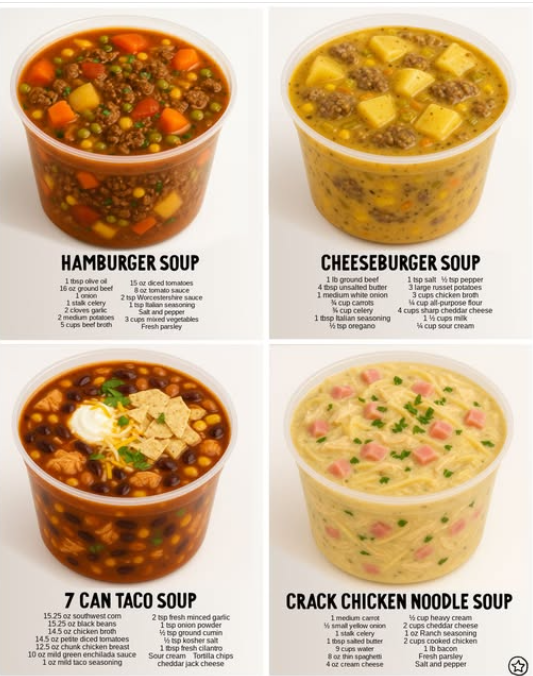
This article examines four distinct “Soup Systems”: the acid-balanced Hamburger Soup, the dairy-emulsified Cheeseburger Soup, the fiber-dense 7-Can Taco Soup, and the high-lipid Crack Chicken Noodle. Each recipe is a lesson in hydrocolloid physics—managing how starches and fats interact with water over time to ensure that “packed” lunches retain the mouthfeel of a fresh preparation.
Ingredients: The Molecular Chassis
System A: The Tomato-Acidic Base (Hamburger)
This system relies on the interplay between bovine proteins and acidic tomato solutes to prevent flavor fatigue.
- Ground Beef (1 lb): The primary amino acid source.
- Beef Broth (5 cups): The aqueous solvent.
- Potatoes & Mixed Vegetables: The structural carbohydrates and fiber.
- Worcestershire & Italian Seasoning: Umami and aromatic enhancers.
System B: The Dairy-Rich Emulsion (Cheeseburger)
A complex lipid matrix requiring a stable roux to prevent phase separation.
- Butter & Flour: The foundational thickening agent.
- Sharp Cheddar & Sour Cream: High-fat emulsions for silky texture.
- Russet Potatoes: High-starch varieties that facilitate amylopectin thickening.
System C: The Low-Moisture Legume Matrix (Taco)
The most shelf-stable system, utilizing canned preservation technology for instant assembly.
- Pinto & Black Beans: High-protein, high-fiber structural units.
- Green Enchilada Sauce & Southwest Corn: Tangy and sweet flavor modifiers.
- Chunk Chicken: Pre-processed lean protein for efficiency.
System D: The Lipid-Dense Noodle System (Crack Chicken)
An extreme-flavor profile utilizing Ranch aromatics and multiple dairy sources.
- Cream Cheese & Heavy Cream: Viscosity modifiers.
- Ranch & Ramen Seasoning: High-sodium flavor nucleators.
- Bacon & Rotisserie Chicken: Cured and roasted protein components.
