
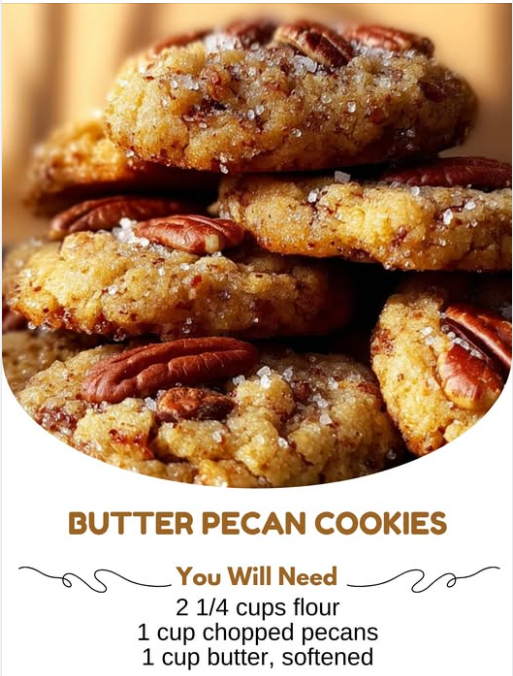
The Maillard Matrix: Decoding the Science of Butter Pecan Cookies 🧈🌰
The **Butter Pecan Cookie** is a classic drop cookie that achieves its signature chewy center and crispy edge through a careful balance of **fat, moisture, and sugar types**. The ratio of $\mathbf{\frac{3}{4} \text{ cup of brown sugar}}$ to $\mathbf{\frac{1}{2} \text{ cup of white sugar}}$ is deliberate: the **molasses** in the brown sugar provides acidity to react with the $\mathbf{\frac{1}{2} \text{ tsp of baking soda}}$, aids in moisture retention, and is the key reactant for the $\mathbf{\text{Maillard reaction}}$, which creates the complex, toasted flavor.
The **texture** is primarily governed by the $\mathbf{1 \text{ cup of softened butter}}$ and the $\mathbf{2 \text{ large eggs}}$. The creaming process (Step 3) incorporates air into the softened butter, which provides initial lift, while the butter’s fat shortens the gluten strands formed by the $\mathbf{2 \frac{1}{4} \text{ cups of flour}}$, ensuring a tender bite. The crucial step of **toasting the pecans** (Step 2) is a simple pre-application of the Maillard reaction, intensifying the nut’s flavor and ensuring they remain crisp after baking. The $\mathbf{20 \text{-minute chill}}$ (Step 8) is a final scientific safeguard: it solidifies the butter, reducing cookie spread and forcing a taller, thicker cookie profile.
Introduction: Sugar Ratios and Browning Chemistry
The combination of sugars dictates both the flavor and final structure of the cookie.
The Brown Sugar Advantage
The greater proportion of $\mathbf{\frac{3}{4} \text{ cup of packed brown sugar}}$ is responsible for the cookie’s $\mathbf{\text{chewiness}}$. Brown sugar is hygroscopic (attracts and retains moisture) due to its $\mathbf{\text{molasses content}}$. This extra moisture remains in the cookie during baking, slowing down the structural set and yielding a soft, bendable center. Furthermore, the molasses is slightly acidic, which is necessary to fully activate the $\mathbf{\frac{1}{2} \text{ tsp of baking soda}}$ for leavening.
The Toasted Flavor (Maillard Reaction)
The depth of flavor comes from two sources. First, toasting the $\mathbf{1 \text{ cup of pecans}}$ in butter (Step 2) concentrates their natural oils and promotes the Maillard reaction prior to mixing. Second, the $\mathbf{\text{brown sugar}}$ is rich in reducing sugars and amino acids, ensuring that the cookie itself undergoes significant Maillard browning in the oven, creating those rich, complex, nutty, “cooked” butter pecan notes.
