Each ingredient is optimized for performance within the dough matrix.
| Component | Functional Role | Technical Insight |
|---|---|---|
| **Structural Foundation** | ||
| **Butter and Sugars** | **Aeration and Shortening** | Creaming ($\mathbf{1 \text{ cup butter}}$, $\mathbf{\frac{3}{4} \text{ cup brown sugar}}$, $\mathbf{\frac{1}{2} \text{ cup white sugar}}$) creates tiny air pockets that expand during baking, providing lift. The fat coats flour, inhibiting gluten. |
| **Eggs and Vanilla** | **Emulsification and Flavor** | $\mathbf{2 \text{ large eggs}}$ contain lecithin, which binds the water (from eggs/molasses) and the fat (butter/pecans), preventing separation. |
| **Flavor and Texture** | ||
| **Toasted Pecans** | **Aromatic Development** | Toasting pre-develops flavor compounds, ensuring the nuttiness is prominent against the sweet dough. |
| **Baking Soda** | **Controlling Spread** | $\mathbf{\frac{1}{2} \text{ tsp of baking soda}}$ is a high-pH base. It raises the dough’s pH, which weakens the gluten network slightly and causes the cookie to spread more quickly before setting, contributing to the thin, crispy edge. |
Instructions: From Toasting to Thermal Set
The method is a classic sequence designed to control flavor, rise, and spread.
- **Preheat & Pan Prep:** Preheat oven to $\mathbf{350^{\circ}\text{F}}$ ($\mathbf{175^{\circ}\text{C}}$). The moderate temperature allows for even cooking and color development.
- **Toasting (Aromatic Pre-Treatment):** Toast the $\mathbf{1 \text{ cup of pecans}}$ with $\mathbf{1 \text{ tbsp of butter}}$ until fragrant (Step 2). This maximizes the intensity of the butter and pecan flavor by gently applying heat before combining them with the dough.
- **Creaming (Aeration):** Cream $\mathbf{\text{softened butter}}$ and $\mathbf{\text{sugars}}$ until light and fluffy (Step 3). This is the key mechanical step for trapping air.
- **Binding:** Add $\mathbf{2 \text{ large eggs}}$ one at a time, followed by $\mathbf{1 \text{ tsp vanilla extract}}$ (Step 4). This step creates a stable emulsion, ensuring the mixture doesn’t separate.
- **Flour Integration (Gluten Control):** Gradually add the $\mathbf{2 \frac{1}{4} \text{ cups of flour, } \frac{1}{2} \text{ tsp baking soda, and } \frac{1}{4} \text{ tsp salt}}$ (Step 5). Mix only until a dough forms; **do not overmix**, as this over-develops the gluten, leading to a tough cookie.
- **Fold Inclusions:** Gently fold in the $\mathbf{\text{toasted pecans}}$ (Step 6). Folding prevents the release of air trapped during creaming and avoids crushing the nuts.
- **Chill (Spread Control):** Chill the dough for $\mathbf{20 \text{ minutes}}$ (Step 8). This solidifies the $\mathbf{1 \text{ cup of butter}}$, preventing premature spreading and resulting in a thicker, chewier cookie.
- **Bake:** Bake for $\mathbf{10 \text{ to } 12 \text{ minutes}}$ (Step 9). The cookie is done when the edges are golden brown but the center remains slightly soft, indicating residual moisture for chewiness.
Serving and Storage: Post-Bake Thermal Stability
Optimal Serving and Handling
Allowing the cookies to cool is essential for their structural integrity.
- **Cooling on Pan:** Leaving the cookies on the $\mathbf{\text{hot baking sheet}}$ (Step 10) for a few minutes continues a gentle baking process (known as **carry-over cooking**), allowing the center to fully set without over-baking the edges.
- **Wire Rack:** Transferring them to a $\mathbf{\text{wire rack}}$ ensures proper air circulation, preventing condensation and a soggy bottom.
Storage and Longevity
Proper storage is essential to maintain the crisp-chewy dichotomy.
- **Room Temperature:** Store cooled cookies in an **airtight container** at room temperature for up to $\mathbf{5 \text{ days}}$. The high sugar and fat content naturally aid in preservation.
- **Freezing Dough:** Scoop the dough onto a baking sheet, freeze until solid, then transfer the frozen balls to a freezer bag for up to $\mathbf{3 \text{ months}}$. Bake from frozen, adding $\mathbf{2 \text{ to } 3 \text{ minutes}}$ to the bake time.
- **Re-crisping:** If the cookies become too soft, place them on a baking sheet and bake at $\mathbf{300^{\circ}\text{F}}$ for $\mathbf{5 \text{ minutes}}$. This drives out excess moisture.
Tips: Mastering the Baking Science
Tip: The Temperature Check
Ensure your $\mathbf{1 \text{ cup of butter}}$ is perfectly softened ($\mathbf{65^{\circ}\text{F}}$). If the butter is too cold, you won’t incorporate enough air during creaming. If it’s melted, the structure will collapse, leading to a thin, greasy cookie.
Technical Pointers
- **The Cinnamon Boost:** Adding a $\mathbf{\text{pinch of cinnamon}}$ (Tip 1) enhances the perceived sweetness and deepens the Maillard-derived flavors without significantly altering the texture.
- **Measuring Dry Ingredients:** Always use the $\mathbf{\text{spoon-and-level method}}$ for the $\mathbf{2 \frac{1}{4} \text{ cups of flour}}$. Scooping directly from the bag compacts the flour, adding too much bulk and resulting in a dry, crumbly dough that resists spreading.
- **Don’t Over-Chill:** While the $\mathbf{20 \text{-minute chill}}$ (Step 8) is important, chilling for much longer (e.g., several hours) will solidify the butter too much. This requires a longer bake time and can prevent the cookie from spreading sufficiently, resulting in a dense, hard disk.
Variations: Altering the Fat and Flavor Profile
Small substitutions can significantly alter the cookie’s final texture and flavor intensity.
Fat and Sugar Swaps
- **Rich Butter Flavor:** Substitute $\mathbf{\text{half of the unsalted butter}}$ with **brown butter** (melted and cooked until milk solids are golden brown) before letting it cool and re-solidify to a softened state. This intensifies the nutty, Maillard notes.
- **Extra Chew:** Increase the $\mathbf{\text{brown sugar}}$ to $\mathbf{1 \text{ cup}}$ and decrease the $\mathbf{\text{white sugar}}$ to $\mathbf{\frac{1}{4} \text{ cup}}$. The increased molasses will maximize the cookie’s moisture and chewiness.
- **Crispier Edge:** Substitute the $\mathbf{\frac{1}{2} \text{ tsp of baking soda}}$ with $\mathbf{1 \text{ tsp of baking powder}}$. Baking powder is pH neutral, which results in a slightly smaller spread and a more even, cakey center.
Inclusion Enhancements
- **Salted Caramel:** Fold $\mathbf{\frac{1}{4} \text{ cup of chopped caramel pieces}}$ into the dough (Step 6) and sprinkle with $\mathbf{\text{flaky sea salt}}$ immediately after baking.
- **Toffee Bits:** Replace $\mathbf{\text{half the pecans}}$ with $\mathbf{\text{toffee bits}}$ for a crunchy, buttery, and slightly sticky center.
- **Bourbon Soak:** Toss the $\mathbf{\text{pecans}}$ with $\mathbf{1 \text{ tablespoon of bourbon}}$ after toasting and cooling (Step 2) for an hour to infuse a deeper, boozy flavor before adding to the dough.
Conclusion: A Decadent Lesson in Thermal Control
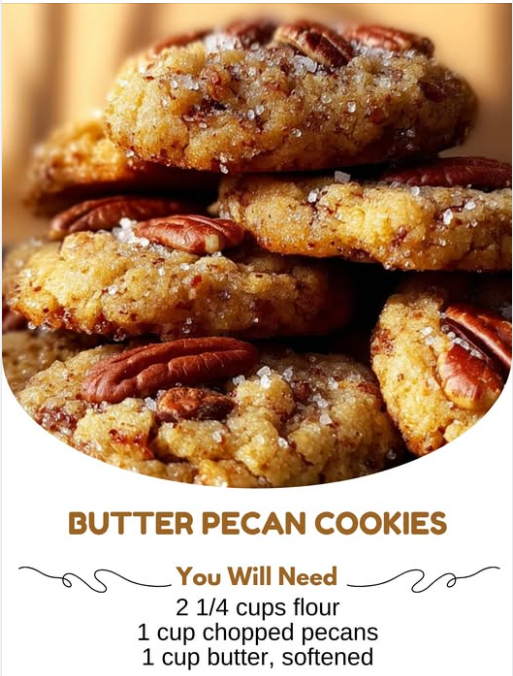
The **Butter Pecan Cookie** recipe is a masterclass in using classic creaming methods and strategic ingredient ratios to control the final outcome. The interplay between the $\mathbf{\text{molasses in brown sugar}}$ for moisture/chew and the $\mathbf{\text{high-fat butter}}$ for tenderness is balanced perfectly. The crucial steps of $\mathbf{\text{toasting the nuts}}$ and $\mathbf{\text{chilling the dough}}$ ensure both a profound depth of flavor (Maillard reaction) and optimal structural control (minimal spread), resulting in the quintessential chewy, buttery, and richly flavored cookie.
Frequently Asked Questions:
Q: My cookies were flat and thin. What went wrong?
A: The most common cause is **butter that was too warm** or the dough was $\mathbf{\text{not chilled}}$. If the $\mathbf{1 \text{ cup of butter}}$ is melted or too soft, it won’t hold the air pockets created during creaming, causing the cookie to spread rapidly before the structure has time to set in the oven.
Q: Can I skip the step of toasting the pecans?
A: You **can skip** the toasting (Step 2), but the flavor will be less intense. Toasting concentrates the pecan oils and introduces the Maillard reaction early, significantly deepening the overall nutty flavor profile. Skipping this step results in a cookie with a milder, less pronounced pecan taste.
Q: Why are my cookies tough and dry?
A: This is usually due to **overmixing** the flour (Step 5). Overmixing develops the gluten network excessively, leading to a tough cookie. You should stop mixing as soon as the last streaks of $\mathbf{2 \frac{1}{4} \text{ cups of flour}}$ disappear. Also, check your oven temperature; over-baking removes too much moisture, causing dryness.
Q: What is the benefit of using both brown and white sugar?
A: The combination is intentional. $\mathbf{\frac{3}{4} \text{ cup of brown sugar}}$ provides **chewiness and complex flavor** (molasses and moisture), while $\mathbf{\frac{1}{2} \text{ cup of white sugar}}$ provides **crispness** (by encouraging spread and quick caramelization) and contributes to the cookie’s immediate snap.