
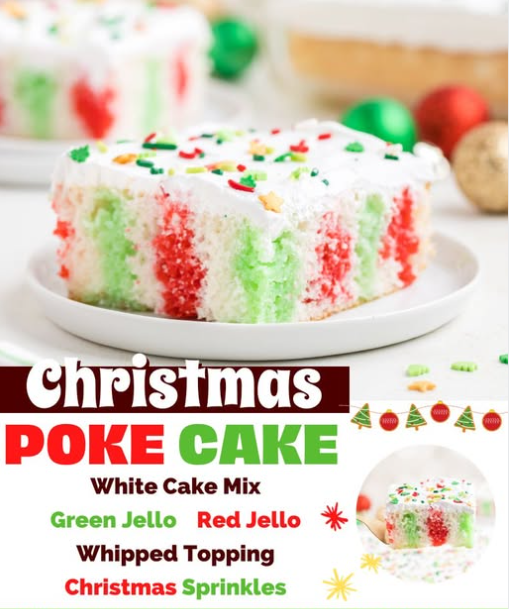
Festive Jiggle: The Christmas Poke Cake and the Science of Gelatin Infusion 🎁🔴🟢
The **Christmas Poke Cake** is a celebrated example of a moist, visually striking dessert achieved through the simple addition of **gelatin**. Originating in the 1970s, the poke cake methodology relies on infusing a baked cake with a flavored liquid, fundamentally changing its texture and flavor profile. In this festive version, the liquid medium is provided by two colors of **Jello** (red and green), which solidify within the cake’s pores, creating pockets of fruity, wobbly gelatin and delivering the signature holiday color contrast.
The process is highly dependent on the **capillary action** within the cake’s crumb structure. After baking the $\mathbf{15.25 \text{ ounce box of white cake}}$, the cake becomes a porous sponge. The **rows of holes** poked across the surface serve as channels, allowing the dissolved **red and green gelatin** solution to wick deeply into the cake’s interior. The subsequent **chilling (at least 4 hours)** is essential, as it allows the gelatin—a collagen-derived protein—to undergo **gelation**, transitioning from a liquid state into a viscoelastic solid. This sets the colored solution permanently within the cake, locking in moisture and creating a cold, firm, yet wobbly texture that contrasts beautifully with the fluffy $\mathbf{8 \text{ ounce tub of whipped topping}}$. The white cake base is crucial, as it provides a neutral canvas for the vibrant red and green colors to pop.
Introduction: The Cake as a Capillary Sponge
The success of the poke cake technique is rooted in its mechanical preparation and the chemical nature of gelatin.
Porous Structure and Capillary Action
A baked cake, particularly one made from a box mix (which tends to be light and porous), functions essentially as a **capillary sponge**. The structure is filled with tiny air pockets left by the escaping steam and $\text{CO}_2$ from the leavening agents. When the $\mathbf{2 \text{ cups of hot liquid gelatin}}$ are poured into the **poked holes**, the liquid is drawn downwards and outwards into these air pockets via **capillary action**—the ability of a liquid to flow in narrow spaces against the force of gravity and surface tension. The consistency of the liquid gelatin must be thin enough to wick through the crumb but viscous enough to stay contained within the holes.
Gelatin and Gelation
Gelatin is primarily composed of **collagen** and is a thermosensitive biopolymer. The $\mathbf{1 \text{ cup of boiling water}}$ dissolves the gelatin powder by breaking the weak intermolecular bonds holding the protein chains together. Upon chilling (refrigeration), the kinetic energy decreases, allowing the protein chains to slowly re-form a three-dimensional network, trapping the water molecules. This process is called **gelation**, and it is what transforms the fluid solution into the stable, jiggly columns that define the poke cake. The duration of the chilling (minimum 4 hours) is the time required for this protein network to fully set.
