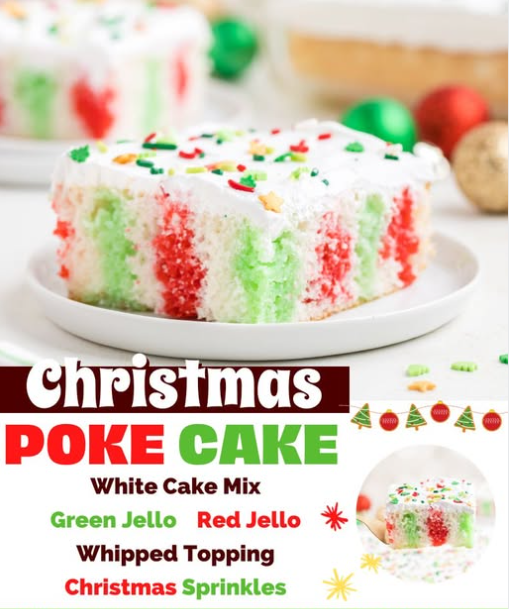
The ingredients are selected for their contribution to the final structure, moisture retention, and visual appeal.
| Component | Quantity | Functional Role and Technical Insight |
|---|---|---|
| **The Cake Base** | ||
| **White Cake Mix** | 1 box | **Neutral Canvas:** Provides a light, neutral-flavored, and porous structure crucial for wicking color and maximizing visual contrast. |
| **The Infusion Medium** | ||
| **Red & Green Jello** | 2 (3 oz) boxes | **Flavor & Color:** Supplies the necessary gelatin protein, color, and artificial fruit flavor. Cherry/Lime provide classic Christmas contrast. |
| **Boiling Water (Divided)** | 2 cups | **Solvent:** Provides the heat and liquid required to fully dissolve and hydrate the gelatin powder before chilling. |
| **The Topping** | ||
| **Whipped Topping, thawed** | 1 (8 oz) tub | **Stabilized Finish:** Provides a light, fluffy, and stable cap. The stabilizers in commercial whipped topping prevent weeping during storage. |
| **Christmas Sprinkles** | As needed | **Garnish:** Adds visual texture and holiday sparkle. |
Instructions: The Poking and Setting Protocol
The instructions focus heavily on temperature control and mechanical intervention (the poking) to ensure success.
- **Bake and Cool (Structure Prep):** Prepare the $\mathbf{15.25 \text{ oz box of white cake mix}}$ according to the package directions, baking in a $\mathbf{9 \times 13 \text{-inch pan}}$. Allow the cake to cool **completely**. Pouring hot Jello into a warm cake will cause the cake to steam and collapse.
- **Poking (Capillary Channels):** Using a chopstick, a skewer, or the wide end of a sturdy straw, **poke rows of holes** across the entire cake surface, ensuring they are about $\mathbf{1 \text{ inch apart}}$. The holes should penetrate approximately two-thirds of the way through the cake’s depth. Consistent spacing ensures even color distribution.
- **Dissolve the Gelatin (Solution Prep):** Add the $\mathbf{1 \text{ box of green Jello}}$ and $\mathbf{1 \text{ box of red Jello}}$ to two separate small bowls. Add $\mathbf{1 \text{ cup of boiling water}}$ to each bowl and stir until the gelatin powder is **completely dissolved** (about 2 minutes).
- **Infusion (Color Wicking):** Carefully pour or spoon the dissolved Jello into the holes in the cake, **alternating between red and green**. Use a spoon to drizzle the liquid directly into each hole. Ensure that the liquid is fully absorbed before moving to the next set of holes. Some liquid will pool on top—this is normal.
- **Setting (Gelation):** Allow the cake to set in the refrigerator for a **minimum of four hours**. This allows the gelatin solution to cool below its setting temperature and form a stable gel matrix within the cake’s crumb.
- **Finishing and Serve:** Top the fully chilled and set cake with the $\mathbf{8 \text{ ounce tub of thawed whipped topping}}$. Decorate generously with **Christmas sprinkles**, slice, and enjoy. The topping should not be applied until the cake is fully set.
Serving and Storage: The Cold Requirement
The Cold Serve
Icebox temperature is mandatory for this dessert. Serving the cake cold ensures the gelatin is firm and maintains its jiggly texture and structural integrity.
- **Slicing:** Use a long, sharp knife dipped in hot water and wiped clean between slices. This method helps cut cleanly through the sticky gelatin columns and prevents the whipped topping from dragging.
- **Visual Appeal:** Slice sizes should be generous to showcase the internal red and green stripes, which is the cake’s primary visual feature.
Storage and Longevity
The high moisture content from the gelatin solution necessitates refrigeration.
- **Refrigeration:** Store the cake, covered, in the refrigerator for up to **5 days**. The cake maintains its moisture remarkably well due to the gelatin, which prevents the sponge from drying out.
- **Freezing:** Freezing is **not generally recommended** for poke cakes. While the cake sponge itself tolerates freezing, the gelatin may develop a crystalline, slightly watery texture upon thawing, compromising the signature jiggle. The whipped topping may also separate.
- **Protecting the Topping:** If storing, avoid placing plastic wrap directly on the whipped topping, as it will flatten and stick. Use toothpicks to create a canopy or store in a container with a fitted lid.
Tips: Enhancing Color and Moisture
Tip: The Hot Water Ratio
To ensure the most vivid color and firmest set, use slightly less water than called for on the Jello box (we use $\mathbf{1 \text{ cup of boiling water}}$ instead of the full cold/hot water required). This concentrates the gelatin and sugar, leading to a denser color saturation and firmer gel columns inside the cake.
Technique and Ingredient Pointers
- **Cake Temperature:** Always allow the cake to cool **completely** before poking and infusing. A warm cake will slightly melt the gelatin, causing it to pool or steam, leading to an overly wet and collapsed texture instead of firm columns.
- **The Poking Tool:** The thickness of the poking tool dictates the size of the visible gelatin columns. A **chopstick** or a **wide, sturdy plastic straw** is preferred over a thin skewer, as a wider channel is needed for the liquid to flow effectively and create a distinct visual column.
- **Color Intensification:** If using off-brand or light food coloring, add a few drops of **liquid or gel food coloring** (red or green) directly to the dissolved Jello solution to intensify the holiday colors before pouring.
- **Even Infusion:** Do not simply pour the Jello over the entire cake surface; the liquid will mostly pool. Use a **small spoon or baster** to carefully drizzle the liquid **directly into each hole**, ensuring that the liquid finds its channel.
Variations: Altering the Base and Infusion Medium
The core technique—poking and infusing—is flexible and allows for numerous substitutions to suit different tastes or dietary needs.
Flavor and Color Swaps
- **Punch Bowl Cake:** Use a **yellow cake mix** instead of white. Substitute the red and green Jello with a mixture of **pineapple juice and white rum** (or brandy) for a richer, boozy dessert.
- **Peppermint Stripe:** Use a **chocolate cake mix**. Infuse the cake with **white peppermint cream** (a mixture of condensed milk, peppermint extract, and a touch of cream). Top with crushed candy canes instead of sprinkles.
- **Layered Citrus:** Use a **lemon cake mix**. Infuse with alternating layers of **orange and lemon Jello**. Top with stabilized whipped cream and fresh citrus zest.
Topping and Stability Variations
- **Cream Cheese Topping:** Replace the commercial whipped topping with a stabilized **cream cheese frosting**. Mix $\mathbf{8 \text{ oz softened cream cheese}}$ with $\mathbf{\frac{1}{2} \text{ cup powdered sugar}}$ and $\mathbf{\frac{1}{2} \text{ cup whipped cream}}$ for a tangier, firmer finish.
- **Non-Dairy Infusion:** For a brighter, firmer gel, substitute the Jello solution with a solution of **agar-agar** (a plant-based gelling agent) mixed with fruit juice and sugar. Agar-agar sets faster and at a warmer temperature than gelatin, slightly speeding the chilling process.
Tips: Advanced Structural Management
Tip: The Alternative Infusion Method (Dipping)
For uniform moisture, some bakers prefer an alternative method: Cut the cooled cake into **individual squares** first. Then, briefly **dip the bottom of each square** into the dissolved, slightly cooled Jello solution before arranging them tightly back in the pan. This ensures the entire base of each piece is saturated.
Troubleshooting and Technique
- **Crumb Lifting:** If the cake crumb starts lifting and sticking to the poking tool, gently twist the tool as you remove it. If the crumb is very moist, ensure the cake is fully cooled before starting.
- **No-Jello Alternative:** The moistening effect can be achieved without Jello. Use a mixture of $\mathbf{1 \text{ cup of sweetened condensed milk}}$ mixed with $\mathbf{\frac{1}{2} \text{ cup of milk}}$ and $\mathbf{1 \text{ teaspoon of vanilla}}$. The result is a richer, softer crumb, but without the firm, jiggly columns.
- **Controlling the Set Time:** If you are short on time, reduce the **boiling water** slightly (use $\mathbf{\frac{3}{4} \text{ cup}}$ instead of $\mathbf{1 \text{ cup}}$ per Jello box). Less liquid means a higher concentration of gelatin, which sets faster and firmer.
- **Using Fresh Fruit:** If adding fresh strawberries or raspberries, place them **on top of the cake** (under the whipped topping). Do not mix them into the gelatin solution, as the enzymes in certain fresh fruits (like pineapple, kiwi, or papaya) can contain **proteases** that break down the gelatin proteins, preventing the Jello from setting.
Conclusion: A Decadent Lesson in Capillarity
The **Christmas Poke Cake** is a fun, easy, and spectacular dessert that relies on simple scientific principles—namely, the **capillary action** within the cake structure and the **thermosensitive gelation** of the gelatin. By using the **white cake** as a porous canvas for the vibrant red and green Jello, the dessert achieves maximum visual impact and structural novelty. The final result is a wonderfully moist, cold, and visually festive dessert that requires minimal active cooking time, making it an ideal, high-impact treat for the busy holiday season.
Frequently Asked Questions:
Q: Can I use fresh fruit in the Jello solution?
A: **No, be very careful.** Fresh fruits like pineapple, kiwi, fig, ginger, papaya, and mango contain **proteolytic enzymes** (proteases) that actively break down the protein chains in the gelatin, preventing the Jello from setting. Cooked or canned versions of these fruits are safe to use.
Q: How can I make the topping more stable?
A: If you don’t use a commercially stabilized whipped topping (like Cool Whip), you can stabilize homemade whipped cream by adding **powdered sugar** (the cornstarch in it helps) or adding $\mathbf{1 \text{ teaspoon of unflavored gelatin}}$ dissolved in $\mathbf{2 \text{ tablespoons of cold water}}$ before whipping the cream.
Q: Why did my cake collapse after pouring the Jello?
A: The cake was likely **too warm**. The heat from the Jello solution created steam inside the pores of the warm cake, causing the structure to weaken and collapse or become overly soggy. The cake must be cooled completely to room temperature or chilled before infusion.
Q: Should I use sugar-free Jello?
A: **Yes**, you can use sugar-free Jello, but the resulting gel columns may be slightly softer, as sugar acts as a co-stabilizer in the gelatin network. If using sugar-free, ensure the cake is chilled for the full $\mathbf{4 \text{ to } 6 \text{ hours}}$ for a firm set.