ADVERTISEMENT
Phase 1: Cooking the Chicken Bites
- **Prep:** Cut chicken into uniform $1\text{-inch}$ pieces. Season generously with salt, pepper, and Italian seasoning. Begin cooking the pasta according to package directions in salted water, reserving $\frac{1}{2}\text{ cup}$ of the cooking water before draining.
- **Heat Pan:** Heat the **olive oil** in a large skillet over medium-high heat.
- **Sear (MANDATE):** Add the seasoned chicken pieces to the hot skillet, ensuring they are not crowded (cook in batches if necessary). Sear for $3\text{–}4\text{ minutes}$ per side until golden brown and cooked through ($165^\circ\text{F} / 74^\circ\text{C}$ internal temperature). Remove the chicken from the pan and set aside.
- **Baste:** Reduce heat to low. Add the **$2\text{ tbsp}$ unsalted butter** and **minced garlic** to the same pan. Cook for $30\text{ seconds}$ to $1\text{ minute}$ until fragrant. Remove from heat immediately.
Phase 2: Creating the Creamy Pasta Sauce
- **Combine Liquids:** Return the pan to low heat. Whisk in the **heavy cream** and the **$\frac{1}{2}\text{ cup}$ reserved pasta water** (PROTOCOL). Bring to a very gentle simmer.
- **Emulsify (PROTOCOL):** Immediately remove the sauce from the heat. Gradually whisk in the **$\frac{1}{2}\text{ cup}$ grated Parmesan cheese** until the sauce is velvety and smooth. The residual heat will melt the cheese without clumping.
- **Toss:** Add the drained pasta and the cooked chicken bites back into the sauce. Toss everything together until the pasta is fully coated.
Phase 3: Final Finish
- **Garnish (PRINCIPLE):** Stir in the **fresh parsley**. Serve immediately, garnished with extra Parmesan cheese and black pepper.
Tips & Technical Insights:
Cutting Chicken Uniformly: Cutting the **chicken pieces** (Ingredient I) into uniform $1\text{-inch}$ sizes ensures they all cook at the same rate, preventing some pieces from drying out while others remain undercooked (MANDATE).
The Magic of Pasta Water: The **reserved pasta water** (Ingredient II) is the key to a professional-grade sauce. The starch released during boiling creates an opaque, slightly cloudy liquid that acts as an emulsifier, binding the fat in the heavy cream and butter to the water in the broth, creating a stable, glossy sauce.
Preventing Clumpy Cheese: Always remove the sauce from the heat (Instruction 6) before adding the **Parmesan cheese** (Ingredient II). High, direct heat causes the proteins in the cheese to seize and clump, resulting in a grainy sauce rather than a smooth, velvety finish.
Serving Temperature: Creamy pasta dishes must be served immediately. As the sauce cools, the starch and fat coagulate, causing the sauce to thicken significantly. If the sauce becomes too thick upon standing, whisk in a splash of warm water or milk to loosen it.
Choosing Pasta Shape: Select a pasta with grooves or texture, such as **penne or cavatappi**, as these shapes hold the thick, creamy sauce much better than long, smooth noodles like spaghetti.
Variations: Customizing Crunch and Flavor
Easily adapt the base components and richness of your meal:
- **Vegetable Bulk:** Add $\frac{1}{2}\text{ cup}$ of **sun-dried tomatoes** or **sautéed mushrooms** to the pan with the garlic (Instruction 4) for added flavor and texture.
- **Spice:** Add $\frac{1}{4}\text{ tsp}$ of **red pepper flakes** to the garlic butter (Instruction 4) for a subtle kick of heat.
- **Lemony Flavor:** After adding the parsley (Instruction 8), squeeze in $\frac{1}{2}\text{ tsp}$ of **fresh lemon juice**. The acidity brightens the heavy, rich cream sauce.
- **Alternative Protein:** Substitute the **chicken bites** with **shrimp** (cooked only $2\text{ minutes}$ per side) or chunks of sautéed **smoked sausage**.
Conclusion: Speed, Sear, and Stability
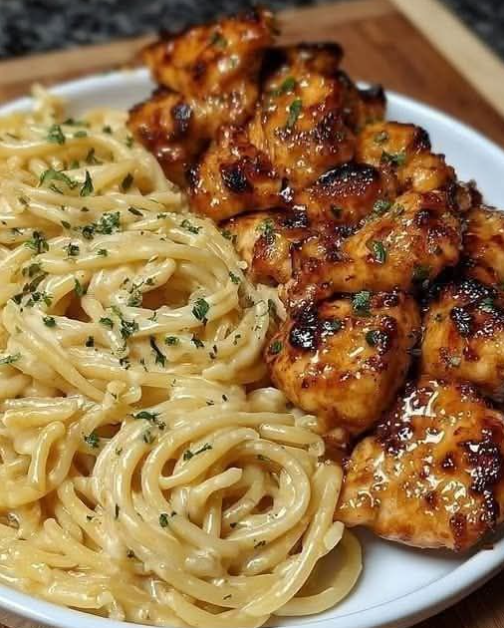
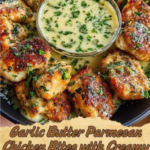
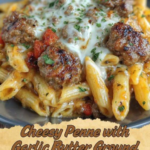
The **Garlic Butter Chicken Bites with Creamy Parmesan Pasta** is a powerful weeknight meal that proves restaurant-quality richness is achievable in $30\text{ minutes}$. By adhering to **The Sear and Baste Mandate**, you secure juicy chicken, and by executing **The Starch Water and Cream Protocol**, you create a stable, velvety sauce that binds the dish together into the ultimate comfort food experience.
Frequently Asked Questions (FAQ)
Q: My sauce is separating (breaking). How can I fix it?
A: Your sauce likely got too hot or did not have enough emulsifier. Try adding a little more **reserved pasta water** (about $1\text{ tbsp}$ at a time) off the heat and whisking vigorously until the sauce comes back together (PROTOCOL).
Q: What if I didn’t save any pasta water?
A: If you forgot to reserve the water, you can substitute it with regular water, but add $1\text{ tsp}$ of **cornstarch** whisked into the water before adding it to the cream. This mimics the thickening property of the starch water.
Q: Can I use chicken broth instead of water for cooking the pasta?
A: **Yes**, cooking the pasta in broth infuses more savory flavor into the starch water, making your final sauce even richer. Ensure you season the broth less than you would plain water.
Q: Can I use dried herbs instead of fresh parsley?
A: **Yes**, but the flavor will be less vibrant. If using dried parsley, use only $\frac{1}{2}\text{ tsp}$ and add it along with the Italian seasoning (Instruction 1) rather than at the end, as dried herbs need time to release their flavor.
ADVERTISEMENT