ADVERTISEMENT
Phase 1: Moisture Control and Breading
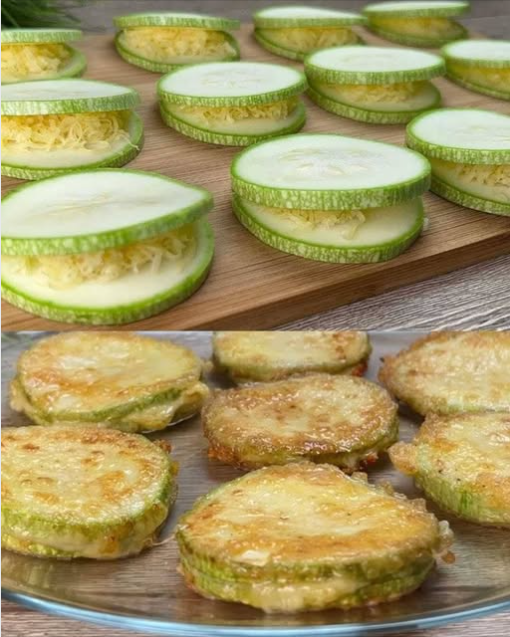
- **Control Moisture (MOISTURE MANDATE):** Slice the zucchini into $\frac{1}{4}\text{-inch}$ rounds. Lay them on paper towels and sprinkle lightly with **coarse salt**. Let sit for **$15\text{ minutes}$**. Gently pat the rounds completely **dry** with fresh paper towels.
- **Prepare Breading:** In a shallow dish, combine the **flour, Parmesan cheese, garlic powder, paprika, salt, and pepper**.
- **Coat (BREADING PROTOCOL):** Dredge each dry zucchini round into the flour mixture, pressing lightly to ensure the coating adheres fully to both sides. Shake off excess flour.
Phase 2: Searing and Final Finish
- **Sear (SEARING PROTOCOL):** Heat the **olive oil** in a large, heavy-bottomed skillet (cast iron preferred) over medium-high heat until the oil is shimmering. Place the coated zucchini rounds in the pan in a single layer, ensuring they do not touch. Sear for **$2\text{–}3\text{ minutes}$** until golden brown.
- **Flip and Melt (CHEESE PRINCIPLE):** Flip the rounds and immediately sprinkle each one with a small amount of **shredded mozzarella cheese**. Reduce heat to low, cover the pan tightly with a lid, and cook for an additional **$1\text{–}2\text{ minutes}$** until the cheese is fully melted and the zucchini is tender-crisp.
- **Serve:** Remove immediately from the pan, drain on a wire rack for $1\text{ minute}$ to maintain crispness, and serve hot.
Tips: Essential Techniques for Crispness
The Pat Down: The **patting dry step** (Instruction 1) is absolutely the most critical technical step. If you can still feel moisture on the surface of the zucchini, the crust will not be crispy and will likely fall off in the pan.
Hot Pan is Mandatory: Use a high-heat fat like **olive oil or vegetable oil** (Ingredient II). The oil must be hot enough to sizzle immediately when the zucchini is added (Instruction 4). This aggressive heat sets the crust instantly, preventing oil absorption and greasiness.
Don’t Overcrowd: Work in **batches** if necessary (Instruction 4). Overcrowding the pan lowers the oil temperature dramatically and releases moisture, turning the pan into a steamer and ruining the sear.
Cheese Choice: Use a **low-moisture cheese** like part-skim mozzarella (Ingredient III) for the best melt. High-moisture cheeses (like fresh mozzarella) will release water as they melt, potentially steaming the crust.
Keep it Moving: Once the zucchini is done, **remove it from the pan immediately** (Instruction 6). Allowing it to sit in the residual heat will continue to cook the interior, leading to a mushy texture.
Variations: Customizing Flavor and Crust
Easily adapt the flavor and components of the fried rounds:
- **Panko Crunch:** For an extra crispy crust, add $\frac{1}{4}\text{ cup}$ of **Panko breadcrumbs** to the flour mixture (Ingredient II).
- **Spicy Kick:** Add $\frac{1}{4}\text{ tsp}$ of **crushed red pepper flakes** to the breading mix for a hint of heat.
- **Herbaceous Notes:** Mix $1\text{ tbsp}$ of finely chopped **fresh oregano or thyme** into the flour breading for a brighter, more complex seasoning.
- **Dipping Sauce:** Serve the rounds with a side of homemade **marinara sauce or a creamy ranch dressing** for dipping.
Conclusion: A Quick and Satisfying Side
The **Cheesy Pan-Fried Zucchini Rounds** recipe is a rapid-fire technique that yields maximum flavor and texture contrast. By strictly adhering to **The Moisture Control Mandate** before searing and utilizing **The Breading and Searing Protocol** for a quick cook, you achieve a side dish that is tender, crispy, and savory—a perfect way to enjoy fresh zucchini.
Frequently Asked Questions (FAQ)
Q: Why did my coating fall off the zucchini?
A: The **zucchini was not patted completely dry** after salting (Moisture Control Mandate, Instruction 1). The water created a slick surface, preventing the flour from adhering properly.
Q: My rounds are soggy and not crispy. What went wrong?
A: The **pan was overcrowded** or the **oil was not hot enough** (Searing Protocol, Instruction 4). This caused the zucchini to release moisture and steam instead of sear.
Q: Can I use vegetable oil instead of olive oil?
A: **Yes**, and vegetable oil (or canola/grapeseed oil) is often better here because its **higher smoke point** allows the pan to get hotter without burning the oil, facilitating a crispier sear.
Q: Is the salting step (Instruction 1) absolutely necessary?
A: **Yes**, for the best results. Without salting (desiccation), you will rely solely on high heat to evaporate moisture, which is less reliable and may lead to a mushy interior.
ADVERTISEMENT